Introduction: Why Plastic Bonding Demands Precision
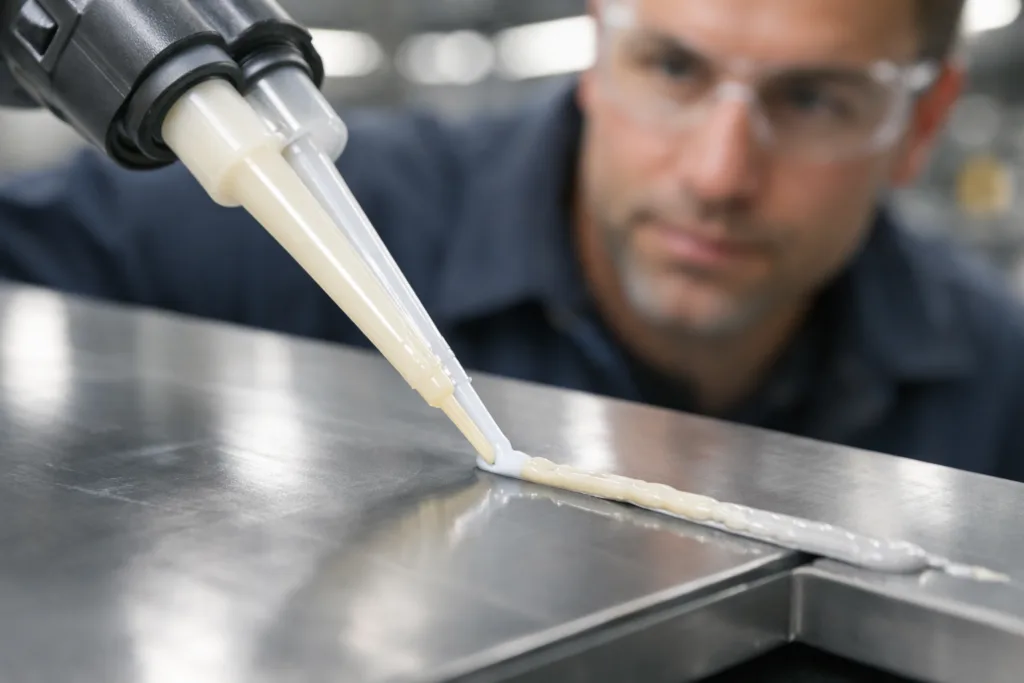
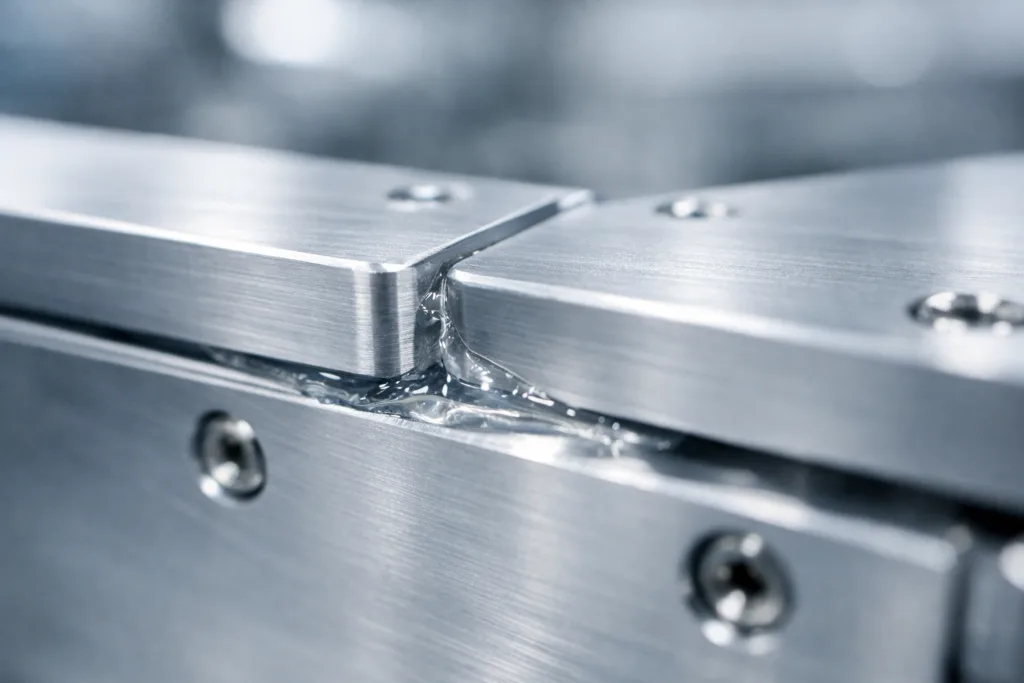
Choosing the right adhesive for plastics is a common industrial challenge, especially as plastics like ABS, PVC, PC, PP, PE, PA, and PMMA are used across manufacturing, automotive, electronics, and consumer goods. This guide, Plastic Bonding Guide: How to Choose the Right Adhesive for Each Plastic Type, takes you through the critical factors that determine adhesives’ performance: surface energy, substrate-specific bonding difficulty, and the proper surface preparation methods. If you’re searching for plastics adhesives or an industrial adhesive for plastic, you’ll discover why a “universal” glue claim rarely matches real-world results.
We’ll break down the process by plastic types, clarify adhesive families that thrive on each, and teach you practical selection based on substrate, service environment, and production process. Let’s build reliability from the bond up.
The Science of Plastic Bonding: Surface Energy Explained
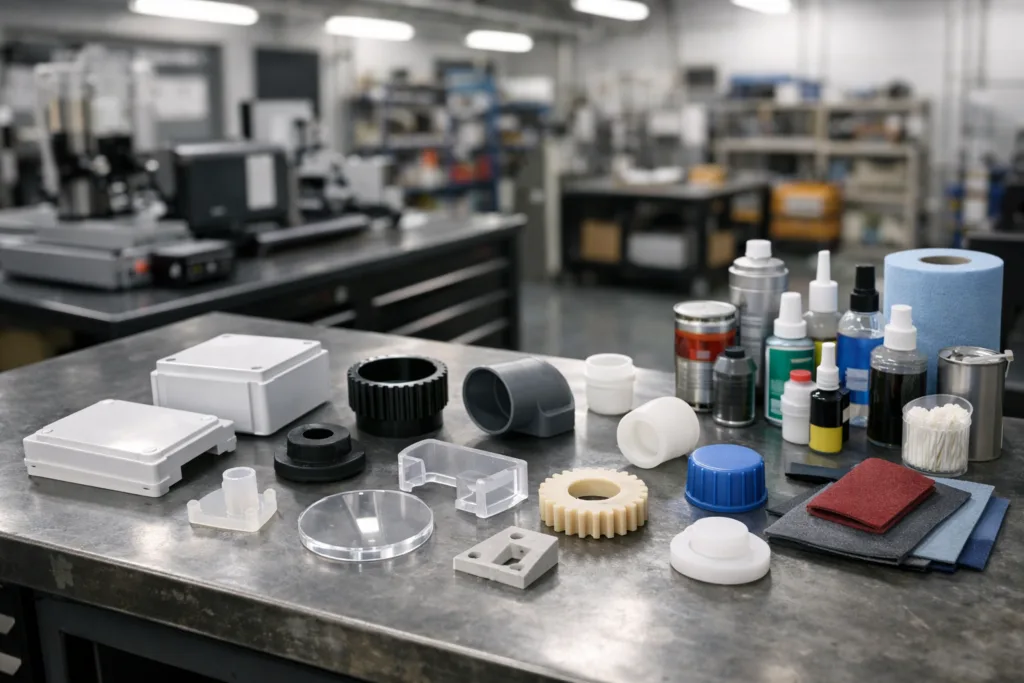
Surface energy is the invisible factor behind adhesive success. It defines how easily a glue wets out and flows onto a surface, forming molecular bonds. High surface energy plastics (like ABS, PC, and PMMA) are easier to bond, while low surface energy materials (such as PP, PE) repel adhesives and require more preparation.
Industrial adhesives often struggle on low-energy substrates. That’s why you’ll see specialized products and surface treatments discussed throughout this guide. For a deeper dive into the basics, refer to the ultimate guide to industrial glue for a full primer on how substrate impacts adhesive selection.
ABS (Acrylonitrile Butadiene Styrene): A Versatile, Bondable Plastic
Bonding Difficulty
ABS is a high surface energy, polar plastic. Most industrial adhesives wet ABS easily and develop strong bonds. The main challenge comes from oily residues or molded parts with additives that interfere with adhesion.
Surface Preparation
- Mechanical abrasion (light sanding)
- Solvent wipe (isopropyl alcohol)
- Degreasing if oil is present
Suitable Adhesive Families
- Two-part epoxy adhesives
- Acrylic structural adhesives
- Polyurethane adhesives
- Hot melt adhesives
- Solvent welding (for specialty plumbing)
For high impact or high fatigue joints, acrylic adhesives excel, as demonstrated in fatigue resistance testing of acrylic structural bonds.
PVC (Polyvinyl Chloride): Rigid vs. Flexible Bonding
Bonding Difficulty
Rigid PVC offers moderate surface energy. Flexible PVC contains plasticizers that migrate to the surface, causing bond failures over time.
Surface Preparation
- Light abrasion or sanding
- Solvent cleaning (methyl ethyl ketone for rigid, isopropyl for flexible)
- Plasticizer removal (specialty methods for flexible PVC)
Suitable Adhesive Families
- Solvent-based PVC cements (for pipe/fitting)
- Cyanoacrylate adhesives (small parts, rigid PVC)
- Polyurethane adhesives (flexible joints)
- Epoxy adhesives (with flexible formulations)
Always verify long-term compatibility with flexible PVC; plasticizer migration can cause bonds to soften or fail.
PC (Polycarbonate): Optical Clarity and Impact Resistance
Bonding Difficulty
PC has high surface energy, but its optical clarity means visible bond lines and stress crazing are concerns.
Surface Preparation
- Very gentle abrasion (to avoid scratching)
- Solvent wipe (non-aggressive, e.g., IPA)
- Antistatic cleaning
Suitable Adhesive Families
- UV-curable adhesives (for clear, precision bonding)
- Acrylic adhesives (structural)
- Two-part epoxies (optically clear formulas)
- Solvent welding (specialty, risk of crazing)
When bonding optical plastics like PC and PMMA, understanding UV dosage is crucial. Explore exact UV dosage for perfect curing for controlling bond quality.
PP (Polypropylene): Low Surface Energy, High Challenge
Bonding Difficulty
Polypropylene resists most adhesives due to extremely low surface energy.
Surface Preparation
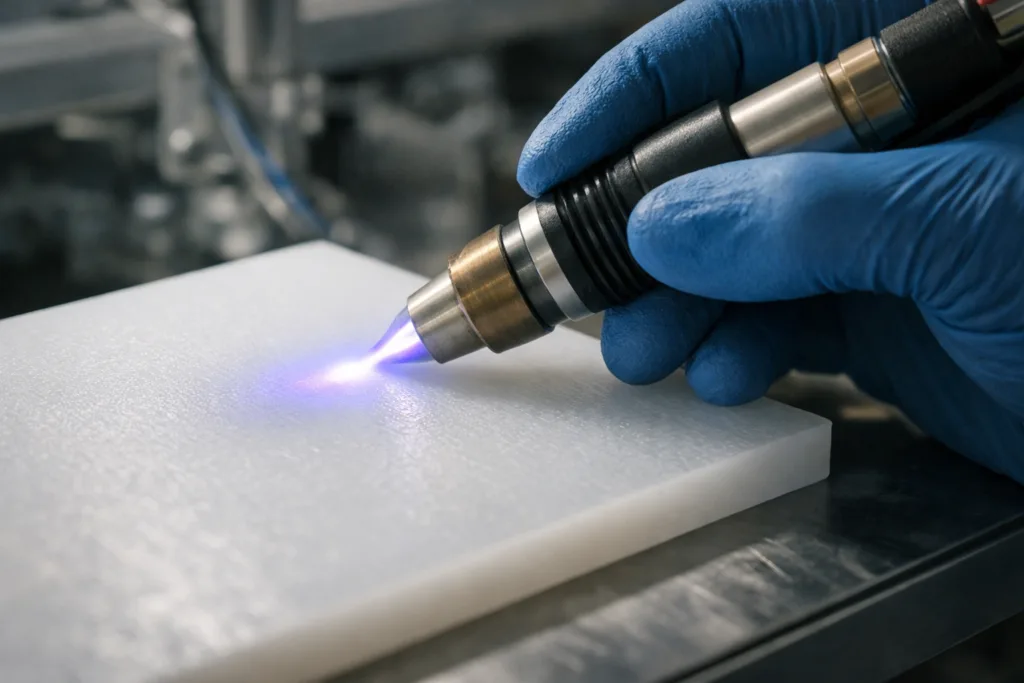
- Flame treatment
- Corona discharge or plasma treatment
- Specialty primer application
Suitable Adhesive Families
- Polyolefin adhesives (developed for PP/PE)
- Hot melt adhesives (with modified formulas)
- Cyanoacrylates (only with specialty primers)
Bond durability is always conditional on proper surface activation. Without it, even “special” adhesives fall short.
PE (Polyethylene): Bonding the Most Bond-Resistant Thermoplastic
Bonding Difficulty
Like PP, PE’s low surface energy makes bonding a challenge. Even industrial adhesives struggle on untreated PE.
Surface Preparation
- Flame treatment
- Corona/plasma treatment
- Specialized primers for cyanoacrylates or structural adhesives
Suitable Adhesive Families
- Polyolefin adhesives
- Modified hot melt adhesives
- Specialty acrylics (with initiators)
Manufacturers must match treatment to process speed and economics. For outdoor or environmental exposure, make sure your chosen adhesive withstands UV, moisture, and temperature cycling.
PA (Polyamide/Nylon): Absorbs Moisture, Needs Flexible Bonds
Bonding Difficulty
Nylon’s moderate surface energy is offset by moisture absorption and flexibility. Bonds can degrade as the substrate swells with humidity.
Surface Preparation
- Drying before bonding (oven or hot air)
- Light abrasion
- Solvent clean (alcohols)
Suitable Adhesive Families
- Epoxy adhesives (flexible grades)
- Polyurethane adhesives
- Hot melt adhesives
- Acrylic structural adhesives
Flexible adhesives allow the joint to tolerate substrate motion. Always test with your specific grade of nylon, as formulations vary.
PMMA (Acrylic): High Surface Energy, Glass-Like Clarity
Bonding Difficulty
PMMA is easy to bond, but the risk is visible flaws—bubbles, crazing, and stress marks in clear joints.
Surface Preparation
- Minimal abrasion (avoid surface damage)
- Solvent wipe
- Cleanroom-level dust control for optical products
Suitable Adhesive Families
- UV-curable adhesives
- Solvent cements (for PMMA only)
- Acrylic structural adhesives
- Epoxy adhesives (clear grades)
In production, opt for UV-cure adhesives for speed and consistency, especially on high-throughput lines.
Comparing Adhesive Families for Plastic Substrates
| Plastic Type | Epoxy | Acrylic | Polyurethane | UV Cure | Hot Melt | Solvent/Cyanoacrylate |
|---|---|---|---|---|---|---|
| ABS | Excellent | Excellent | Good | Good | Good | Good |
| PVC | Moderate | Good | Good (flexible) | Moderate | Good | Excellent |
| PC | Excellent | Excellent | Good | Excellent | Moderate | Moderate |
| PP | Conditional | Conditional | Conditional | Conditional | Conditional | With primer |
| PE | Conditional | Conditional | Conditional | Conditional | Conditional | With primer |
| PA (Nylon) | Good | Good | Excellent | Moderate | Moderate | Moderate |
| PMMA | Excellent | Excellent | Good | Excellent | Moderate | Excellent |
Surface Preparation Methods: Maximizing Bond Reliability
Proper surface preparation often counts more than brand or adhesive chemistry. Here are the most effective methods for each plastic group:
- Abrasion: Removes mold release and increases mechanical grip. Use for ABS, rigid PVC, nylon, but not PC or PMMA (risk of scratching).
- Solvent Cleaning: Removes oils and contaminants. Use IPA, acetone, or methyl ethyl ketone depending on substrate compatibility.
- Flame Treatment / Corona Discharge: Raises surface energy in PP and PE, making them adhesive-friendly. Essential for process lines working with these plastics.
- Primers: Specialty primers for low-energy plastics can transform bond strength—never skip when bonding PP or PE.
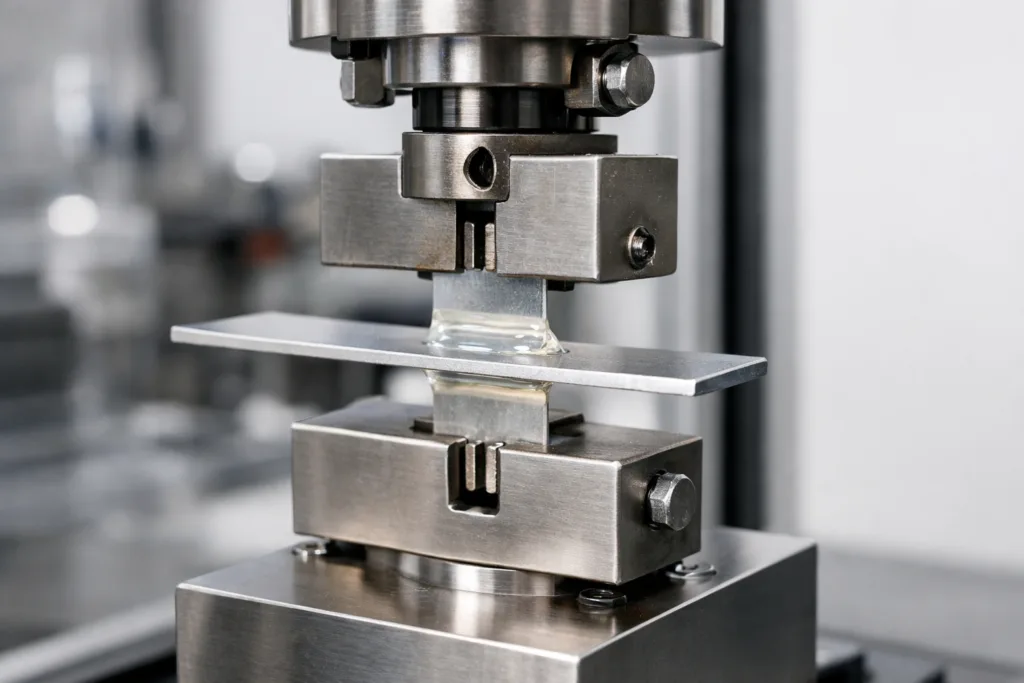
From an assembly-line viewpoint at ZDS Adhesive, an industrial adhesive manufacturer, the real-world lesson is: Always test surface prep with lap shear and peel testing, not just visual inspection.
Industrial Production Factors: Process, Environment, and Design
Every plastic bonding scenario should start with three questions:
- What is the substrate’s surface energy and chemistry?
- What service stresses (compression, shear, peel, impact, temperature, humidity) will the joint face?
- How fast must the bond set, and what tooling or process constraints exist?
For example, electronics assemblers often rely on UV-curable adhesives for speed, while automotive manufacturers may prefer a structural acrylic for bond-line flexibility. If moisture resistance is critical, review strategies for moisture protection in adhesive selection.
Plastic Bonding Guide: How to Choose the Right Adhesive for Each Plastic Type
This section brings the guide together. The right adhesive must suit:
- Substrate: Always check surface energy and chemistry first—no universal glue can overcome fundamental incompatibility.
- Service Environment: Define temperature, UV, moisture, and chemical exposure.
- Production Process: Consider open time, fixture time, pot life, and cure method. Will you bond by hand or automated lines?
Here’s a checklist for modern production:
- Identify plastic substrate (ABS, PVC, PC, PP, PE, PA, PMMA)
- Assess surface energy
- Choose appropriate prep (abrasion, solvent, flame/corona, primer)
- Select adhesive family (epoxy, acrylic, polyurethane, UV, hot melt, solvent/cyanoacrylate)
- Test joint with relevant mechanical and environmental tests
- Monitor for long-term durability (fatigue, moisture ingress, UV exposure)
Adhesive Testing: Ensuring Long-Term Reliability
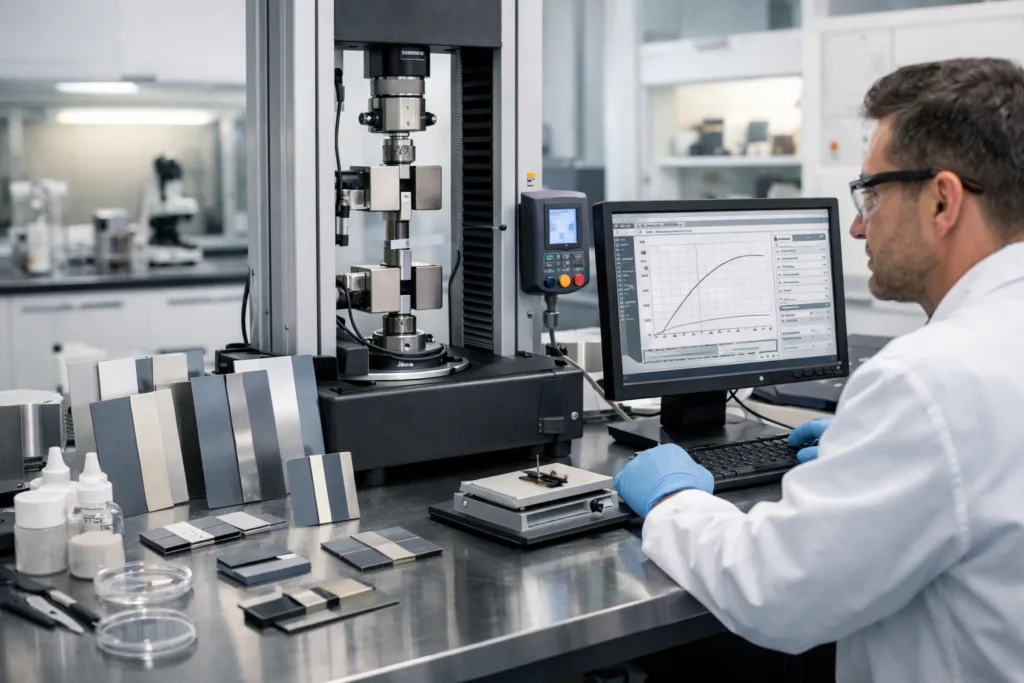
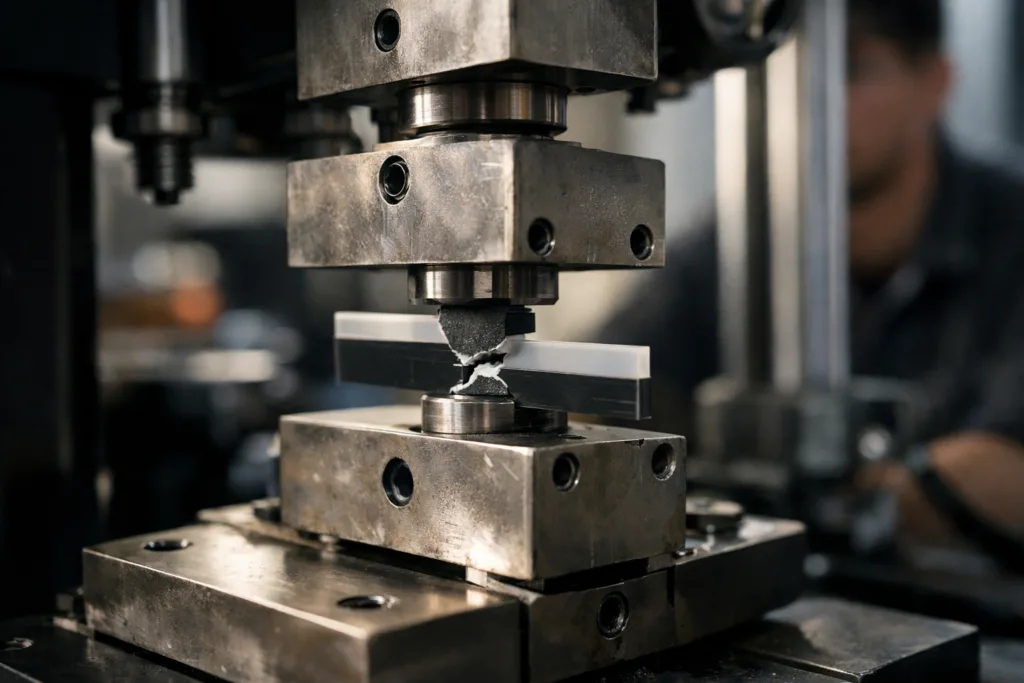
Bonding isn’t done until you test for lap shear, peel, fatigue, thermal cycling, and environmental exposure. Most failures trace back to overlooked prep steps or incompatible adhesive chemistry. Manufacturers should incorporate sample coupons and periodical testing as standard procedure, as seen in best practices for aircraft and automotive assembly. If you’re trying to minimize failures, review what adhesive experts do for process stability.
Real-World Examples: Industry Problems and Solutions
In automotive, bonding PP and PE is routine—but never trivial. Proper surface activation, followed by polyolefin-specific adhesives, delivers durable results from dashboards to under-the-hood components. In electronics manufacturing, PC and PMMA demand optically clear, rapid-curing adhesives; UV-curable products are preferred for throughput and invisible bond lines.
For challenging plastics, process reliability must always trump convenience. The lesson: there’s no shortcut—only substrate-specific science.
Common Mistakes: Why Universal Glue Claims Fall Short
The search for a universal plastic glue leads to costly errors. Most “all-purpose” adhesives work well on high-energy plastics but fail miserably on PP, PE, and flexible PVC. Overlooking surface prep, ignoring substrate chemistry, or skipping mechanical testing can turn a production line into a warranty headache. Manufacturers need a substrate-driven, environment-aware approach.
Conclusion: Mastering Adhesive Selection for Reliable Bonds
The key to strong, durable plastic bonds is an understanding of surface energy, substrate chemistry, and service environment—matched with the right adhesive family and preparation method. There’s no one-size-fits-all solution: building reliability starts with proper substrate matching, followed by process stability and honest mechanical testing. As plastics evolve, the principles remain. Invest in science, not shortcuts, and your assemblies will stand the test of time.
Frequently Asked Questions
Why do industrial adhesives fail on polypropylene and polyethylene?
These plastics have very low surface energy, which prevents adhesives from properly bonding. Surface activation or special primers are required for reliable results.
How important is surface preparation when bonding plastics?
Surface preparation is critical. Cleaning, abrasion, or treatment directly impact the adhesive’s ability to wet the substrate and create a strong bond.
What tests should I use to confirm bond reliability?
Lap shear, peel, fatigue, and environmental tests (temperature, moisture, UV) provide real-world assurance; visual inspection alone isn’t enough for industrial assembly.
Can I use one adhesive for all plastics on my production line?
No. Each plastic has unique surface energy and chemistry. The correct adhesive depends on substrate, environment, and production process for best results.
What adhesive works best for clear plastics like PC and PMMA?
UV-curable adhesives and optically clear epoxies deliver excellent bond strength and invisible seams, especially for optical or high-clarity applications.
How do I choose between epoxy, acrylic, and polyurethane adhesives?
Base your choice on substrate compatibility, service conditions, flexibility needs, and cure speed. Epoxy offers rigidity, acrylic is versatile, and polyurethane provides flexibility.
Related Reading
- Industrial Sealants or Adhesives? The 7 Differences You Need to Know for 2026
- 7 Expert Insights on Acrylic Bond Fatigue Resistance in Industry
- Moisture-Proofing 2026: How to Protect Your Electronics
- 15 Secrets Adhesive Experts Use for Production Success
- The Ultimate Guide to UV Curing Dosage for Plastics in 2026