Introduction: Why Calculating UV Dosage (mJ/cm²) for Complete Cure Is Critical
The transformation of UV-curable adhesives, coatings, and inks into reliable, end-use materials is ruled by one key parameter: UV dosage, measured in millijoules per square centimeter (mJ/cm²). Understanding how to calculate UV dosage for complete cure is essential to avoid tacky surfaces, weak bonds, poor abrasion resistance, or premature failure. If you work in electronics, automotive, or industrial manufacturing, controlling curing efficiency means quantifying, not guessing, your UV energy exposure. In this guide, we break down every factor—from lamp intensity to part geometry—so you can ensure a full, robust cure on every component.
UV Dosage Fundamentals: What Is mJ/cm² and Why Does It Matter?
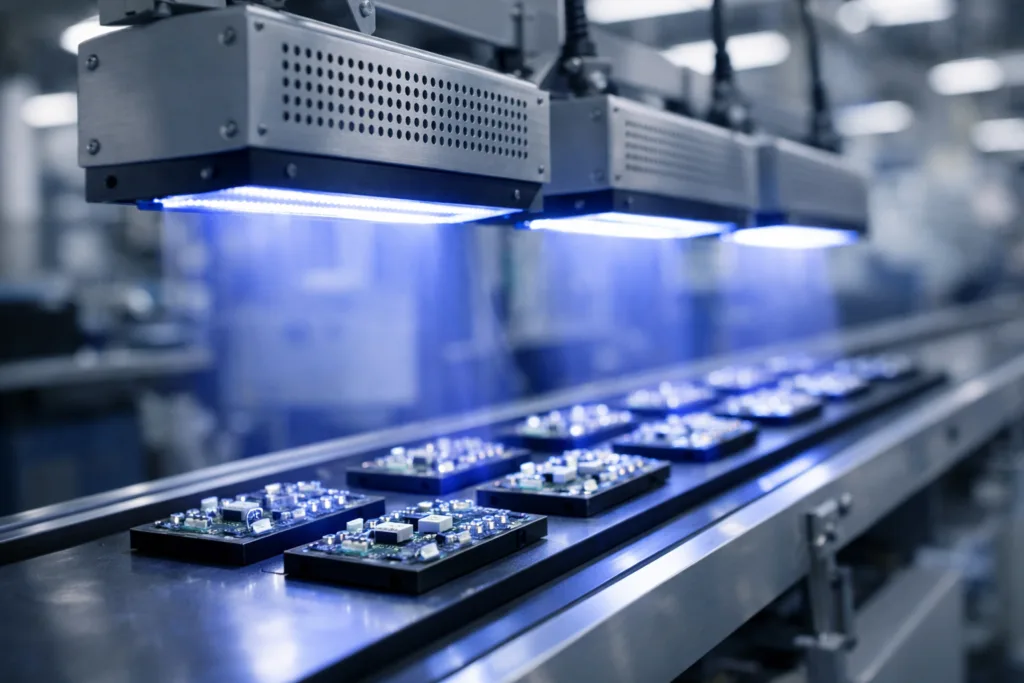
UV dosage represents the total ultraviolet energy delivered per unit area, typically expressed in mJ/cm². This simple metric can make or break the curing process for adhesives, coatings, potting compounds, and printed electronics. Dosage integrates both UV intensity and the time the material is exposed. Too little energy may leave unreacted photoinitiator, while excess can trigger yellowing, degradation, or overheating. Most UV formulations specify an optimal curing window—ensuring bond integrity without surface or bulk defects.
How UV Curing Efficiency is Defined
“Curing efficiency” isn’t just a lab curiosity—it governs throughput, yield, and product reliability on assembly lines. It’s defined by how effectively a given UV system achieves complete chemical cross-linking for a specific application. Efficiency metrics include surface hardness, tack-free time, tensile strength, and moisture resistance. Tracking dosage and cure efficiency together helps you dial in process controls and react quickly to lamp drift or contamination.
Key Variables Affecting UV Dosage and Cure
Many factors influence how much UV energy actually reaches and cures your part:
- Lamp type and output (LED or mercury vapor)
- Distance from lamp to workpiece
- Exposure time
- Material absorptivity and thickness
- Fixture design and shadowing
- Substrate reflectivity (metal vs. plastic)
Even glazing or colored substrates can significantly reduce effective dosage. Adjusting lamp intensity, use of collimators, or correcting for dirty lenses is standard practice in UV process control.
How to Calculate UV Dosage (mJ/cm²) for Complete Cure
The calculation is straightforward—but easily misunderstood. UV dosage (mJ/cm²) = UV intensity (mW/cm²) × exposure time (seconds). For example: with 300 mW/cm² irradiance for 2 seconds, the delivered dosage equals 600 mJ/cm².
| UV Intensity (mW/cm²) | Exposure Time (s) | Dosage (mJ/cm²) |
|---|---|---|
| 100 | 3 | 300 |
| 250 | 2 | 500 |
| 400 | 1.5 | 600 |
Manufacturers often supply minimum and recommended dosage for each adhesive or coating—see technical data sheets before finalizing settings.
Radiometers: The Essential Tool for Accurate Dosage Measurement
A radiometer, designed for in-process measurement, gives the most trustworthy reading of UV intensity on the workpiece itself. It accounts for lamp aging, optical obstructions, and real-world geometry. Modern radiometers even graph exposure profiles and store process data for traceability. For validation, manufacturers should hold calibration certificates dated within the past year.
Methods for Characterizing Curing Profiles
Besides dosage, success means matching the photoinitiator in your adhesive to the lamp’s emission spectrum—and adjusting for process speed. Example: A high-speed line using UV maskants may demand several overlapping exposures, or a staged ramp in intensity to fully cure shadowed regions.
Dynamic vs. Static Exposure
Static exposure (flood lamp, stationary part) simplifies calculation, but real assembly lines often use conveyors—making overlapping, dynamic exposure the norm. Mapping total dosage across conveyor width is key to stopping weak bonds at the edges.
Impact of Lamp Intensity and Positioning
Lamp output degrades with age—some systems lose 10–20% irradiance per 1000 hours. Too much distance or non-uniform lamp alignment leaves cold spots. Re-measure after each lamp change or maintenance event. Maintenance logs should track cleaning and replacement intervals for optimal cure efficiency.
Material Thickness and UV Penetration
Thicker sections reduce cure efficiency, particularly for pigmented or filled formulations. UV light attenuates exponentially with depth. For thick bond lines or opaque substrates, consider dual-cure adhesives or shift to epoxy adhesives that cure fully in shadowed areas.
Wavelength Selection: Matching Lamp to Material
Every adhesive, ink, or coating uses photoinitiators tuned to specific UV ranges—typically 365nm (mercury), 385nm, or 395nm (LED). Mismatched wavelength drastically lowers curing efficiency. Manufacturers must validate spectra using optical filters and ensure lamp output aligns with photoinitiator requirements.
Curing Profile Differences: Adhesives, Coatings, Encapsulants
Each UV-cured material has a unique cure window and reaction mechanism. Acrylate adhesives flip from liquid to solid in seconds, while thick potting silicones may show a tack-free surface long before interior crosslinking completes. Referencing cure profiles in data sheets is vital for robust performance.
The Role of Oxygen Inhibition
Atmospheric oxygen can inhibit the cure of surface layers, especially in free-radical acrylates. Workarounds include nitrogen purging, tack-free overcoats, or using cationic cures. For more, see the sticky UV glue guide on oxygen inhibition.
Process Validation and Documentation
Documenting dosage, lamp settings, and cure profiles is essential for audits and repeatability. Use traceable radiometer data, regular maintenance reports, and batch logs. This ensures compliance, quality, and rapid troubleshooting.
Challenges When Scaling Up UV Curing
Lab-scale settings do not always translate directly to production. Large parts, complex geometries, and line speed changes demand regular recalibration—and sometimes a switch in lamp geometry, optics, or adhesive chemistry.

Practical Insights: Assembly Line Observations
From an engineering perspective, incomplete cure often traces to lamp misalignment, clouded glass, or over-optimistic conveyor speeds. Spot checks by pressing or scraping with a wooden stick can reveal undercured “dead zones” missed by radiometers alone. Periodic full-cure validation—especially for hidden joints or electronic assemblies—prevents costly failures.
Case Study: Calculating UV Dosage for Electronic Lens Bonding
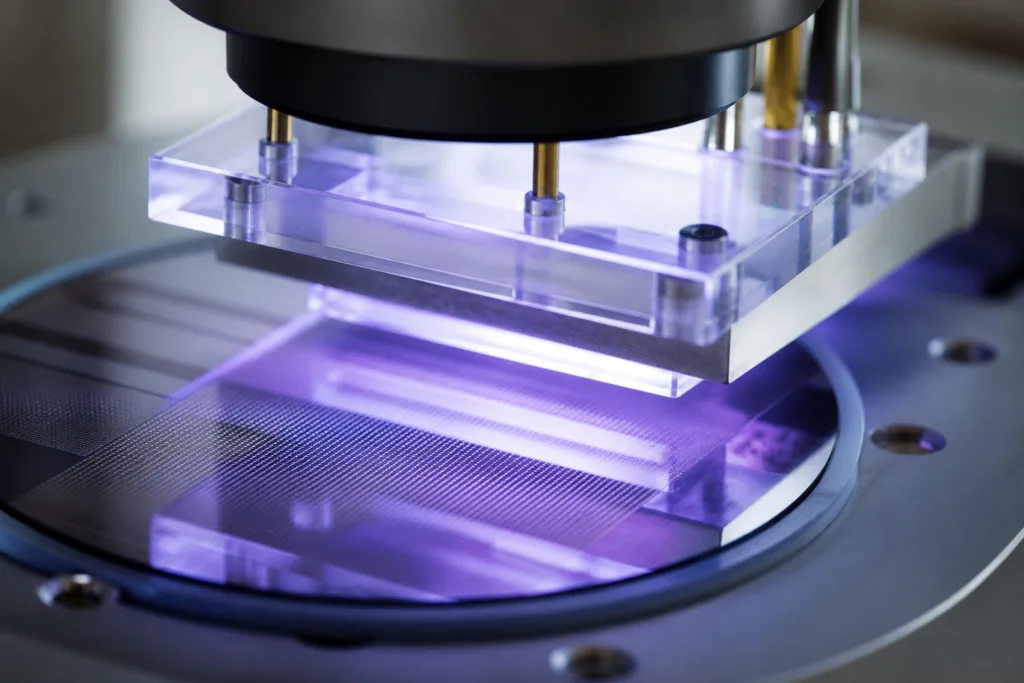
In high-speed optical transceiver assembly, precise dosage ensures that lens adhesives reach full strength without outgassing, which can fog optics. Balancing lamp position, exposure time, and material choice is critical. For more on this, see this deep dive on optical lens bonding.
Integrating Dosage Calculations into Process Control Systems
Modern manufacturing lines link UV lamp output, radiometer readings, and line speed via process controls. Automated alerts signal when maintenance or adjustments are needed, minimizing waste and defects.
Common Mistakes in Calculating UV Dosage
Typical pitfalls include assuming lamp output is constant, neglecting maintenance, or ignoring part geometry. Overestimating the curing window leads to excess energy, heat, and warping. Always confirm with surface and bulk cure tests—not just theory.
When to Adjust Your UV Dosage Settings
Adjustment is mandatory if there’s a lamp change, speed increase, substrate change, or unexplained decrease in yield. Track “tack test” or adhesion failures—these usually signal a dosage miscalculation or exposure non-uniformity.
Full UV Dosage Calculation Example
Suppose a part requires a minimum of 750 mJ/cm². The UV lamp provides 250 mW/cm² at the bonding interface. Minimum exposure time needed is 3.0 seconds (750 ÷ 250 = 3). If the lamp output decreases by 20%, increase exposure to 3.75 seconds to reach the same dosage. It’s all about balancing the equation for your real-world setup.
Special Considerations for Low Transmission Plastics
Polycarbonate and PMMA scatter or absorb UV, reducing cure efficiency. Use surface-specific radiometers and alternative lamp types where necessary. Our experts offer step-by-step UV bonding tips for low transmission plastics.
Adhesive and Coating Choices Affecting UV Curing Efficiency
Adhesive selection often determines cure speed, fixture time, and vulnerability to undercure. For shadowed sections or highly filled systems, consider hybrid-cure (UV + thermal or moisture) or epoxy materials tailored for complex assemblies.
The Role of ZDS Adhesive’s Experience in UV Dosage Calculation
ZDS Adhesive, an industrial adhesive manufacturer, routinely investigates process drift by correlating specific lamp geometries, adhesive chemistries, and environmental conditions. For instance, in water-resistant electronics, even small shifts in dosage can alter surface tension and wetting—changing both bonding reliability and insulation. Their approach starts with radiometer benchmarks, cross-validating with lap shear and peel tests after cure, and finally refining lamp–part distances to guarantee every unit hits required UV dosage without overexposure.
Maintaining Consistent Curing Results Over Time
Reliable lines use scheduled radiometer checks, lamp cleaning, and documented cure tests to ensure stable, repeatable process windows. Small deviations are natural—but consistent monitoring keeps quality high and rejects low.
Advanced Topics: Dual Cure and Shadow Area Solutions
For shadowed, opaque, or highly-filled areas, dual-cure (UV plus heat or moisture) systems offer robust full-cure performance, even where UV can’t fully penetrate. Regular validation of shadow area cure is needed to confirm true crosslinking throughout complex assemblies.
Calculating UV Dosage (mJ/cm²) for Complete Cure

Summing up: Determining accurate UV dosage requires you to assess lamp intensity, exposure time, substrate, adhesive chemistry, and geometry. When these variables are documented, measured, and fine-tuned, you’ll ensure full cure and long-term reliability—avoiding the risks of undercured or degraded joints.
Frequently Asked Questions
What is the minimum UV dosage for complete curing?
The required dosage depends on the material but is typically in the range of 250–1000 mJ/cm² for most adhesives and coatings. Always confirm with your product’s technical data sheet.
How do I measure UV intensity accurately?
Use a calibrated radiometer placed at the exact spot where the part is cured. Check intensity regularly, especially if you change lamps or components.
What happens if UV dosage is too low?
Undercure may cause weak bonds, sticky surfaces, or incomplete chemical reactions—reducing product strength, water resistance, and durability.
Does material thickness affect UV curing?
Yes, increased thickness or opacity lowers the amount of UV that reaches inner areas, often requiring longer exposure or dual-cure techniques for a full cure.
Can different lamp types affect curing efficiency?
Absolutely. Mismatch between lamp wavelength and adhesive photoinitiator can dramatically reduce curing speed and final bond quality.
How often should I calibrate my radiometer?
Once every 12 months at a minimum, or right after any damage, to ensure reliable UV intensity readings and consistent process control.
Related Reading
- See Curing in Action: Color-Changing UV Adhesives for Visual Confirmation
- LED or Mercury UV Lamps? 7 Safety and Efficiency Reasons Explained
- Automotive Assembly: 8 Game-Changers for Structural Acrylics in 2026
- How to Use Thermal Potting Compounds for Reliable LED Driver Electronics
- Damping Adhesives: Quelling Roof Panel Noise and Boosting Durability