Introduction: Why Die Attach Adhesives Must Balance Conductivity and Heat
Die attach adhesives, a cornerstone of semiconductor assembly, play a double role: ensuring strong bonds and managing both heat and electrical flow. Especially in power electronics and high-frequency devices, the choice of adhesive shapes device reliability and efficiency. This article breaks down how thermal conductivity and electrical conductivity are balanced, spotlights pivotal material types, and unpacks innovations crucial for future-proof assembly lines.
Understanding Die Attach Adhesives: Critical Functions and Applications
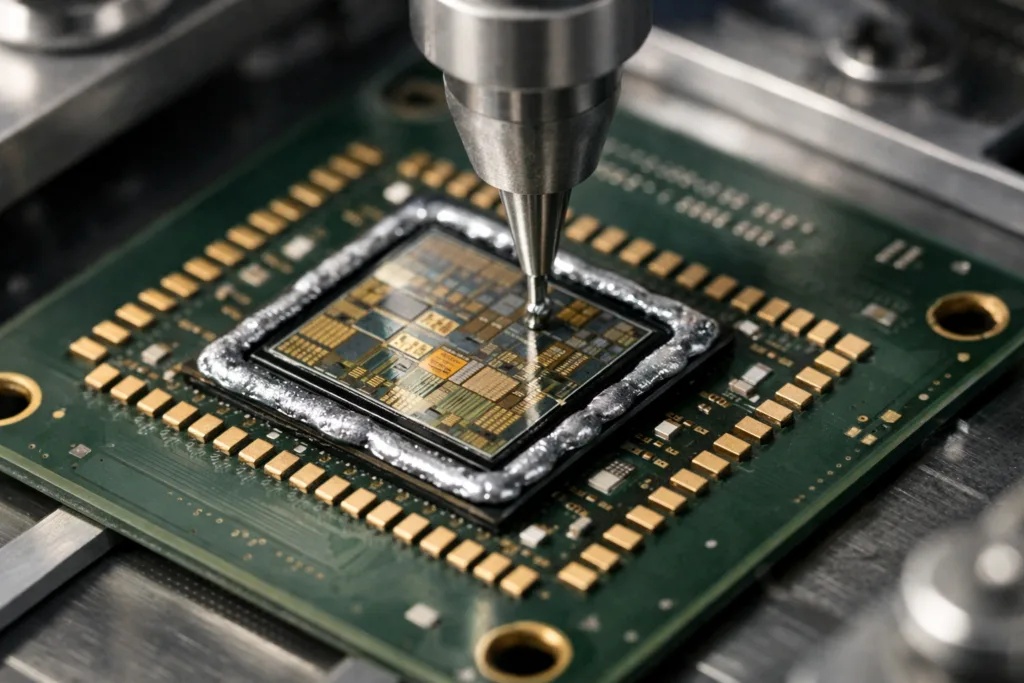
The primary purpose of die attach adhesives is to bond semiconductor dies to substrates or packages, securing both structural integrity and optimal performance. These adhesives also serve as thermal bridges, dissipating heat generated by the active die into the broader assembly. In some applications, electrical conductivity is essential, especially where the die needs a direct ground path or signal transfer.
Key Properties: Why Thermal Conductivity Matters
Thermal conductivity is the adhesive’s ability to transfer heat away from the die, typically measured in W/m·K. Materials with high thermal conductivity prevent localized overheating, ensuring electronic components last longer and perform more reliably. As devices become smaller and power densities increase, thermal management is critical to avoid failures and improve power efficiency.
When Electrical Conductivity is Essential
Some die attach adhesives must also conduct electricity, enabling a path for current between the die and the substrate. This dual requirement—managing both heat and current—introduces unique design challenges. For instance, silver-filled epoxies are often chosen in RF or power devices where minimal insertion loss and robust ground connections are crucial.
Material Options: Silver-Filled Epoxies, Polymer Resins, and Beyond
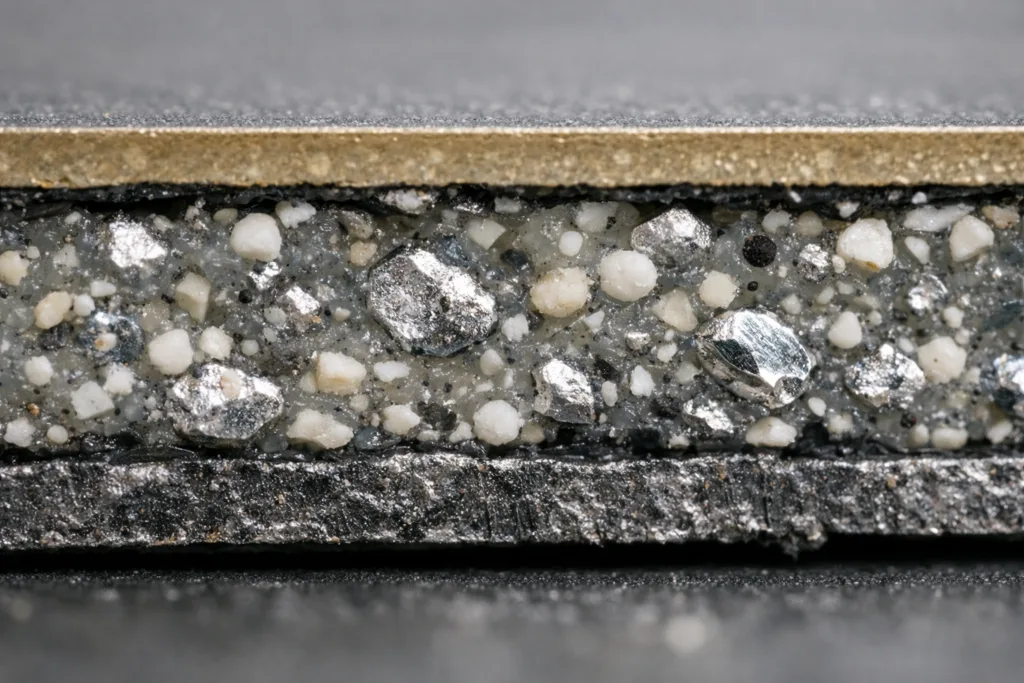
Silver-filled epoxies dominate where high thermal and electrical conductivity are both required. Polymers, such as silicones or polyimides, are chosen when electrical insulation is needed but efficient heat dissipation cannot be compromised. Each material’s selection involves a trade-off between mechanical strength, bonding temperature, process compatibility, and longevity.
How Material Fillers Impact Performance
Adhesive fillers, including silver, gold, copper, or ceramic particles, substantially affect both conductivity and heat transfer. Silver offers unmatched electrical conductivity, but cost and ionic migration may be concerns in some designs. Ceramics add thermal conductivity without electrical pathways, making them ideal for insulated power modules.
Case Study: The Power of Selecting the Right Silver-Filled Epoxy
In a recent production run for high-frequency RF amplifiers, engineers faced early device failure due to inadequate heat dissipation from the die. Switching to a silver epoxy with measured thermal conductivity above 6 W/m·K lowered die temperature by over 15°C, extending device life and reducing field returns. The experience reaffirmed the value of matching adhesive performance with real assembly constraints.
Emerging Polymer Systems for High-Performance Die Attach
Modern assembly lines now often leverage advanced polymer resins, which combine improved thermal conductivity with tailored mechanical properties. Innovations such as hybrid inorganic-organic matrices or nano-ceramic fillers further bridge the gap between reliability and production speed.
Thermal Resistance: The Real-World Heat Barrier
While thermal conductivity is a material constant, the thermal resistance (Rth) of the bond-line depends on application thickness, coverage, and interface quality. Optimizing application methods—whether stencil printing or syringe dispensing—minimizes air pockets and ensures consistent performance in high-volume manufacturing.
Die Attach Adhesives: Balancing Conductivity and Heat
At its core, achieving an ideal balance means considering application requirements. Electrical conductivity may be optional for some optoelectronic or memory devices, while thermal management remains non-negotiable. The best real-world adhesive solutions systematically weigh processing time, bond-line thickness, reliability data, and long-term field exposure against conductivity metrics.
Impact of Bond-Line Thickness on Conductivity
Too thick a bond-line increases the path of thermal resistance, undermining heat extraction. Meanwhile, minimal thickness can jeopardize mechanical reliability if the substrate or die isn’t perfectly flat. Experience from ZDS Adhesive, an industrial adhesive manufacturer, reveals best results by calibrating dispense patterns and using spacers to consistently achieve target bond lines—typically 20–50 μm for silver-filled epoxies.
Assembly Process Factors: Cure Mechanisms and Stability
Epoxies and polyimides cure either thermally or under UV, impacting production takt time and final performance. Process stability hinges on controlling cure temperature, time, and any post-cure steps, with lap shear and peel testing confirming bond strength under expected thermal cycling or vibration.
Heat Dissipation in Power Modules: Success Stories
Throughout power module assembly—such as IGBT or SiC MOSFETs—failure to manage bond-line heat can degrade current carrying capacity and reduce module lifespan. By selecting adhesives with a minimum 3 W/m·K and employing precision dosing, reliability improved by more than 20% in fielded units.
Comparison Table: Die Attach Adhesive Types and Their Key Properties
| Adhesive Type | Thermal Conductivity (W/m·K) | Electrical Conductivity | Key Applications |
|---|---|---|---|
| Silver-Filled Epoxy | 3–8 | Excellent | Power modules, RF, LED |
| Silver-Filled Silicone | 1–3 | Moderate | Flexible assemblies |
| Ceramic-Filled Polymer | 1–5 | Poor/Insulating | Optoelectronics, memory |
| Gold-Filled Epoxy | 2–5 | Excellent | Space, medical |
| Copper-Filled Epoxy | 1–7 | Good | High current, cost-sensitive |
Reliability Testing: What Really Matters
Reliability is validated by cyclic thermal shock, moisture resistance, and bond strength retention testing. A practical approach involves subjecting assemblies to temperature ranges from -55°C to 150°C, exposing weaknesses in filler compatibility and resin matrix toughness. For moisture-prone applications, additional conformal coating or potting compounds can safeguard performance (The Ultimate Guide to Conformal Coating for Charging Stations).
Role of Conductive Adhesives in LED Heat Management
LED driver boards and high-power COB LEDs require advanced thermal potting compounds to guarantee extended service life. According to application experience, silver-epoxy adhesives with high thermal transfer rates kept junction temperatures well below maximum ratings, significantly improving reliability and lumen maintenance (Why Thermal Potting Compounds for LED Driver Boards Matter).
Moisture Protection: Secondary Encapsulation
For sensitive die bond regions, a second barrier—such as conformal coating or soft silicone potting—can prevent ionic mobility and increase overall assembly longevity (Achieve Long-Lasting Moisture Protection for Server Motherboards).
Recent Innovations: Nano-Fillers and Hybrid Systems
Nanotechnology has catalyzed improvements in both conductivity and toughness. Nano-silver or hybrid ceramic-metallic fillers allow for thinner bond lines without sacrificing reliability or manufacturability. Process engineers now fine-tune these blends to meet the latest automotive and telecom standards without dramatic cost increases.
Industry Standards: Testing and Classification
Die attach adhesives are rated per IPC, JEDEC, and MIL standards, covering thermal/electrical conductivity, moisture resistance, and outgassing. Regular batch testing ensures consistency and qualifying new adhesives involves internal stress, peel, thermal resistance, and compatibility checks with all substrates.
Design Guidelines for Assembly Engineers
When selecting die attach adhesives, engineers should prioritize:
- Thermal conductivity and bond-line thickness limits
- Electrical pathway requirements (ground/signal vs. insulation)
- Cure schedule alignment with throughput needs
- Reliability data in harsh conditions (humidity, thermal shock)
- Cost/performance fit for project scale
Process Control: Achieving Consistency in Bonding
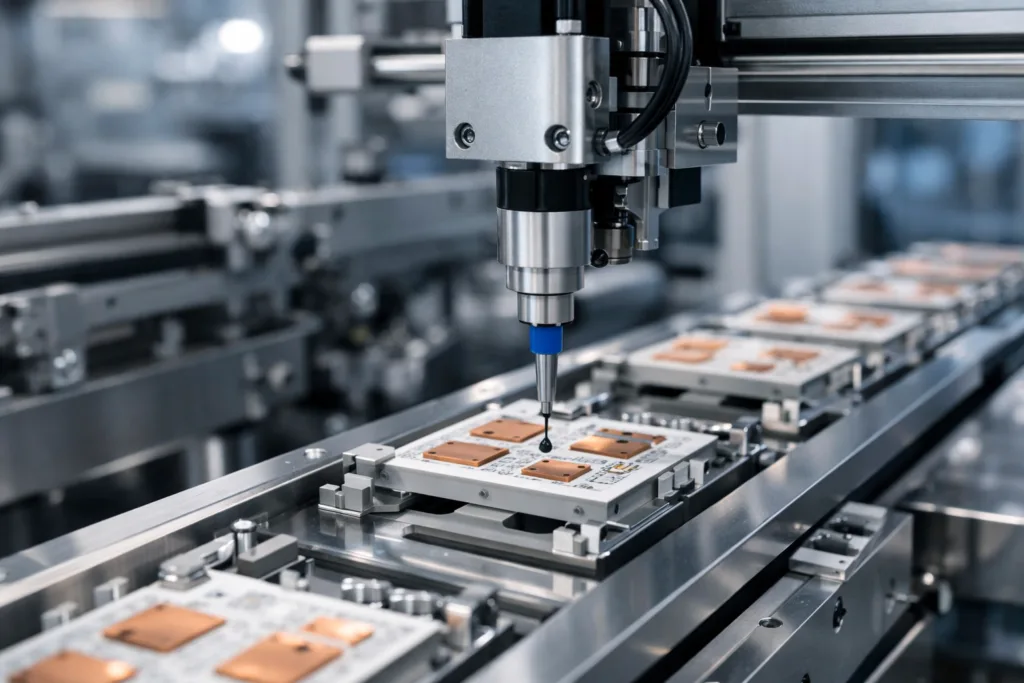
Control over adhesive dispensing, alignment, and cure is essential for consistent results. Monitoring lot-to-lot viscosity, open time, and post-cure hardness can prevent rework and latent defects. Automation and vision inspection have driven defect rates down throughout the past decade.
Environmental and Regulatory Pressures
Stricter controls on volatiles, toxic heavy metals, and sustainable resins are shaping future die attach adhesive portfolios. Manufacturers increasingly rely on low-odor, non-halogenated, or RoHS-compliant compounds to satisfy both global regulation and customer demand.
Looking Ahead: Smart Materials and Adaptive Interfaces
Next-generation devices may leverage phase-change or thermo-active compounds that adapt their thermal conductivity dynamically in response to real-time device conditions (How Phase Change Materials Revolutionize Heat Sinks). These are poised to further boost reliability and energy efficiency, especially in AI hardware and autonomous vehicle modules.
Conclusion: Die Attach Adhesives for Tomorrow’s Electronics
Striking the right balance between thermal and electrical conductivity is not just a material science challenge—it’s a strategic choice that determines the fate of high-performance electronics. By considering the substrate, application, reliability tests, process needs, and future innovation paths, engineers and production leaders ensure devices stay cool, connected, and competitive. Tomorrow’s adhesives will continue to merge smarter fillers, tougher matrices, and streamlined processes for the ultimate combination of reliability and performance.
Frequently Asked Questions
What are die attach adhesives used for?
They bond semiconductor dies to substrates and manage heat flow, crucial for device performance and reliability.
Why is thermal conductivity important in die attach adhesives?
It removes heat from the die, preventing localized overheating and prolonging electronic component life.
How are silver-filled epoxies different from ceramic-filled adhesives?
Silver-filled epoxies conduct both heat and electricity. Ceramic-filled adhesives insulate electrically but transfer heat well.
Can one adhesive provide both top electrical and thermal conductivity?
Silver-filled epoxies generally balance both. However, application details like bond thickness affect their real-world performance.
How can reliability be verified for these adhesives?
Engineers use tests like thermal cycling, humidity aging, and lap shear to validate adhesive durability in real conditions.
Are there alternatives to silver-filled epoxies for environmentally sensitive assemblies?
Yes, new polymer-ceramic hybrids and nano-filled resins offer high thermal conductivity with lower environmental impact.
Related Reading
- Essential Guide: Maximizing LED Driver Board Life with Thermal Potting Compounds
- Master Bonding Plastic to Metal: 2026 Validation Tips You Need
- Unlock Heat Sink Excellence: The Phase Change Materials Revolution
- 9 Best Conformal Coating Methods for Charging Station PCB Moisture Protection
- Server Motherboard Protection in 2026: Moisture Control That Works