Clear Epoxy Resin: Start With the Application, Not the Appearance
Clear epoxy resin should be selected by the finished part and process, not by appearance alone. First classify the job as a thin decorative coating or casting, a wood finish or deeper pour, or a clear floor system. Then verify the candidate system’s approved substrates, permitted film or pour thickness, cure conditions, appearance expectations, UV-exposure limitations, service demands, coverage method, mixing instructions, and handling requirements in current technical and safety documentation. Product-specific enquiries can begin with clear epoxy resin systems.
Clarity is only 1 selection criterion. A resin that looks acceptable in a small decorative sample may not fit a wood assembly, larger pour, or trafficked floor. Substrate condition, geometry, application orientation, ambient conditions, and service environment can all change the outcome. Use the current technical data sheet (TDS), safety data sheet (SDS), application instructions, and representative trials to support approval.
Choose the Right System Category: Crafts, Wood Projects, or Clear Floors

Do not presume that the same clear epoxy resin is suitable for crafts, wood tables, and floors. These applications can require different thicknesses, preparation methods, visual criteria, cure sequences, and service checks. Route the enquiry by use case before comparing price or appearance.
| Use case | Typical substrate or assembly | Application format | Key selection variables | Service/environment checks | TDS/SDS items to verify |
|---|---|---|---|---|---|
| Decorative crafts, thin coatings, or small castings | Prepared decorative surface or mould | Thin coating or casting | Geometry, visual target, layer sequence, and handling need | Lighting, intended use, and exposure | Approved substrates, permitted thickness, mixing procedure, cure criteria, and handling instructions |
| Wood finishing, tabletop work, or river-style pours | Wood surface, void, or wood assembly | Finish, fill, or deeper pour | Wood condition, sealing approach, geometry, orientation, and target thickness | Movement, moisture, use conditions, and appearance | Wood preparation, sealing or primer guidance where applicable, layer limits, intercoat preparation, and cure conditions |
| Clear floor coating or floor-system component | Concrete or existing floor system | System layer or multi-layer build | Substrate condition, film build, traffic, slip requirement, and maintenance plan | Moisture, cleaning chemicals, wear, traffic, and temperature change | Preparation, moisture limits where stated, application sequence, traffic-readiness criteria, topcoat needs, and limitations |
For wood work, distinguish a finish applied over timber from resin used to fill a void or form a deeper river-style section. Wood condition, sealing, geometry, and movement may need different technical guidance. ZDS information on epoxy resin for wood provides a relevant route for that discussion, while the named product documentation remains the basis for selection.
For tabletop projects, provide the dimensions, wood condition, target thickness, edge configuration, application orientation, expected use, and appearance criteria. The commercial page for epoxy for wood table tops helps direct the enquiry, but it does not establish suitability for every tabletop design.
Clear Epoxy Resin Selection Checklist
Prepare a short application brief before requesting a quotation, sample, or recommendation. It gives the supplier the information needed to identify open qualification points.
- Application format: State whether the use is a thin coating, decorative casting, wood finish, deeper pour, or floor-system layer. Note whether it is horizontal, vertical, moulded, or placed in an open void.
- Substrate and condition: Identify the actual material and describe porosity, dust, oil, loose material, cracks, joints, moisture condition where relevant, and prior preparation. Do not infer compatibility from a material name alone.
- Thickness and coverage: Give the target film build or pour depth plus total area or volume. Request the permitted thickness range and supplier-approved coverage method. Do not use a generic calculator when product guidance is unverified.
- Appearance: Define transparency, colour, gloss, surface texture, edge appearance, and acceptable defects. State the lighting and viewing conditions used for acceptance. Do not promise bubble-free or high-gloss results without product and process evidence.
- Process: Record batch size, mixing and dispensing method, planned application conditions, recoat need, handling point, and required production rate. Confirm values and procedures in the current documentation.
- Service environment: Describe sunlight or window exposure, temperature change, moisture contact, cleaning chemicals, abrasion, traffic, impact, and maintenance. A request for UV resistant clear epoxy resin should include the actual exposure profile and any available formulation-specific evidence.
A successful small sample does not automatically validate a larger mass, deeper pour, wood assembly, or floor. Use a representative trial with the intended substrate, geometry, application method, and cure conditions.
Substrate Preparation and Compatibility
Surface preparation is part of system selection. Wood may need assessment for moisture, resinous areas, dust, movement, and sealing. Concrete may require evaluation of soundness, contamination, profile, joints, and moisture. Plastics and existing coatings can require adhesion and chemical-compatibility trials. Obtain the preparation instructions for the specific system before committing material.
During the trial, check wetting, adhesion, colour, bubbles, edge behaviour, recoating, and cure under planned conditions. Record the substrate, preparation method, environmental conditions, mixing procedure, applied thickness, and acceptance result. If the system includes a primer, sealer, hardener, or topcoat, qualify the complete sequence rather than the clear resin alone.
Thickness, Coverage, and Application Method
Separate a film-build coating from a deeper casting or multi-layer floor system. Ask the supplier to confirm permitted thickness, whether limits apply per layer or to total build, recoat preparation, and approved application or dispensing equipment. Calculate coverage only from verified product guidance and measured project geometry.
If the available documents do not state a limit or calculation method, treat it as unresolved. Request the current TDS, SDS, application guide, and written technical confirmation before purchase.
Cure Profile and Process Window
A candidate system must fit the actual installation or production sequence. Obtain current instructions for component identification, authorised mixing, dispensing, application conditions, working-time information where published, cure conditions, recoating, demoulding, handling, and return-to-service criteria. Do not transfer instructions from another epoxy product or a trial conducted under different conditions.
Batch size, container geometry, material temperature, ambient conditions, and application thickness should be controlled during qualification. Document the planned method and ask whether it falls within the product’s published or confirmed scope. This is important for deeper pours, multiple layers, large mixed batches, automated dispensing, or floors that must be released on a defined schedule.
- Mixing and dispensing: Confirm whether the system is supplied as 1 component or multiple components, its authorised procedure, and compatibility with intended equipment.
- Environmental controls: Compare expected temperature, humidity, airflow, and contamination risks with current documentation.
- Production sequence: Define when a layer is recoated, a part is moved, or a floor accepts later work. Use documented criteria rather than a generic cure-time assumption.
Review the current SDS, label, and application instructions before use. Manage ventilation, personal protective equipment, spills, and waste according to the applicable documentation and local requirements.
Clarity, Gloss, UV Exposure, and Long-Term Appearance

Convert “clear” into visual acceptance requirements before approval. Specify whether the evaluation concerns transparency, colour, gloss, surface smoothness, substrate visibility, edge appearance, or a combination. Also define lighting, viewing distance, substrate colour, sample geometry, and acceptable surface variation.
The substrate and process can influence the visible result. Wood grain, pores, void edges, stains, and sealers can affect appearance; casting mould condition, geometry, layer interfaces, and application control can also matter. A clear cured sample on 1 substrate is not evidence of the same appearance on another substrate or at another thickness.
UV-exposure requests require formulation-specific evidence. Do not infer sunlight, weathering, or yellowing performance from the word “clear” or from a generic resin family. Request evidence identifying the system, test method, exposure conditions, duration, assessed property, and limitations. If the evidence is unavailable or does not represent the project, set a project-specific appearance target and conduct representative exposure evaluation before approval.
For exterior, window-adjacent, or high-light work, confirm whether documented guidance includes a protective layer, topcoat, maintenance instruction, or exposure limitation. Assess the complete build, not a resin layer in isolation.
Floor Service Requirements: Abrasion, Chemicals, Traffic, and Maintenance
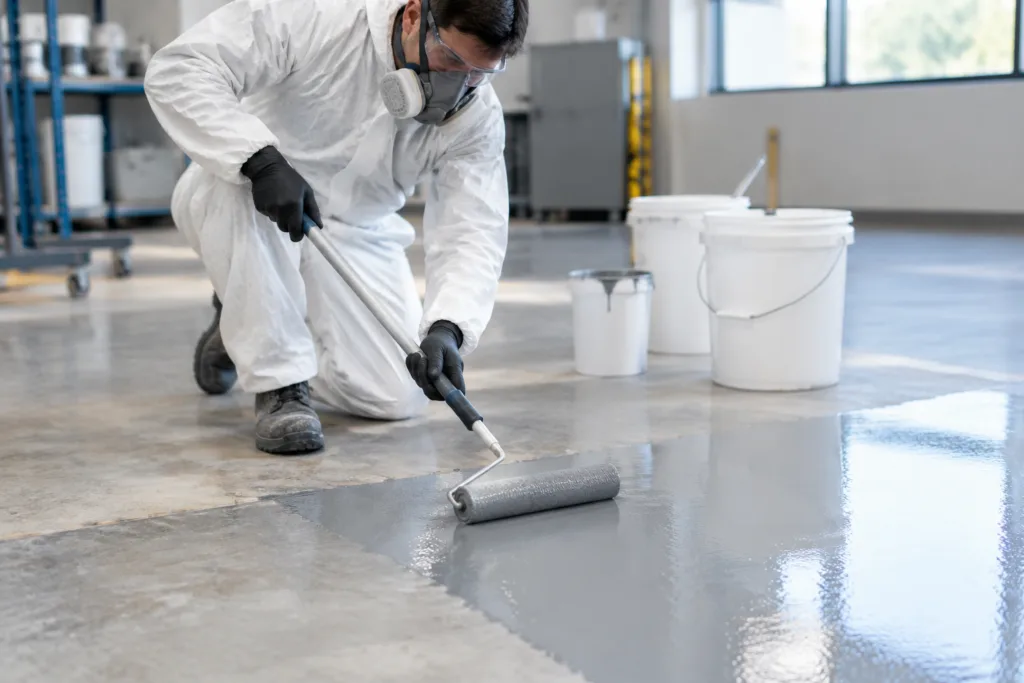
A clear epoxy resin for floors must be assessed as part of a floor system. Decorative coating or casting suitability does not demonstrate that a product meets the preparation, film-build, traffic, cleaning, wear, joint, moisture, or maintenance demands of a specific floor.
Start with a jobsite brief covering substrate condition, occupancy, foot or wheeled traffic, point loading, wet areas, cleaning routine, contact chemicals, temperature changes, slip requirements, repairs, and maintenance. Identify whether the floor is new concrete, existing concrete, or an existing coating. Assess moisture, contamination, cracking, joints, and soundness through the project’s approved procedure.
Where abrasion, chemical resistance, or traffic readiness matters, request system-specific evidence that defines the test or evaluation method, conditions, scope, and limitations. If it does not match the actual chemical, contact mode, temperature, or traffic pattern, seek written clarification or evaluate the representative system. ASTM C722 provides a reference point for chemical-resistant monolithic floor surfacings, but it does not verify the suitability of an unnamed resin system.
Confirm preparation, primer or topcoat needs, layer sequence, cure and handover criteria, documented maintenance products, repair procedure, and restrictions. For a performance-led route beyond decorative selection, review industrial epoxy resin options and request system-specific documentation.
How to Compare Suppliers, Documents, Samples, and Supply Requirements
Use the same acceptance brief for each candidate. Request the current TDS, SDS, label information, application instructions, confirmation of system components, storage and handling instructions, available packaging information, and batch identification or traceability process. Ask which points are published data and which require application-specific written confirmation. Request certificates or destination-market documents only where relevant and available for the named product and transaction.
Evaluate samples against pre-agreed criteria. Build the trial around intended substrate, preparation, geometry, thickness, orientation, mixing and application method, cure environment, appearance target, and service exposure. For floor work, trial the complete proposed system. For wood or casting work, use representative wood and void geometry, including planned sealing and layer sequence.
Also establish required quantity, packaging preference, storage capability, delivery destination, documentation needs, change-control expectations, and the procedure for reporting a batch or application concern. If the project includes an assembly bond line as well as a coating or pour, the epoxy resin adhesive guide helps separate assembly-selection questions from clear-finish qualification.
To move from screening to a project-specific qualification discussion, contact the ZDS technical team with the substrate pair, surface condition, target thickness, area or volume, application orientation, ambient conditions, appearance standard, exposure profile, validation plan, quantity, packaging needs, and destination-market documentation requirements.
What is the best clear epoxy resin for my application?
The best choice is the specific system whose current documentation and representative trial support your substrate, thickness, process, appearance target, and service environment.
Can I use the same clear epoxy resin for crafts, wood, and floors?
Do not assume so. Craft, wood, and floor applications have different substrate, thickness, preparation, cure, and service requirements that must be confirmed for the named system.
How do I choose clear epoxy resin for a wood tabletop or river-style project?
Provide the wood condition, geometry, sealing approach, intended thickness, orientation, appearance target, and service exposure, then verify the specific product’s instructions and trial the planned build.
What should I verify before using clear epoxy resin in sunlight or near windows?
Request formulation-specific UV or colour-stability evidence with its test conditions and limitations, and evaluate the complete system under representative exposure where needed.
How do I calculate the amount of clear epoxy resin needed for a coating or pour?
Use measured project geometry and the supplier-approved calculation based on the verified product guidance, intended thickness, layer plan, and application method.
What documents should I request before buying clear epoxy resin in bulk?
Request the current TDS, SDS, label and application instructions, system-component confirmation, packaging and storage information, traceability process, and relevant transaction-specific documentation.