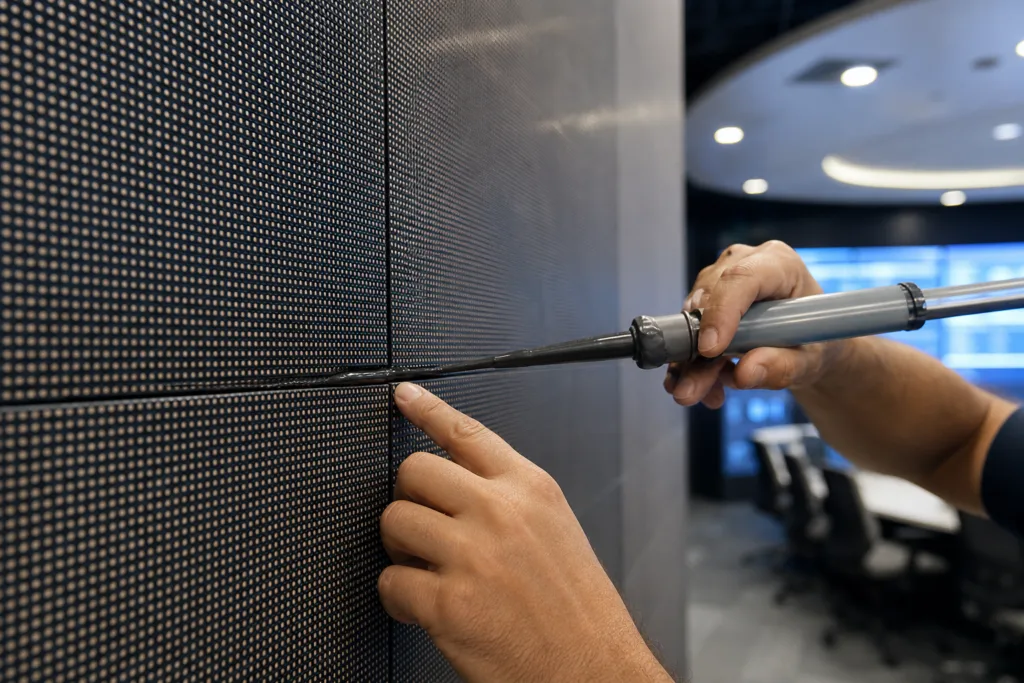
A high tack adhesive is designed to grab quickly at the moment of contact, helping parts stay in place before the bond has fully developed. For engineers, installers, and procurement teams, that fast initial grab can save time, reduce clamping, and improve placement accuracy during assembly. But high tack is not the same as final bond strength, and it is not the right answer for every substrate, load, or environment.
To choose correctly, it helps to understand how surface condition, wetting, viscosity, cure behavior, and substrate chemistry work together. Our surface energy and adhesion fundamentals guide is a useful bridge for this topic because initial grab depends heavily on how well an adhesive wets a surface before it sets. From our adhesive manufacturing perspective, we often help buyers balance grab, open time, repositioning tolerance, and durability through sample evaluation, viscosity adjustment, and OEM or private label formulation support.
What High Tack Means in Adhesives and Sealants
In practical industrial language, “high tack” means an adhesive feels sticky and begins holding a part almost immediately after application and contact. That first-stage hold is often called initial grab, wet grab, or green strength. It is especially important when parts are vertical, heavy, awkward to fixture, or difficult to clamp.
High tack is common in sealants, construction adhesives, pressure-sensitive products, hot melts, and some fast-setting liquid systems. The key point is that tack describes early handling behavior, not the full cured properties. A product can have strong tack and still have moderate shear strength, limited chemical resistance, or poor performance on a low-energy plastic.
Buyers sometimes assume the stickiest product is automatically the strongest. In reality, a high tack adhesive is a process tool as much as a bonding material. It can reduce downtime and make installation easier, but only if the final chemistry matches the substrate pair and the service environment.
Why Initial Grab Matters in Production
Initial grab affects line speed, rework risk, and the amount of temporary fixturing needed. On a busy assembly line, a product that holds itself in place right away may reduce labor even if its ultimate cure schedule is unchanged. That is why high tack is especially attractive in jobs where alignment is difficult or where gravity works against the joint.
However, production teams should look beyond the first few seconds. A strong initial hold can still fail if the product creeps under load, loses grip on dusty surfaces, or becomes brittle after cure. We usually recommend judging a candidate adhesive by both the first touch and the final joint performance.
How High Tack Adhesives Work: Viscosity, Wetting, and Green Strength

High tack comes from a combination of formulation choices and application behavior. In many systems, relatively fast wetting lets the adhesive spread into microscopic surface irregularities. Higher viscosity may help the bead stay where it is placed, while a balanced solvent, moisture, heat, or reactive cure profile allows the adhesive to build handling strength without excessive slippage.
Green strength is the early cohesive structure that develops before full cure. In some products, this develops through solvent evaporation, moisture uptake, cooling, or chemical reaction. In others, it is largely provided by the inherent pressure-sensitive nature of the polymer network. For buyers, the important question is not just “does it feel sticky?” but “how fast does it become stable enough for handling, movement, or transport?”
For fast-grab assembly, process engineers often compare adhesive behavior to other rapid-setting systems. Our article on hot melt application for fast-grab assembly is relevant here because hot melt systems can provide immediate hold when speed matters, though they also have their own temperature and equipment requirements. In many projects, the best choice depends on whether the priority is instant fixture, long open time, or a more forgiving installation window.
Tack, Peel, and Ultimate Strength Are Different Metrics
One of the most common selection mistakes is confusing tack with peel adhesion or structural strength. Tack measures how quickly a bond forms on contact. Peel resistance describes how well the bond resists peeling forces. Shear strength reflects resistance to sliding or sustained load. A product can score well in one area and poorly in another.
That is why lab review matters. Standards such as tack test methods, peel testing, and strength development methods help teams compare candidate products more objectively. The purpose is not to turn every project into a lab study, but to avoid relying on feel alone when the service requirement is more demanding than a simple hand test.
Common Chemistry Families Used for High Tack Adhesives and High Tack Sealants
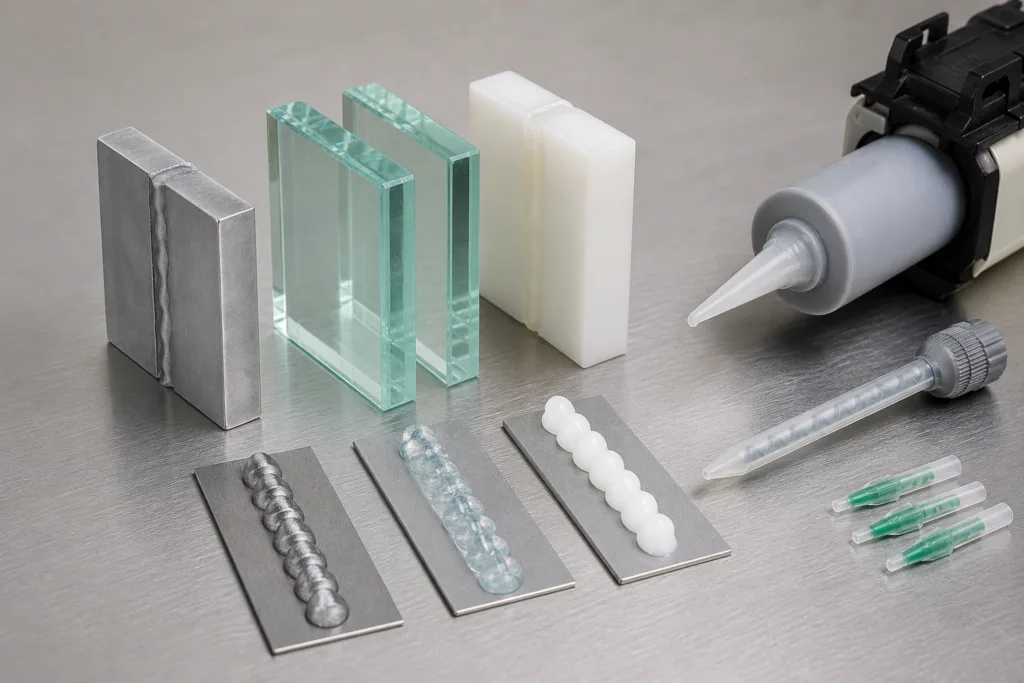
Several adhesive families can be formulated for high tack behavior, and each has a different balance of speed, flexibility, durability, and substrate compatibility. The right chemistry depends on whether the project is indoor or outdoor, structural or non-structural, static or vibration-prone, and whether the adhesive must also seal against moisture or dust.
| Chemistry family | Typical high tack advantage | Common limitations | Typical fit |
|---|---|---|---|
| Pressure-sensitive acrylic | Very fast grab and easy handling | May be limited under heat or heavy structural load | Labels, tapes, laminating, light assembly |
| Silicone | Flexible grab and good weathering potential | Lower structural strength than rigid systems | Sealing, flexible bonding, electronics support |
| Polyurethane | Good balance of grab, toughness, and flexibility | Cure sensitivity can vary by formulation | Construction, transport, mixed-material bonding |
| MS polymer / hybrid sealant | Useful tack with strong sealant behavior | Not ideal for every high-load structural joint | Assembly, sealing, gap filling |
| Hot melt | Instant hold on cooling | Heat resistance may be limited by grade | Packaging, furniture, fast assembly |
When selecting a chemistry, buyers should decide whether they need a temporary handhold or a fully engineered joint. A sealant with high tack may be perfect for a panel edge, but not for a load-bearing bracket. Likewise, a fast-grab adhesive may help a production team move faster but may still need a primer, surface pretreatment, or cure schedule to deliver reliable long-term performance.
Best Substrates and Poor-Fit Substrates for High Tack Adhesive Selection
Substrate compatibility is one of the biggest determinants of success. A high tack adhesive that performs well on metal and glass may struggle on low-surface-energy plastics. Porous materials can also change the result by absorbing liquid components or preventing a smooth wet film from forming.
Metals often respond well when the surface is clean, dry, and free of oil or oxide debris. Glass usually offers good wetting if contamination is controlled. Many rubber and wood surfaces can bond well, but the result depends heavily on porosity, filler content, and surface treatment. Plastics are more complicated, especially when the part is made from difficult materials such as PP, PE, POM, or PTFE.
For buyers working with low-energy plastics, the difference between a workable assembly and a chronic failure can come down to pretreatment or primer selection. Our discussion of primers for low-surface-energy plastics is useful for that reason, because high tack alone rarely solves poor wetting on those substrates. In some cases, we also recommend looking at surface pretreatment for stronger initial bonding when the line can support it.
When Surface Texture Helps and When It Hurts
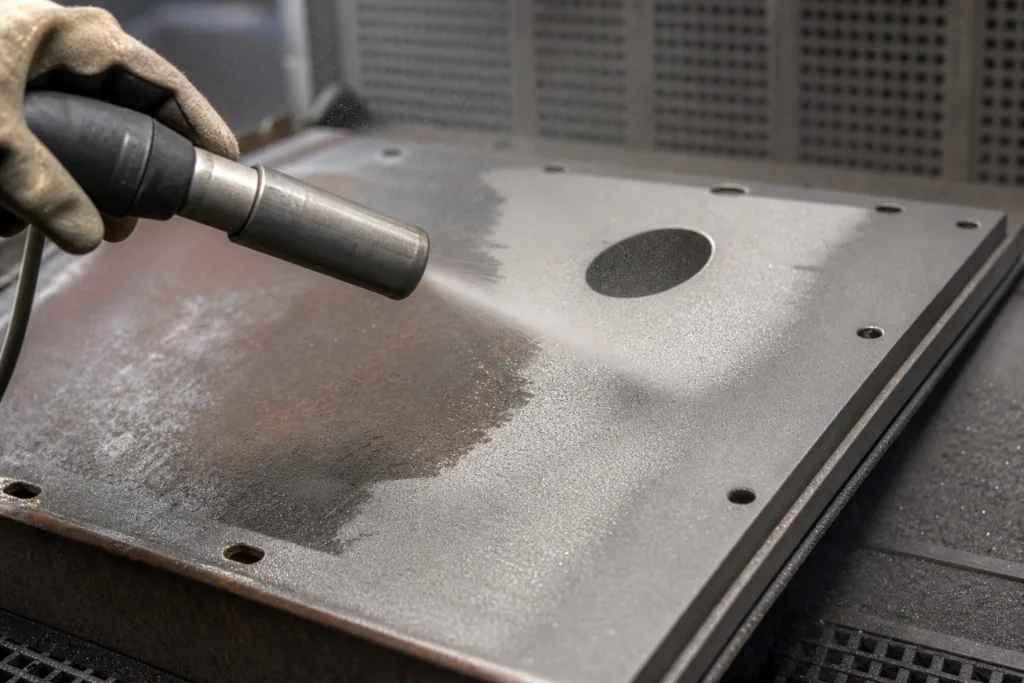
Moderate roughness can improve mechanical interlocking on metal or rigid composites, especially when the adhesive is meant to resist peel or vibration. But excessive roughness can trap air, create voids, or reduce effective contact area if the adhesive is too viscous to flow into the profile. Sandblasting may help certain metal bonds, but it should be evaluated alongside coating condition and corrosion risk rather than used automatically. In our experience, surface roughness and metal bond strength is best treated as a process variable, not a universal fix.
Typical Use Cases Where High Tack Improves Productivity
High tack is most valuable when a part must stay where it is placed without long clamping or long curing downtime. That is why it appears often in vertical installation, assembly of decorative or functional panels, field repair, and mixed-material bonding where fixture time affects labor cost.
- Vertical panel mounting where gravity can cause sag or slip
- Temporary positioning before full cure or mechanical fastening
- Fast assembly of components that cannot be clamped easily
- Sealing jobs where the bead must stay in place immediately
- Light-to-moderate duty bonding where setup speed matters more than structural load
- Assembly lines that need reduced fixture time and quicker handling
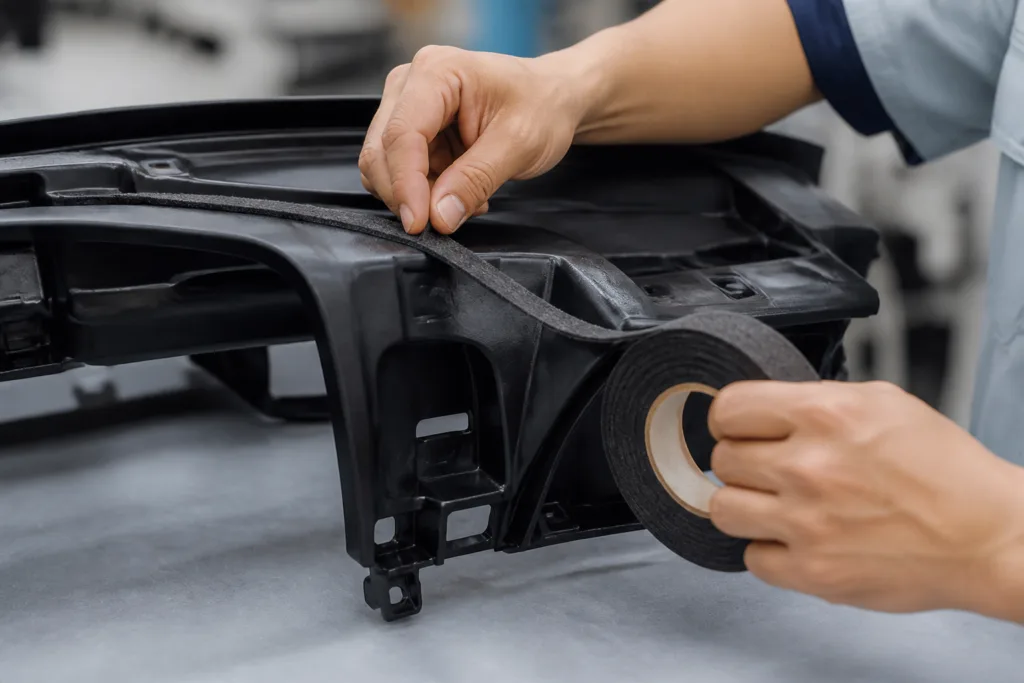
In some production environments, the right answer is not a liquid adhesive at all, but an instant-grab hot melt system. A hot melt can provide strong early hold on compatible substrates, especially when the process is designed around the equipment and cooling profile. That is why we often evaluate product choice together with process design, not only chemistry. The right adhesive can fail if the application method is mismatched to the line.
When we discuss fast handling with customers, we also compare it against the broader equipment and process requirements of matching hot melt equipment to process. A high tack adhesive is only productive if the application can deliver a consistent bead, enough coverage, and repeatable placement at production speed.
When High Tack Is the Wrong Choice
High tack is not ideal when the assembly needs easy repositioning, long working time, or very low stress during alignment. It may also be the wrong choice if the joint will be exposed to heavy peel forces, constant heat, strong chemicals, or dynamic movement that could slowly deform a soft bond line.
It is also a poor fit when the application requires a deep potting or encapsulation function. In those cases, the buyer usually needs controlled flow, bubble release, and longer working time rather than immediate grab. Likewise, if the task is precision electronic assembly with narrow tolerances, an adhesive that grabs too early can make positioning harder instead of easier.
For flexible or delicate materials, some high tack products are excellent, but others can be too aggressive. Soft substrates may deform before the adhesive finishes wetting, or the bond may look strong at first but fail after repeated movement. Our article on high-grab bonding for soft substrates is useful when the joint involves foam, elastomeric parts, or other compliant materials.
Repositioning, Fixture Time, and Cure Time on the Shop Floor
Many buyers ask whether a high tack adhesive still allows repositioning. The answer is usually “only briefly, and not always.” The real window depends on viscosity, open time, temperature, humidity, substrate porosity, and how much pressure is applied. A product that feels movable on one day may lock much faster on a warm, porous, or absorbent surface.
Fixture time is the point at which a joint can stay in place under the intended handling load. Cure time is when the adhesive reaches the target final property level. These are not the same. Some systems with strong tack still need significant time to develop full strength. In many projects, fixture time and strength development should be reviewed alongside the practical production schedule so the line does not confuse “held in place” with “fully ready for service.”
Durability Factors: Heat, Moisture, UV, Vibration, and Aging Resistance
A strong first grab means little if the bonded part later sees temperature swings, humidity, UV exposure, salt spray, or recurring vibration. Durability should be considered as a separate filter from tack. In real service, the joint experiences creep, fatigue, and environmental aging long after installation.
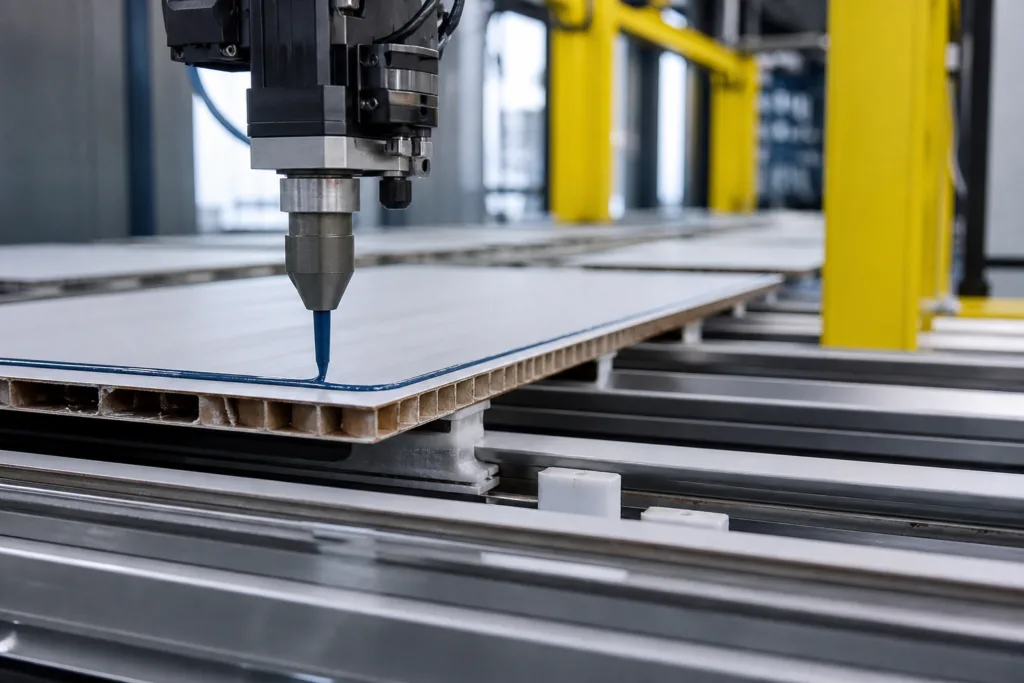
Silicone-based systems are often considered when flexibility and weathering are important. Some polyurethane and hybrid systems offer a better balance of grab and toughness, especially when the assembly sees repeated movement. Acrylic systems may be very attractive for fast handling, but the exact grade matters if the joint will be exposed to elevated temperatures or harsh chemicals. For some projects, temperature tolerance becomes the deciding factor more than initial tack.
When customers are choosing between different fast-setting options, we often compare them against alternatives such as high-temperature instant adhesive performance, since a product that grabs fast but softens too early can create hidden warranty risk. The bond should be selected for the actual service envelope, not just for the installation experience.
Choosing Between High Tack Adhesive, High Tack Sealant, and Other Bonding Options
Buyers often use the phrase high tack adhesive to describe a family of products that includes sealants, construction adhesives, and pressure-sensitive materials. The correct label matters because it affects expectations. A sealant may prioritize flexibility and weather resistance. A structural adhesive may prioritize strength and load transfer. A pressure-sensitive product may prioritize instant handling but have limited load-bearing capacity.
As a rule, choose a high tack sealant when sealing and gap accommodation are part of the job. Choose a high tack adhesive when bonding is primary and the process needs fast positioning. Choose another bonding option when the joint needs high structural strength, long repositioning time, deep potting, or extreme chemical and temperature resistance.
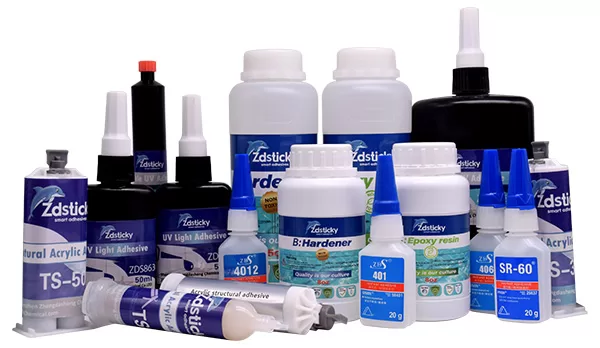
At ZDS Adhesive, we usually ask customers to define four things before recommending a formula: substrate pair, service environment, production process, and the required balance between initial grab and final performance. That framework prevents over-specifying tack when the project actually needs toughness, insulation, waterproofing, or thermal management.
How to Evaluate a Product: TDS Data, Sample Testing, and Application Trials
A technical data sheet is the starting point, not the final decision. Buyers should read it for application method, viscosity, open time, fixture time, cure schedule, hardness, elongation, tensile or shear data where available, temperature limits, and compatibility notes. If the TDS is vague on a property that matters to your process, ask for clarification before moving into production trials.
We recommend a small but realistic trial that mirrors the real line conditions. The sample should be tested on the actual substrate, with the same surface preparation, bead size, cure temperature, and handling time you plan to use in production. A product that looks perfect on a bench sample may behave differently on a large panel, dusty part, or porous component.
During evaluation, watch for bead stability, slippage, squeeze-out, bubble formation, surface staining, and cure consistency. If the product is used for assembly rather than sealing, check not just whether it sticks, but whether it remains stable after transport, vibration, and environmental exposure. A strong sample program helps reduce the risk of choosing a product that is easy to apply but expensive to maintain.
What Procurement Teams Should Ask Before Approval
- Does the adhesive work on our actual substrate pair without special handling?
- How much repositioning time do we have before initial grab becomes permanent?
- What cure conditions are needed for handling and full performance?
- Are primers, pretreatment, or special cleaners required?
- Can the product be supplied in the package size and viscosity we need?
- What QC controls keep batch-to-batch behavior consistent?
Common Application Mistakes That Reduce Grab or Bond Performance
Even a well-chosen high tack adhesive can underperform if the application process is weak. Surface contamination is one of the biggest causes of failure. Oils, dust, release agents, mold residue, oxidation, and moisture can all interfere with wetting and early hold.
Another frequent issue is applying too little adhesive. High tack does not mean the bond line can be starved. Too little material may give strong initial feel but poor long-term coverage. Too much adhesive can be equally harmful if it traps air, slows cure, or causes excessive squeeze-out.
Temperature also matters. Cold parts may reduce wetting and lengthen fixture time. Hot parts may shorten the working window too much. Humidity, if the chemistry is moisture reactive, can accelerate or disrupt cure depending on the system. The same product can therefore seem inconsistent when the actual issue is process variation, not formulation failure.
Why Application Method Can Change the Result
Manual dispensing, cartridge packaging, spray, bead, and hot melt equipment all influence the performance window. The best formulation can still look weak if the bead is irregular or the application rate is inconsistent. That is why we pay attention to packaging and dispensing as part of the product design, not after the fact.
In OEM projects, the application tool sometimes drives the chemistry choice. If the line needs a very fast set and precise application, a hot melt may be more appropriate. If the project needs more working time, a moisture-curing or reactive system may fit better. The right choice is the one that matches both the substrate and the manufacturing rhythm.
Custom Formulation Considerations for OEM and Industrial Buyers
When standard products do not fit, custom formulation can solve the mismatch between tack, cure speed, and final performance. This is common in OEM assembly, private label projects, and industrial installations with unusual substrates or service demands. The most useful adjustments typically involve viscosity, open time, fixture time, flexibility, temperature resistance, or substrate wetting.
From a manufacturing standpoint, custom development should start with realistic constraints: target substrate, required packaging, shelf life, production temperature, and expected annual volume. If a buyer wants high tack plus low odor, or high tack plus electrical insulation, or high tack plus thermal conductivity, trade-offs will need to be managed carefully. No single formulation maximizes every property at once.
We support this stage by screening sample formulas, checking batch consistency, and aligning QC checkpoints with the buyer’s process. For some projects, simple rebalancing of viscosity and cure speed is enough. For others, the adhesive family itself must change. That is why an early technical conversation saves time later.
When products must combine fast grab with controlled cure or improved environmental performance, teams often also review auxiliary technologies such as activators for faster adhesive cure. Those options can shorten the handling window, but they should be selected carefully because they may also reduce working time or change process sensitivity.
Practical Selection Checklist for B2B Buyers
If you are deciding whether a high tack adhesive is right for your project, use this simple filter before making a purchasing decision:
- Is immediate hold more important than repositioning time?
- Will the joint face peel, shear, vibration, or thermal cycling?
- Does the substrate support good wetting, or will pretreatment be needed?
- Is the product acting as an adhesive, sealant, or temporary assembly aid?
- Can the line control bead size, temperature, and cure conditions consistently?
- Do you need a standard product or a custom formulation for the exact process?
If you answer these questions honestly, it becomes much easier to avoid overbuying tack where you really need strength, or underbuying tack where you need speed and handling efficiency. The most successful projects treat adhesive selection as a process decision, not only a material decision.
Conclusion
A high tack adhesive can be a powerful production advantage when quick initial grab, reduced fixturing, and easier placement are important. It can also be a poor choice when the project needs long repositioning time, deep fill, heavy structural strength, or exceptional environmental resistance. The best results come from matching the chemistry to the substrate, the service environment, and the real production process.
For B2B buyers, the safest path is to evaluate tack, peel, and strength development together, then confirm the result through sample testing on the actual line. If you are comparing options for industrial assembly or installation, we recommend treating high tack as one performance requirement among several, not as the only one that matters. That approach leads to more stable production, fewer application surprises, and better long-term bond performance.
FAQs
What does high tack mean in an adhesive?
High tack means the adhesive grabs quickly when it first touches the substrate, creating early holding power before full cure. It is useful when parts need immediate positioning support, but it should not be confused with final strength or long-term durability.
Is a high tack adhesive always stronger than a regular adhesive?
No. High tack describes initial grab, not overall bond strength. Some regular adhesives develop much higher final shear, peel, or structural performance after cure, even if they feel less sticky at the start.
Can a high tack adhesive be repositioned after application?
Sometimes, but only within a limited working window. Repositioning depends on viscosity, temperature, substrate porosity, and cure speed. Once the adhesive starts building grab, moving the part can reduce bond quality.
Which substrates work best with high tack adhesive products?
Clean metal, glass, wood, rubber, and many coated surfaces often work well if surface condition is controlled. Low-surface-energy plastics and very porous materials usually need pretreatment, primers, or a different chemistry.
How should I test a high tack adhesive before production?
Test it on the real substrate with the real surface preparation, bead size, temperature, and handling time used in production. Check initial grab, fixture time, final bond performance, and durability under the actual service conditions.
Can ZDS Adhesive customize a high tack adhesive for OEM production?
Yes. We can evaluate your substrate pair, process requirements, packaging needs, and performance targets, then adjust the formulation or recommend a different adhesive family if needed. Sample testing and batch consistency checks are part of that development process.