High-strength epoxy systems are widely used when an assembly needs more than basic bonding: they must carry load, resist vibration, hold alignment, and keep performing after heat, moisture, and production stress. For engineers and procurement teams, the real question is not whether an epoxy can bond two parts, but whether the bond will remain reliable in the actual joint geometry, substrate condition, and service environment. That is where a high strength epoxy adhesive earns its place in structural assembly.
For projects involving metal assemblies, mixed substrates, or demanding load paths, metal-to-metal bonding guidance is a useful starting point because the best results come from matching chemistry, surface preparation, and joint design to the real application. From our manufacturing perspective, we support those decisions with formula selection, viscosity tuning, cure planning, sample testing, and bulk production consistency so buyers can evaluate fit before scaling up.
What Makes an Epoxy Adhesive Suitable for Structural Bonding
A structural epoxy adhesive is different from a general-purpose glue because it is designed to transfer loads across a bonded area rather than simply hold two parts together. The cured network typically provides strong adhesion to metals, plastics, ceramics, composites, and other industrial substrates, along with good dimensional stability and resistance to creep. In practical terms, that means the bond can support shear, peel, vibration, and thermal cycling more effectively when the product is chosen correctly.
In our work, the most important structural questions are usually these: What load is being transferred? Is the joint mostly in shear, peel, or impact? Is the assembly rigid or slightly flexible? Will the parts see heat, solvents, water, or repeated movement? A high strength epoxy adhesive can be formulated for very different answers to those questions, which is why product selection should start with the application rather than with a generic strength number.
For buyers comparing options, it helps to think of epoxy performance as a balance of strength, toughness, and processability. A very rigid system may look impressive in a lab test, but if the joint sees vibration or differential expansion, a tougher formulation may deliver more reliable field performance. Likewise, a fast-curing system may improve throughput but reduce working time, so the process window must fit the assembly line.
Where epoxy stands out in industrial assemblies
- Metal joining where welding or fasteners are not ideal
- Mixed-material bonding where different thermal expansion rates matter
- Gap-filling structural joints that need controlled cure shrinkage
- Assemblies exposed to heat, moisture, or intermittent chemical contact
- Bonding tasks that require both load-bearing performance and clean aesthetics
How High-Strength Epoxy Adhesives Transfer Load
Structural bond reliability depends on how the adhesive transfers stress between substrates. A bonded joint does not carry load like a bolt; it spreads load across the bond area. That is why lap geometry, overlap length, adhesive thickness, and edge design matter so much. When the joint is designed well, the adhesive layer shares stress efficiently. When the design is poor, the same adhesive can fail early even if the material itself is strong.
Three mechanical ideas matter most when evaluating a high strength epoxy adhesive:
- Shear strength: important in lap joints and many metal assemblies, where the adhesive resists sliding forces.
- Peel resistance: critical when the joint experiences edge lifting, prying, or thin flexible substrates.
- Toughness: the ability to absorb energy without brittle cracking, especially useful under vibration and impact.
Engineers often focus on shear strength first, but peel and toughness can be just as important in the field. A joint with high apparent shear performance may still fail if the service load creates peel stress at the edges. That is why we recommend reviewing the entire load case, not just one headline property, before selecting chemistry or finalizing the joint geometry.
For applications involving dissimilar materials, the transfer of load becomes even more sensitive to thermal expansion and modulus mismatch. In such cases, the epoxy may need a slightly more flexible profile to reduce stress concentration during temperature swings or equipment movement.
Epoxy Chemistry Basics: Why Epoxy-Based Adhesives Deliver Strong and Durable Bonds
Epoxy adhesives cure by reacting resin and hardener into a crosslinked network. That network is the reason epoxies are valued for structural work: they can provide strong adhesion, good cohesion, and stable performance over time. Crosslink density, filler package, and curing agent selection all affect final hardness, flexibility, heat resistance, chemical resistance, and processing speed.
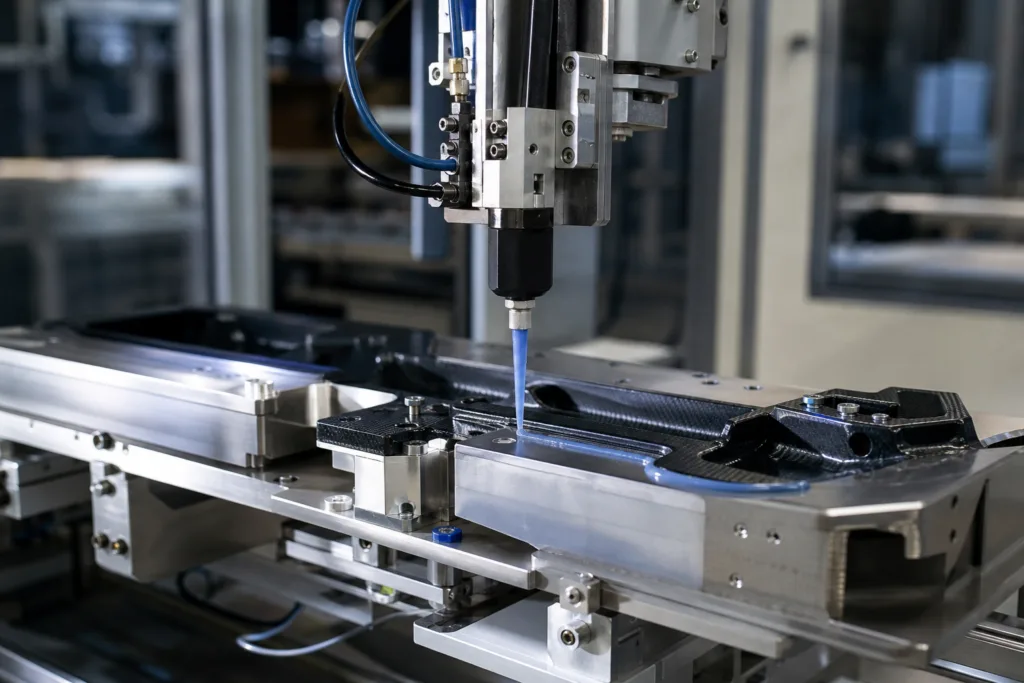
From a manufacturing standpoint, the chemistry choice affects much more than final strength. It also influences pot life, mix ratio tolerance, viscosity, exotherm, and whether the product suits manual dispensing, meter-mix equipment, or automated application. A formulation intended for large bond lines may need a different rheology than one intended for thin film bonding or vertical surfaces.
Epoxy systems can also be customized for special performance targets. For example, fillers may be used to improve gap control, reduce shrinkage, adjust thermal conductivity, or change flow behavior. Toughening agents may be added to improve impact resistance and fatigue behavior. These design choices are not random; they are made to match the assembly requirements and the buyer’s production process.
For mixed-material projects, our team often reviews surface energy, curing temperature limits, and the expected thermal cycling range before recommending a formulation path. That is one reason industrial buyers often value a manufacturer who can adapt the chemistry rather than simply ship a standard product.
Selecting the Right Industrial Epoxy Adhesive for the Load Case and Substrate Pair
Choosing the right industrial epoxy adhesive starts with the substrate pair and the load case. Metal-to-metal bonding often needs strong cohesive properties and careful surface preparation. Plastic-to-metal assemblies may need a more flexible system to manage differential movement. Composite bonding can demand low shrinkage, good wetting, and controlled cure exotherm. Ceramics and glass may benefit from strong adhesion and dimensional stability. Each pairing changes the performance priorities.
For mixed-material assemblies, it is often helpful to ask whether the adhesive will be expected to carry structural load alone or whether it is one part of a broader mechanical design. If fasteners, clips, or housings provide some redundancy, the epoxy can sometimes be optimized for sealing, damping, or positioning. If the adhesive is truly load-bearing by itself, the qualification threshold should be stricter.
One practical example is metal-to-polymer bonding. The metal side may be stiff and thermally conductive, while the plastic side may expand more under heat. In that case, a very rigid adhesive could concentrate stress at the interface, so a tougher and slightly more forgiving epoxy may be the better engineering choice. For more detail on substrate pairing, plastic-to-metal bonding strategies help frame the trade-offs between adhesion, flexibility, and production window.
At ZDS Adhesive, we usually narrow selection by asking four questions: what substrates are involved, what stress type dominates, what curing method fits the line, and what environmental exposure is expected. That approach helps avoid overspecifying strength while underspecifying durability.
| Application Need | Epoxy Property to Prioritize | Why It Matters |
|---|---|---|
| Metal load-bearing joint | Shear strength and cohesion | Supports direct structural load transfer |
| Plastic-to-metal assembly | Toughness and stress relief | Manages thermal expansion differences |
| Outdoor or humid service | Moisture resistance | Helps maintain bond durability |
| Vibration-prone equipment | Fatigue resistance | Reduces crack growth under repeated stress |
| Gap-filling structural bond | Viscosity and cure shrinkage control | Improves wetting and bond-line consistency |
Joint Design Principles That Improve Structural Bond Reliability
Even the strongest epoxy cannot fully compensate for a poor joint design. Structural adhesives work best when the geometry encourages shear loading rather than peel loading. Large bond areas, controlled bond-line thickness, smooth transitions, and minimized edge lift all contribute to better reliability. Designers should also consider whether the joint will be exposed to impact, thermal cycling, or dynamic stress during service.
A common mistake is assuming that a stronger adhesive automatically makes the joint more reliable. In reality, a well-designed joint using a moderate-strength epoxy can outperform a high-strength product used in a stressed or poorly prepared joint. Structural design and chemistry selection must work together.
When reviewing design, we pay attention to the following:
- Overlap length and effective bond area
- Whether the load is centered or eccentric
- Bond-line thickness and gap uniformity
- Edge geometry and peel-prone corners
- Whether fixtures or clamps can hold alignment during cure
If the assembly includes thin sheets or uneven surfaces, a controlled-viscosity epoxy may help maintain a uniform bond line. If the gap is larger, a gap-filling formulation can improve fit without excessive slump. The design should always match the cure behavior, not fight against it.
Surface Preparation: Cleaning, Abrasion, Primers, and Contamination Control
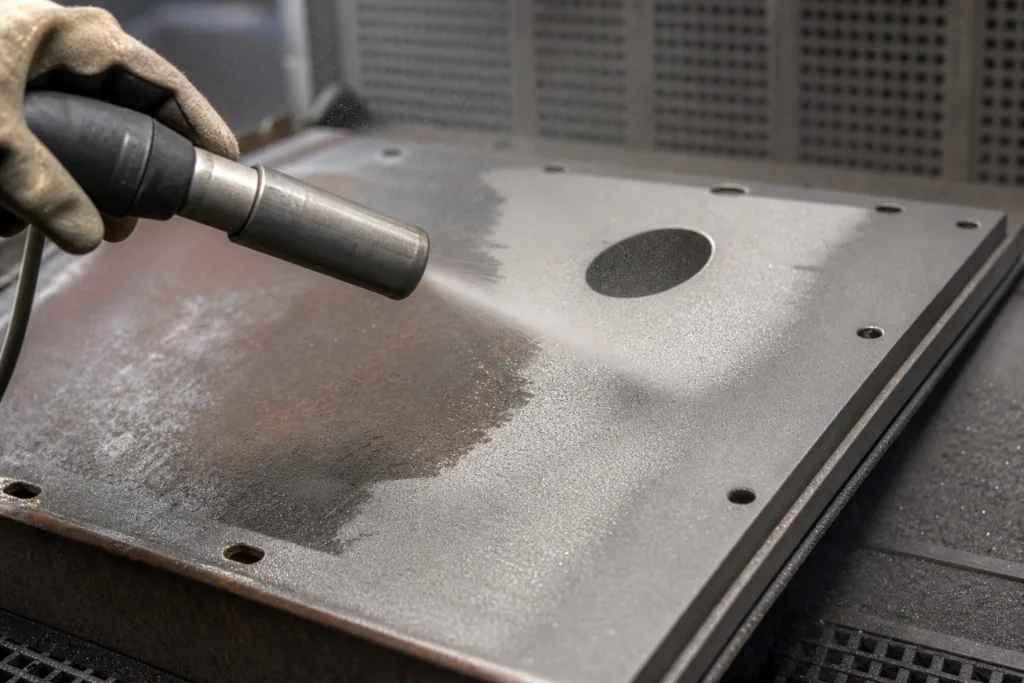
Surface preparation is often the difference between a durable structural bond and a premature failure. Oils, release agents, oxidation, dust, fingerprints, and even trace process residues can prevent full wetting or weaken the interfacial layer. For industrial epoxies, the surface is not a small detail; it is a major part of the bonding system.
In general, the sequence should be consistent: clean, abrade if needed, remove debris, and bond as soon as practical. For some substrates, a chemical pretreatment or primer may be useful. For others, abrasion alone may improve mechanical interlock. The correct method depends on material type, part condition, and production constraints. A useful reference for this discipline is surface preparation and pretreatment for epoxy bonding, which reinforces the importance of cleaning, abrasion, and contamination control before assembly.
From a production viewpoint, contamination control should be treated like a process parameter, not a maintenance task. A perfectly formulated epoxy can still fail if parts sit too long after pretreatment, if compressed air introduces oil, or if handling re-contaminates the substrate. This is especially important for high-value structural assemblies where failure is costly and traceability matters.
For galvanized steel, aluminum, painted metal, and some composites, surface condition can be particularly variable. In these cases, we usually recommend sample trials that compare real production parts rather than ideal lab coupons. That gives a more realistic picture of wetting, cure response, and long-term bond consistency.
Cure Profile and Processing Window: Pot Life, Open Time, Fixture Time, and Full Cure
The cure profile must fit the production line. Pot life determines how long a mixed epoxy remains usable after blending. Open time affects how long the adhesive can remain exposed and still bond effectively. Fixture time tells the operator when parts can be handled or moved. Full cure defines when the adhesive has reached its intended performance window. These times are not just convenience metrics; they shape throughput, labor planning, and quality.
A fast system can improve cycle time, but only if the line can place and clamp parts quickly enough. A slower system offers more working time, which is helpful for larger parts or manual assembly, but may delay downstream handling. Heat-cured systems can accelerate production and improve final properties, but they require thermal control and part compatibility. Moisture-cured or UV-cured systems are used in specific niches, but structural epoxy work is often chosen because it provides robust room-temperature or heat-assisted cure options depending on the formulation.
For procurement teams, the key question is whether the stated cure profile matches actual manufacturing reality. If operators need extra time for alignment, a short pot life may create waste. If a line relies on rapid turnover, a long fixture time may become the bottleneck. The right product is the one that works in the process window the factory can consistently support.
Environmental Durability: Heat, Moisture, Chemicals, Vibration, and Aging Resistance
Structural performance is not proven on day one; it is proven after the bond has lived through the real environment. Heat can soften some formulations or accelerate aging. Moisture can affect interfaces and promote degradation over time. Chemicals may swell, attack, or embrittle the adhesive depending on exposure. Vibration and repeated movement can grow microcracks if the system is too brittle.
That is why durability testing should include more than initial strength. Standard aging conditions help reveal whether the formulation and substrate pair remain stable after exposure. ISO guidance on laboratory ageing conditions for bonded-joint durability testing is useful when a project needs structured evaluation of heat, humidity, or environmental stress before field deployment. In practice, these tests help buyers understand retention, not just initial performance.
When durability is a concern, we often ask whether the epoxy should be optimized for stiffness, toughness, or environmental resistance first. A highly stiff adhesive may offer excellent load transfer, but a more balanced system may survive thermal cycling or vibration better. If the assembly sees both load and movement, durability often comes from controlled flexibility, not maximum hardness.
For buyers working on outdoor equipment, energy systems, transportation parts, or appliance assemblies, aging resistance is not optional. It should be part of the selection brief from the start.
Fatigue and vibration considerations
Repeated load can weaken a bond even when the initial strength is high. Fatigue resistance becomes especially important for mobile equipment, rotating assemblies, and parts subject to vibration. If the joint geometry concentrates stress at one edge, cracks may begin there and spread over time. A tougher adhesive and better joint design can reduce that risk. For buyers comparing materials, fatigue resistance testing methods are also a helpful framework for understanding how repeated loading should be evaluated, even when the final adhesive choice is epoxy rather than acrylic.
When High Strength Is Not Enough: Balancing Stiffness, Toughness, and Flexibility
It is easy to assume that the highest-strength epoxy is automatically the safest choice. In reality, structural reliability comes from balance. Too much stiffness can make a joint brittle under shock or thermal expansion. Too much flexibility can reduce load transfer or creep resistance. The ideal formulation depends on the service environment and the assembly design.
In manufacturing, we often describe this as a triangle of priorities: strength, toughness, and processability. Strength supports the load. Toughness protects against crack growth. Processability ensures the factory can apply the adhesive consistently. A successful product fits all three points well enough for the project.
If the assembly contains dissimilar materials or sees frequent temperature swings, a slightly more forgiving epoxy may outperform a very rigid one. If the joint is compact and load-dense, a higher modulus may be useful. If the bond line must absorb impact, a toughened system is often the safer route. These are not abstract differences; they directly affect warranty risk and production yield.
Validation Testing for Structural Bonds
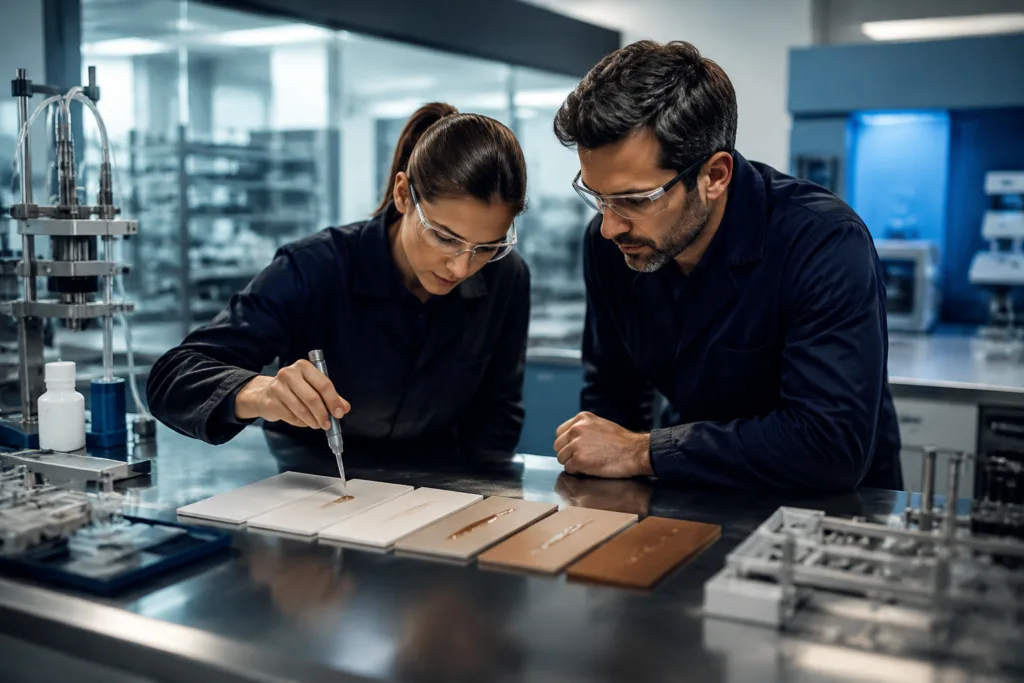
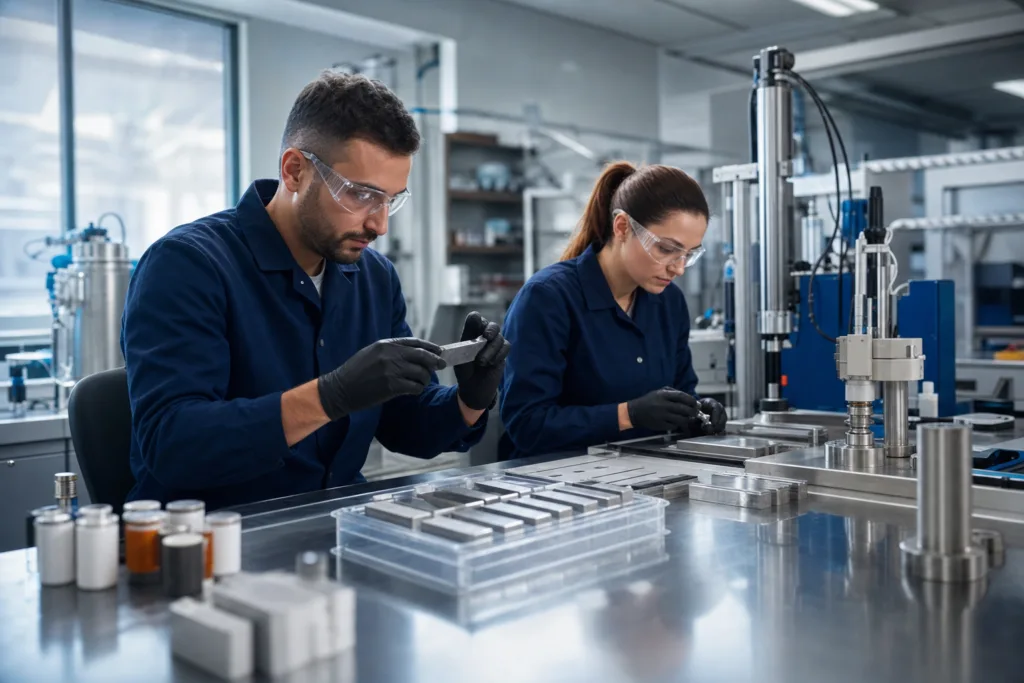
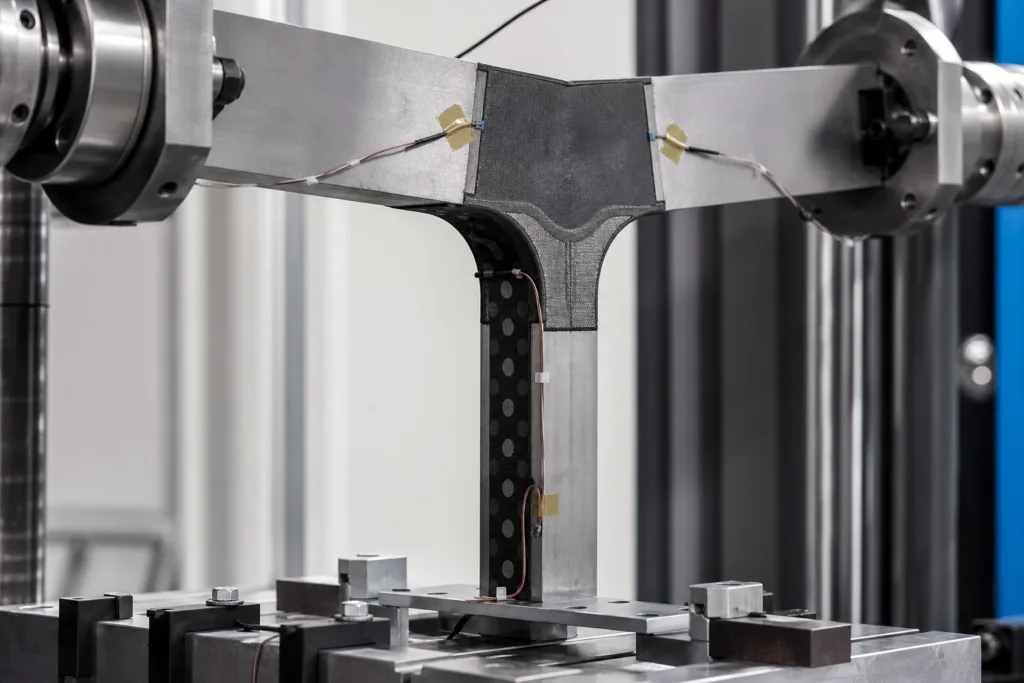
Validation should confirm both adhesive behavior and assembly behavior. That means testing the cured adhesive in a geometry that resembles the real application as closely as possible. Lab coupons are useful for screening, but they are not a substitute for representative parts, process conditions, and aging exposure.
Common validation methods include lap shear, peel, impact, thermal cycling, humidity exposure, and long-term aging. In many industrial programs, lap shear is the first screen because it is simple and comparative. However, a lap-shear result alone does not define design allowables for every joint. The result must be interpreted alongside geometry, substrate condition, cure profile, and service environment. ASTM’s ASTM D1002 lap shear test method for structural adhesive validation is a widely recognized reference for this type of comparative testing.
Validation should also include process checks. Did the adhesive wet the surface consistently? Was the mix ratio controlled? Did the cure complete across the full bond line? Was there voiding, edge lift, or squeeze-out that changed the real effective area? These questions matter because a structural bond is a system outcome, not a material-only outcome.
For buyers and engineers, a good qualification package usually includes:
- Tested substrate pair and surface preparation method
- Mix ratio, dispensing method, and cure schedule
- Bond-line thickness and joint geometry
- Initial and aged performance results
- Failure mode notes and visual inspection criteria
Common Bond Failure Modes and How to Prevent Them
Failure analysis is one of the fastest ways to improve bond reliability. If a joint fails adhesively, the problem may be surface preparation, contamination, or poor wetting. If it fails cohesively, the adhesive may be overloaded or undercured. If the substrate fails before the bond does, the adhesive may actually be performing well and the design may need adjustment.
Typical failure modes include:
- Adhesive failure: weak interface, often tied to poor cleaning or incompatible surface condition
- Cohesive failure: the adhesive tears within itself, often a sign of high stress or incomplete cure
- Substrate failure: the base material breaks before the bond, often showing strong adhesion
- Peel-edge failure: stress concentration at corners or thin edges
- Environmental degradation: strength loss after heat, humidity, or chemical exposure
The prevention strategy is straightforward but disciplined: improve surface prep, reduce peel stress, verify cure, and test under realistic conditions. If a design is repeatedly failing, changing the adhesive alone may not be enough. Sometimes the answer is a better joint shape, a different fixture approach, or a more appropriate adhesive modulus.
Custom Formulation Considerations for Industrial Epoxy Adhesives
Not every industrial line needs the same epoxy. Custom formulation becomes valuable when the substrate mix, cure schedule, or performance target falls outside standard product windows. Custom work may involve adjusting viscosity for dispensing, extending pot life for manual assembly, increasing toughness for vibration resistance, or improving thermal performance for electronics or power systems.
From our perspective, custom development is most efficient when the buyer can share real process data early: substrate types, surface prep method, line temperature, cure equipment, part size, gap range, target cycle time, and any known failure history. The more practical the input, the faster we can evaluate whether a standard epoxy can work or whether a modified formulation is justified.
For applications involving thermal management, buyers may want a product that bonds while also supporting heat transfer. In those cases, the formulation tradeoff between viscosity, filler loading, and thermal conductivity becomes important. A helpful overview of that balance is thermal epoxy performance tradeoffs, especially when structural bonding and heat flow must be considered together.
Custom packaging can also matter. Bulk drums, cartridges, dual syringes, pails, or private label formats each support different production environments. A good manufacturer should be able to align packaging with the dispensing equipment and the scale of the buyer’s operation.
Qualification Checklist for Engineers and Purchasing Teams
When teams compare suppliers, they should look beyond the product label and ask whether the manufacturer can support the full qualification path. That means material selection, sample evaluation, technical interpretation, and production consistency. A capable adhesive partner should help reduce sourcing risk rather than add to it.
Useful qualification questions include:
- Does the adhesive match the substrate pair and load case?
- Is the cure schedule compatible with the line?
- What is the real working time after mixing or dispensing?
- How sensitive is the product to surface preparation variation?
- What are the expected aging and environmental limits?
- Can the supplier adjust viscosity, hardness, or cure speed if needed?
- What QC checks are used from batch to batch?
In procurement reviews, consistency can matter as much as peak performance. If a product is excellent on one batch but variable on the next, production risk increases quickly. That is why we place so much emphasis on sample verification, documented process control, and communication during trial phases.
Packaging, Shelf Life, MOQ, and Supply Consistency Considerations for Bulk Buyers
Bulk buyers need more than technical performance. They also need reliable supply planning. Packaging should fit the dispensing method and plant workflow. Shelf life should be long enough for inventory turns. MOQ should align with trial-to-production scale-up. Most importantly, the supplier should be able to maintain batch consistency once the product is approved.
For epoxy systems, storage conditions can affect viscosity, reactivity, and ease of mixing over time. Buyers should confirm recommended storage temperature, container integrity, and any limits on freeze-thaw exposure or prolonged heat. If the product is sensitive to humidity or contamination, packaging design becomes part of the quality system.
We also advise teams to consider how the product will be received and used on site. Will it be mixed manually? Dispensed through equipment? Used in a controlled cell or a high-throughput line? Those factors influence not only packaging choice but also how the adhesive should be validated before purchase orders are locked in.
How to Reduce Risk Before Moving to Production
The safest path is to treat adhesive selection as an engineering process, not a catalog selection. Start with a clear description of the load case, substrates, and service environment. Then test a realistic sample, inspect the failure mode, and confirm process stability. If the adhesive passes those stages, move to a controlled pilot run before full-scale adoption.
That is the point where a manufacturer can provide real value: not only by supplying the adhesive, but by helping interpret sample behavior, adjust formulation details, and support scale-up. A high strength epoxy adhesive can be a strong structural solution, but only when the design, cure, and quality controls are aligned with the application.
Conclusion
Reliable structural bonding is the result of the right chemistry, the right joint design, and the right process discipline. A high strength epoxy adhesive can deliver excellent performance in industrial applications, but its success depends on surface preparation, cure control, environmental validation, and careful matching to the real load case. For engineers and buyers, the goal is not simply to choose the strongest product on paper; it is to choose the adhesive system that will remain stable in production and in service.
When those factors are considered together, epoxy bonding becomes more than an assembly method. It becomes a controllable manufacturing solution that can support load-bearing structures, mixed materials, and demanding operating conditions with confidence.
FAQs
What makes a high strength epoxy adhesive suitable for structural bonding?
A structural epoxy must do more than stick two parts together. It should transfer load efficiently, maintain cohesion under stress, and stay stable after curing. For industrial use, suitability also depends on joint design, surface preparation, curing conditions, and whether the adhesive can handle the service environment without brittle failure or premature aging.
How important is surface preparation before applying epoxy adhesive?
It is critical. Cleaning removes oils and residues, abrasion improves mechanical keying, and pretreatment or primers may improve adhesion on difficult substrates. If the surface is contaminated or poorly prepared, even a strong epoxy may fail early. In production, consistent surface preparation is one of the biggest factors affecting bond reliability.
Should I choose a fast-curing or slower-curing epoxy for production?
Choose the cure speed that fits the assembly process. Fast-curing systems improve throughput but reduce working time, while slower-curing systems give operators more time for alignment and complex part placement. The right choice depends on fixture availability, part size, line speed, and whether heat curing is practical in your facility.
Can epoxy adhesives be customized for different substrates or performance targets?
Yes. Epoxy formulations can be adjusted for viscosity, toughness, pot life, cure speed, gap filling, and environmental resistance. Customization is especially useful for mixed-material assemblies, unusual gaps, thermal management needs, or production lines with specific dispensing and cure requirements. Sample testing is usually the best way to confirm the fit.
What tests should we use to qualify a structural epoxy bond?
Start with tests that reflect the real load case and environment. Lap shear is useful for comparative screening, but it should be paired with peel, impact, thermal cycling, humidity aging, or chemical exposure when relevant. The most meaningful qualification uses representative parts, real surface preparation, and the intended cure schedule.
What should procurement teams check before approving a supplier?
Procurement teams should verify technical support, batch consistency, MOQ, shelf life, packaging format, and the supplier’s ability to support trials and scale-up. It also helps to confirm whether the manufacturer can adjust formula details if production needs change. A good supplier should reduce risk across testing, qualification, and bulk supply.