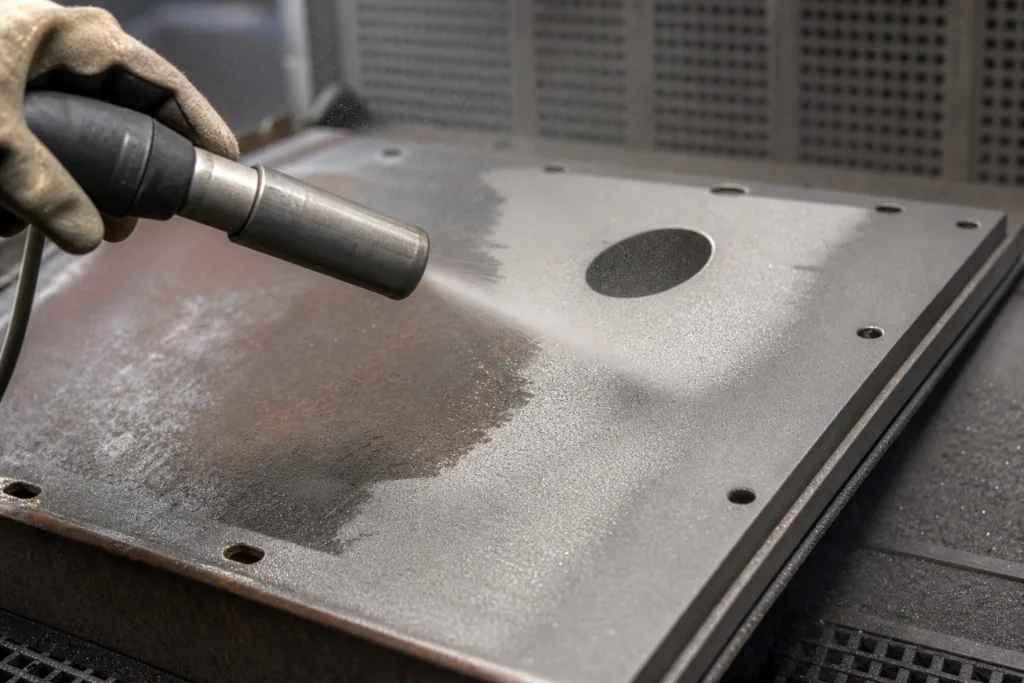
Wood bonding looks simple on the surface, but manufacturing changes the rules quickly. A product that works well in a workshop may not survive a production line that needs repeatable open time, controlled squeeze-out, faster throughput, and consistent bond performance across different wood species, composites, and coating systems. That is why wood adhesives are not just a single category of glue; they are a set of formulations chosen for process speed, durability, load requirements, and downstream finishing needs.
For projects that move beyond hand assembly, the choice often shifts toward industrial hot melt adhesive systems, especially when production speed and controlled application matter. If your team is comparing press cycles, automated dispensing, packaging formats, or bond consistency across large batches, our formulation and manufacturing support can help align adhesive behavior with the line rather than forcing the line to adapt to the adhesive.
Why wood bonding requirements change from workshops to industrial manufacturing lines
In a workshop, operators can compensate for slower cure, variable spread rate, or longer clamp time. In manufacturing, those adjustments cost time, create variation, and make quality harder to control. The adhesive must fit the substrate, the assembly method, and the production rhythm. That is the central difference between household-style wood glue and industrial wood adhesives.
From our manufacturing perspective, buyers usually start asking the right question only after the first trial run: not “Does it stick?” but “Does it still perform when the line runs at scale?” That includes whether the adhesive wets the surface evenly, holds the joint during transfer, cures within the target window, and delivers consistent strength after aging, humidity, or heat exposure.
What manufacturers are really buying
Industrial buyers are not simply purchasing adhesive chemistry. They are buying process reliability. A formulation that reduces rework, supports automation, and avoids downtime can be more valuable than one that is slightly cheaper on paper. That is especially true in furniture, cabinetry, flooring, doors, panels, and engineered wood products, where bond quality directly affects appearance, durability, and warranty risk.
For a broader overview of bonding categories and application contexts, our wood bonding adhesive options article can help frame the main product families before you narrow selection based on line speed, joint design, and service environment.
What are wood adhesives?
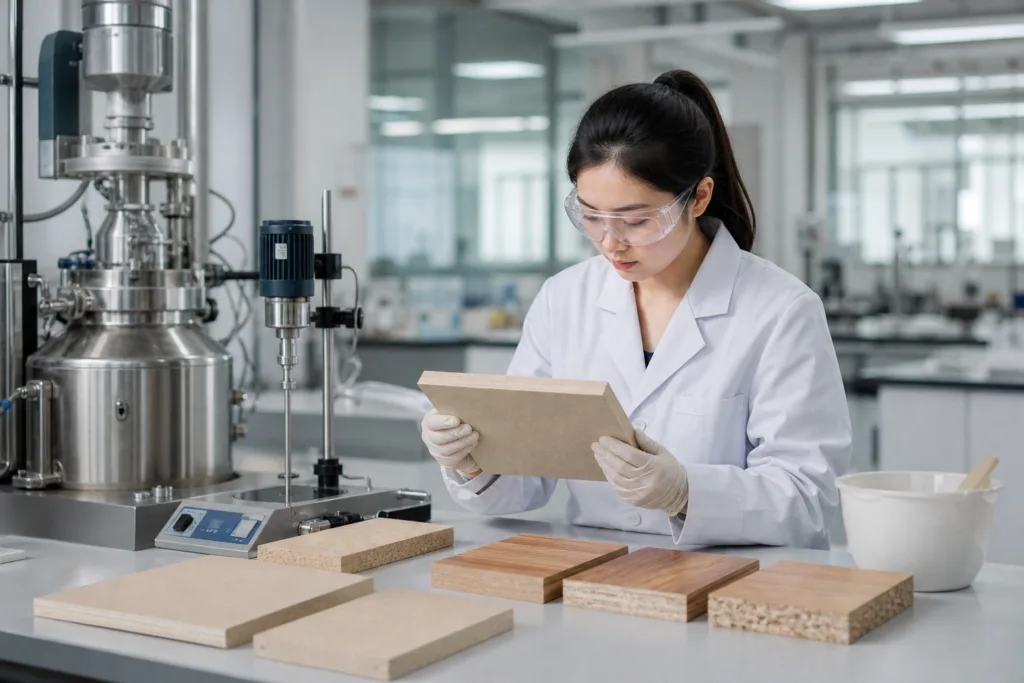
Wood adhesives are formulations designed to bond wood to wood, or wood to other materials such as MDF, particleboard, plywood, veneers, plastics, foams, metals, and coated substrates. In practice, the term covers several chemistries, each with different strengths and trade-offs. Some prioritize cost and ease of use, some prioritize water resistance or heat resistance, and some are made for fast automated processing.
For manufacturers, the important distinction is not only chemistry but application intent. A general-purpose wood glue may be enough for low-stress indoor assembly. An industrial system may need to survive press heat, humidity swings, transport vibration, or structural loading without changing bond quality from one shift to the next.
| Adhesive family | Typical manufacturing role | Main trade-off |
|---|---|---|
| PVA | General woodworking, furniture assembly, interior bonding | Good usability, but water and heat resistance vary by grade |
| EVA hot melt | Fast assembly, edge banding, high-throughput line use | Fast processing, but service temperature limits must be checked |
| Polyurethane | Flexible structural bonding, moisture-tolerant applications | Better durability, but process control is more important |
| Epoxy | High-strength or special-performance joints | Excellent performance potential, but less forgiving in process |
| Reactive systems | Specialty industrial assemblies and demanding substrates | More customization and validation needed |
The right family depends on whether the line values speed, structural reliability, flexibility, or environmental resistance most. In procurement discussions, we often find that the “best” adhesive is simply the one that matches the real stress profile of the product.
Household wood glue vs industrial wood adhesives: the core differences
Household wood glue is often optimized for ease of hand application. Industrial wood adhesives are engineered for repeatability under production constraints. That difference affects nearly every property buyers care about: open time, working window, press time, surface wetting, viscosity, and final bond durability.
Performance intent matters
Consumer-grade products usually assume intermittent use, manual clamping, and moderate environmental stress. Industrial products assume repetitive application, controlled spreading equipment, and higher sensitivity to line timing. The bond may also need to survive post-processing steps such as machining, sanding, coating, lamination, or thermal cycling.
One practical way to compare them is this: household glue is often judged by convenience, while industrial wood adhesives are judged by production fit. If the adhesive does not fit the cycle time or tooling, the chemistry alone will not save the process.
When plants need faster bond development or hot-applied application logic, equipment compatibility becomes as important as chemistry. Our hot melt processing equipment guide explains why delivery method, melt stability, and nozzle control influence line efficiency as much as raw adhesive formulation.
Speed and curing behavior: open time, clamp time, press time, and line throughput
Manufacturers often compare adhesives by cure speed, but that term hides several different timing windows. Open time is how long the adhesive remains workable after application. Clamp time is how long the joint must stay held before it can move. Press time applies to panel and lamination operations, where the assembly enters a press and must reach sufficient green strength or final bond under a controlled cycle.
For high-volume production, these timing windows determine line throughput. If open time is too short, operators lose assembly flexibility. If it is too long, parts may move before the bond develops enough strength. If press time is too long, throughput falls. If cure is too fast without adequate wetting, bond quality can suffer.
Matching cure behavior to the process
Some applications need quick handling strength. Others need extended assembly time for large panels, complex joints, or multi-part assemblies. This is where industrial formulation work becomes valuable. We can adjust viscosity, reactivity, or heat response to support a specific process window rather than forcing a one-size-fits-all adhesive into every operation.
For automated lines, the adhesive also has to dispense cleanly and predictably. In our experience, production teams benefit from a trial that measures not only bond failure but also operator handling, nozzle stability, and whether the adhesive remains consistent through a full shift. Our automated dispensing for production lines resource is useful when the application method is part of the throughput problem, not just the chemistry.
Water resistance and environmental durability
Water resistance is one of the most common reasons manufacturers move from basic wood glue to more industrial wood adhesives. Indoor furniture may only need resistance to humidity and occasional cleaning. Kitchens, bathrooms, utility spaces, and outdoor products face much harsher exposure. In some markets, wash-down environments or repeated moisture cycles create long-term bond challenges even when the original assembly looked strong.
Moisture changes wood itself, not just the adhesive. Wood swells, shrinks, and moves across grain directions, so the bond line must tolerate dimensional change while maintaining grip. A formulation that is technically strong in dry conditions may fail in service if it becomes brittle or softens in humidity.
For buyers comparing process-friendly systems with water-based technologies, it helps to understand the limitations of drying and re-emulsifying systems under harsher service conditions. Our water-based adhesive performance limits article highlights where water-based systems fit well and where environmental exposure starts to change the decision.
Exterior use demands more than initial strength
For exterior or semi-exterior applications, the bond must resist delamination, shear loss, and long-term degradation. In structural wood products, this means manufacturers should not rely only on immediate pull tests. Long-term performance under heat, moisture, and cyclic exposure matters more. Standards such as ASTM exterior exposure performance standard are useful because they focus attention on durability, not just initial tack or lab-day results.
That does not mean every product needs an exterior-rated system. It does mean the service environment should be defined before cost is optimized. A low-cost adhesive can become expensive if it drives warranty claims or field failures.
Heat resistance and aging performance
Heat resistance is another area where industrial buyers often outgrow standard wood glue. Furniture near windows, appliance panels, transport interiors, and products shipped through hot climates can all see elevated service temperatures. An adhesive that softens too much can creep under load, lose edge integrity, or allow joints to move.
Aging performance is equally important. Over time, adhesive films can become more brittle, more plasticized, or more prone to microcracking depending on chemistry and exposure. The important manufacturing question is not whether the adhesive passes one fresh-bond test, but whether it maintains service performance after heat aging, humidity exposure, or storage variation.
Where epoxy and polyurethane systems enter the conversation
For demanding loads, mixed-material assemblies, or higher environmental stress, epoxy and polyurethane families are often considered. They are not always necessary for ordinary woodworking, but they can be valuable when the product must carry more load or tolerate more aggressive service conditions. For a closer look at these families, our high-strength structural epoxy bonding article and polyurethane bonding systems guide are useful reference points for performance trade-offs.
In our formulation work, we usually recommend starting with the actual failure mode: heat softening, creep, brittle fracture, moisture swelling, or interface loss. Once the failure mode is clear, the chemistry choice becomes much easier.
Structural strength requirements in woodworking
Not every wood bond is structural, but many industrial assemblies are more loaded than they appear. Edge bonding, frame assembly, panel lamination, door construction, stair parts, and engineered wood products can all experience stress over time. Static load is only part of the picture. Vibration, impact, repeated handling, and seasonal movement also matter.
Joint design is part of adhesive selection
Adhesive strength should be matched to joint geometry. A well-designed lap joint behaves differently from a butt joint or a large panel lamination. Some systems need excellent shear strength. Others need flexibility to absorb movement. A very rigid adhesive may look strong in lab testing but crack under real-world movement if the substrate expands and contracts.
As a manufacturer, we often evaluate whether the adhesive should contribute stiffness, toughness, or stress relief. In load-bearing woodworking, this is one reason formulations are customized rather than simply purchased off the shelf. Our epoxy resin adhesive fundamentals resource is helpful when buyers need to understand how base chemistry affects structural behavior, adhesion, and cure characteristics.
Substrate compatibility: solid wood, MDF, particleboard, plywood, veneers, and coated surfaces
Wood is not one substrate. Solid hardwood, softwood, MDF, particleboard, plywood, veneer, and laminated panels all absorb adhesive differently. Porous, dense, oily, coated, or engineered surfaces each create different wetting and penetration behavior. Industrial wood adhesives must be chosen with those differences in mind.
Why porous and engineered boards behave differently
Solid wood may draw adhesive into the surface, which helps anchoring but can starve the joint if the spread rate is too low. MDF and particleboard can absorb adhesive aggressively, so viscosity and application volume must be controlled. Veneers require even spread without show-through or telegraphing. Coated or sealed surfaces may need surface preparation or a different chemistry entirely to achieve durable adhesion.
For product teams working across mixed substrates, sample evaluation should include the exact board, coating, and moisture condition that will be used in production. Small changes in density or surface finish can change bond outcomes more than teams expect.
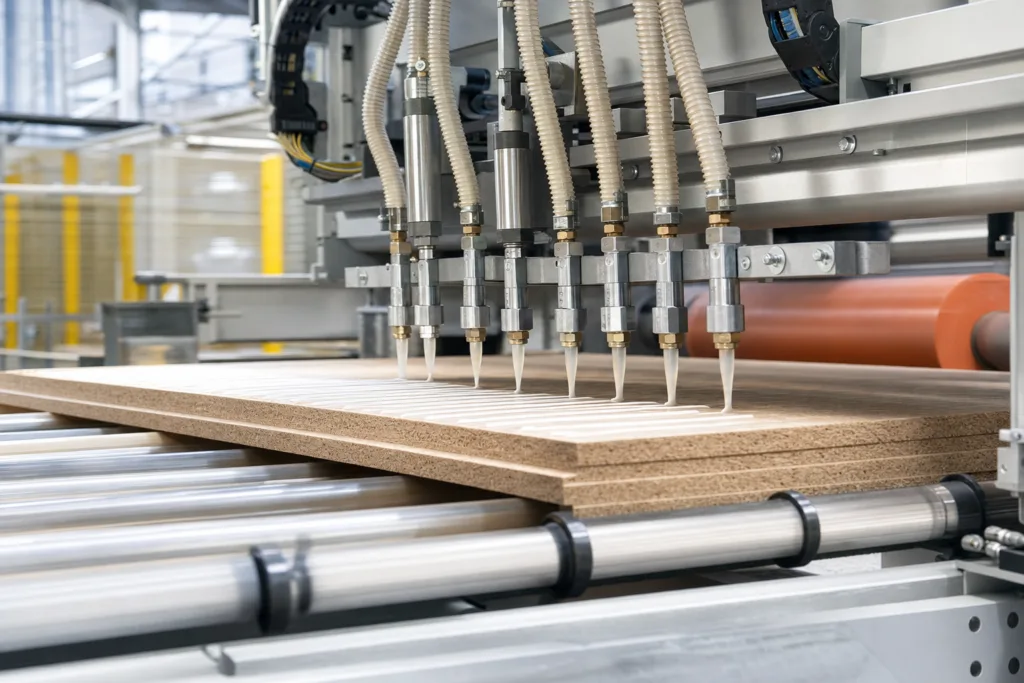
Production method differences: manual shop use vs automated lines
Manual application gives operators flexibility. Industrial production demands consistency. That changes the role of the adhesive from a simple bonding agent to a process component. If the adhesive is too thick, it may not spread well in a roller or spray system. If it is too thin, it may run, soak excessively, or produce weak coverage.
Manufacturers also need to consider whether the adhesive fits the existing equipment. A dispensing system, heated tank, roller coater, spray unit, or press line all have different handling requirements. The wrong viscosity or cure behavior can slow the entire operation.
From our perspective, a good production trial should include equipment compatibility, line speed, cleanup, and re-start behavior after pauses. A formulation that works for a bench sample but clogs after an idle period is not production-ready, even if the bond itself is strong.
When plant teams want to improve precision and repeatability, it is worth reviewing the role of choosing adhesive dispensing equipment alongside the adhesive itself. The best results usually come from matching chemistry and hardware together.
Viscosity, wetting, and squeeze-out control
Viscosity is one of the most practical parameters in wood adhesive selection. It affects wetting, penetration, bead stability, application speed, and squeeze-out. Too much squeeze-out can create cleanup problems, surface defects, or finishing delays. Too little wetting can cause poor coverage and weak bonds.
What production teams should watch during trials
- Does the adhesive wet the surface before the line moves to the next step?
- Does it stay in place on vertical or angled parts?
- Does it fill the joint without excessive soak-in?
- Does it leave a controllable squeeze-out profile?
- Does viscosity remain stable during a full production shift?
These questions matter because wood adhesives are often judged visually in the plant long before they are tested mechanically. A clean application that supports finishing can save time even when the formulation cost is slightly higher.
How to choose the right wood adhesive for different product categories
Different products create different adhesive priorities. Furniture may emphasize appearance and assembly speed. Cabinetry may emphasize clean edge lines and reliable joint strength. Flooring often demands dimensional stability and moisture control. Doors and panels may need heat resistance, press compatibility, and long-term rigidity.
| Product category | Primary concern | Adhesive selection focus |
|---|---|---|
| Furniture | Appearance and assembly efficiency | Open time, clean squeeze-out, and finish compatibility |
| Cabinetry | Repeatable joint quality | Wetting, clamp time, and panel compatibility |
| Flooring | Moisture and movement | Flexibility, durability, and environmental resistance |
| Doors | Structural integrity and heat aging | Strength, creep resistance, and cure profile |
| Panels | Production throughput | Press time, spread rate, and line stability |
There is no single chemistry that is automatically right for every category. Buyers should define their main failure risk first, then look for the adhesive family that minimizes that risk.
Testing and validation before bulk production
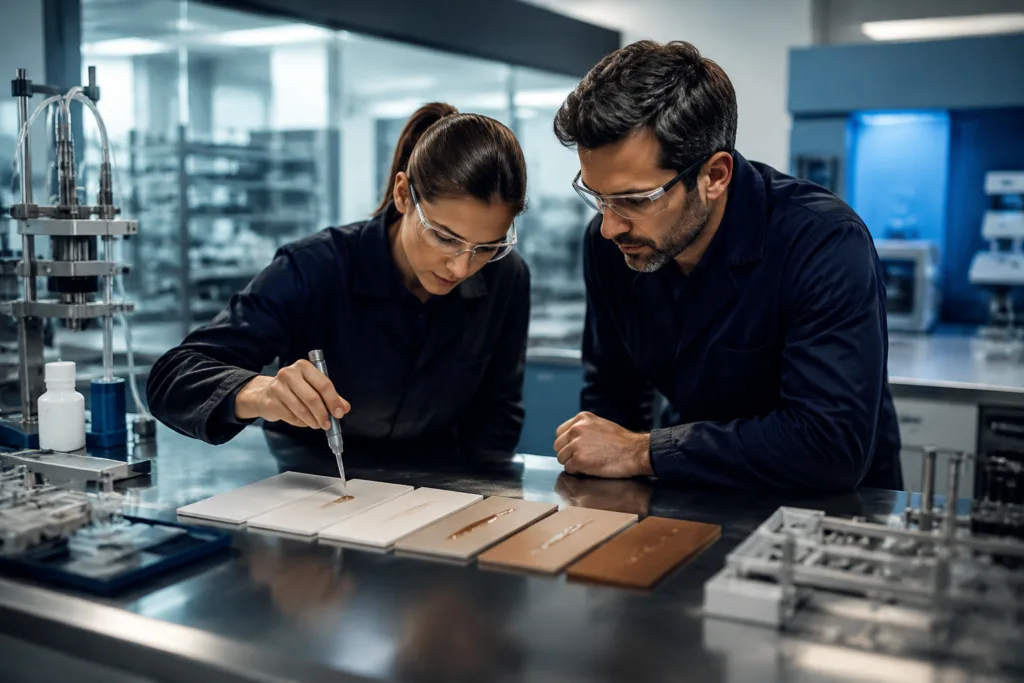
Testing should be practical, not just theoretical. A useful validation plan usually includes bond strength checks, moisture exposure, heat aging, workability on the production line, and any downstream process that might affect the joint. In some cases, the sample passes the lab test but fails in finishing, sanding, or pressing. That is a process issue, not just a chemistry issue.
What we recommend during sample evaluation
- Test the exact substrate combination, not only a clean laboratory coupon
- Run the adhesive at the intended temperature and humidity range
- Measure open time and handling strength under real line conditions
- Check whether the adhesive interferes with coating or finishing
- Repeat the test after storage, not only with fresh material
For structural projects, long-term exposure testing is especially important. Buyers who want to benchmark higher-load systems can also compare the requirements used in pot life control in 2-part systems, because working window control becomes critical when mixing, dispensing, and pressing must all stay aligned.
When standards-based structural service matters, buyers should make sure their qualification plan looks beyond immediate peel strength. Long-term resistance to moisture and heat is often what separates a good lab result from a reliable production solution.
Quality control and batch consistency in bulk wood adhesive supply
Once a formulation is approved, the next challenge is consistency. Batch variation can affect viscosity, cure rate, wetting, and final appearance. Even small differences can change how the adhesive behaves in high-speed production.
In bulk supply, quality control should focus on properties that affect the line directly: solids consistency, viscosity stability, cure response, packaging integrity, and storage behavior. Good QC is not just about passing a certificate; it is about reducing surprises in the plant.
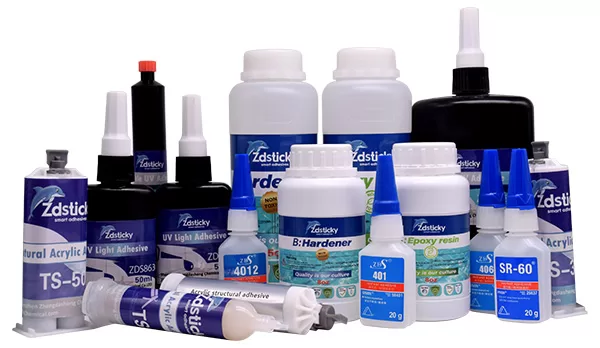
At ZDS Adhesive, we view production consistency as part of product performance. If a formula must be adjusted for seasonal temperature, substrate absorbency, or equipment type, those changes should be controlled and documented so the plant does not need to relearn the process every time a new batch arrives.
Customization options from an adhesive manufacturer
Customization is often the difference between an acceptable adhesive and a production-ready one. Manufacturers may ask for viscosity tuning, faster or slower cure, better wetting on difficult surfaces, improved moisture resistance, or packaging that suits their dispensing method. In some cases, private label buyers also need supply continuity, labeling support, and stable reordering terms.
What can be adjusted
- Viscosity for roller, spray, nozzle, or hand application
- Open time and cure profile for the target production speed
- Flexibility or hardness for movement-sensitive joints
- Moisture or heat resistance for the service environment
- Packaging format for easier storage, transport, and dispensing
When manufacturers compare sourcing partners, they should ask whether the supplier can make the adhesive fit the process or only sell a standard product. As a manufacturer, we build value by adapting the formula to the line, not by expecting the line to adapt to a fixed product.
MOQ, lead time, and storage considerations
Procurement teams often focus on price per kilogram, but the real sourcing cost includes minimum order quantity, lead time, storage limits, shelf life, and the risk of downtime if product consistency changes. A cheaper adhesive can become more expensive if it requires frequent reordering, special storage, or extra waste control.
Storage and shelf life are particularly important for wood adhesives that are sensitive to temperature, moisture, or settling. Packaging should protect the material, simplify handling, and fit the application flow. For example, a plant using an automated dispensing system may prioritize different packaging than a manual assembly line.
To keep procurement decisions grounded, buyers should evaluate whether the supply plan supports the production schedule. If the line needs stable inventory and repeatable performance, the supplier’s ability to deliver consistent batches matters as much as the formulation itself.
Common mistakes manufacturers make when choosing wood adhesives
One common mistake is choosing by familiar name rather than by service requirement. Another is testing only one substrate or one lab condition. A third is underestimating how much production method changes adhesive behavior. A glue that works in a hand-built sample may not behave the same under automated spreaders, heated presses, or long production runs.
Another frequent issue is ignoring the finishing process. Some adhesives interfere with sanding, staining, or coating if squeeze-out is not controlled. Others may create bond lines that are too visible or too stiff for the product design.
The safest approach is to define the failure risk first, then evaluate chemistry, process, and supply readiness together. That reduces sourcing risk and prevents late-stage redesigns.
Decision checklist: when standard wood glue is enough and when industrial wood adhesives are required
Standard wood glue can be enough when the product is indoor, lightly stressed, manually assembled, and not heavily exposed to heat or moisture. Industrial wood adhesives are usually the better choice when any of the following apply: high throughput, automated application, mixed substrates, structural loading, exterior or humid service, heat exposure, or strict batch consistency requirements.
If your team is still weighing the trade-off, this simple rule helps: choose the simplest adhesive that can reliably survive the real service environment and the real production process. If the glue only works under ideal test conditions, it is not a low-risk choice.
When the application demands higher durability or more exacting process control, it is worth reviewing formulation options with a manufacturer early. That is often where ZDS Adhesive can support sample development, technical evaluation, and bulk production planning without turning the project into a trial-and-error exercise.
Conclusion
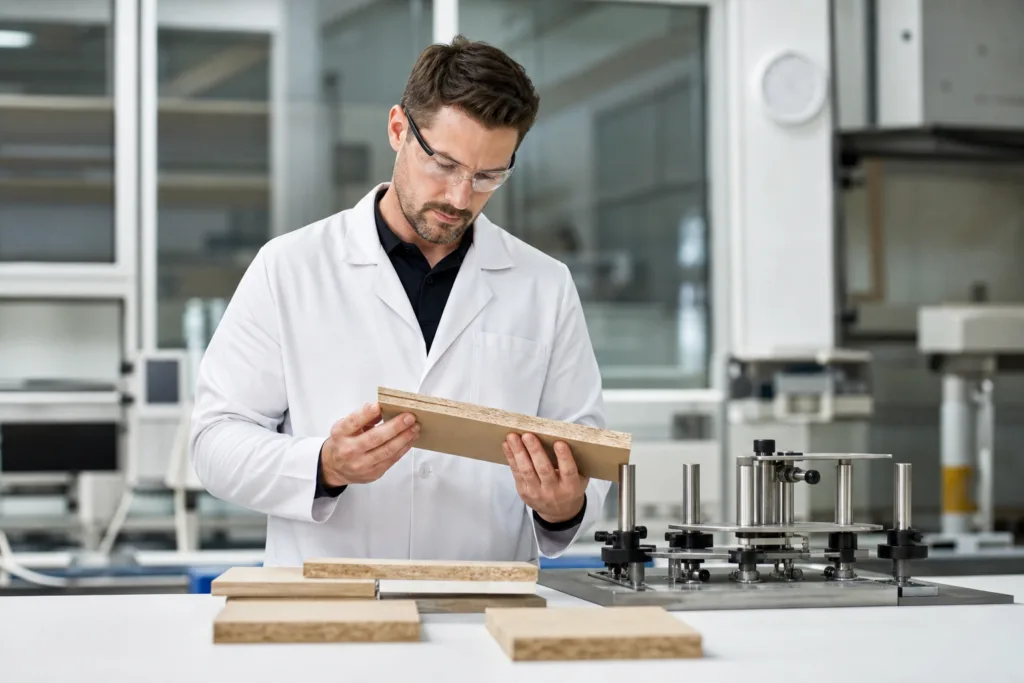
The gap between household wood glue and industrial wood adhesives is not just about strength. It is about production fit, environmental durability, substrate compatibility, and the ability to keep performance stable across batches and over time. Manufacturers that define their service conditions early can choose a system that improves throughput, reduces rework, and lowers sourcing risk.
For industrial projects, the best adhesive is the one that meets the joint requirement and supports the process without creating hidden costs. That is the standard we use when we evaluate wood adhesives for manufacturing customers.
FAQs
What is the main difference between wood glue and industrial wood adhesives?
Wood glue is often optimized for general woodworking and manual use, while industrial wood adhesives are designed for production speed, repeatability, and service durability. Industrial systems are more likely to account for equipment compatibility, batch consistency, and real manufacturing conditions.
How do I know if my application needs water-resistant wood adhesives?
If the product will face humidity, cleaning exposure, repeated moisture cycles, or outdoor use, water resistance should be part of the selection criteria. Even indoor products may need better moisture performance if they are used in kitchens, bathrooms, or wash-down areas.
Can industrial wood adhesives improve production speed?
Yes, if the formulation matches the line. Faster cure, suitable open time, and clean dispensing can reduce clamp time, press time, and cleanup. The adhesive must work with the process, not just bond the substrate.
What samples should we request before bulk production?
Ask for samples that match the exact substrate, application method, and service environment you plan to use. It is also wise to request different viscosities or cure profiles if your process may change during launch or scale-up.
How important is viscosity in wood adhesive selection?
Very important. Viscosity affects wetting, penetration, squeeze-out, and dispensing stability. If it is too high or too low for your equipment, the adhesive can create process defects even if the chemistry is otherwise suitable.
What should procurement teams check before placing a bulk order?
They should confirm MOQ, lead time, packaging format, shelf life, batch consistency, and whether the supplier can support formula adjustments if needed. The lowest unit cost is not always the lowest total cost when production risk is included.