Water-based adhesive systems have become a practical choice in many industrial bonding lines because they can combine workable open time, cleaner handling, and lower emissions with acceptable bond performance on the right substrates. For buyers and engineers, the real question is not whether a water based adhesive is “good” in general, but where it fits, where it struggles, and what process conditions must be controlled to avoid production losses.
For projects that involve plastics or mixed-material assemblies, it is often useful to start with a substrate-focused view, such as our plastic bonding selection guide. At ZDS Adhesive, we use that same decision logic in formulation work: we look at surface energy, porosity, line speed, cure window, and the required balance between flexibility, strength, and resistance to moisture or heat before recommending a waterborne system or suggesting a different chemistry.
What Water-Based Adhesives Are and Why They Are Used in Industry
A water-based adhesive uses water as the main carrier phase for polymers, resins, or dispersed particles. The bond develops mainly as water leaves the joint, allowing the adhesive components to come together and form a continuous film or network. In practical manufacturing terms, this means the adhesive is often easier to apply, can be cleaned up more easily before dry-down, and may help reduce solvent emissions compared with solvent-borne systems.
That does not make it automatically the right choice. In industrial procurement, the key is to separate convenience from performance. A water based adhesive can work extremely well when the process allows enough time for drying, when the substrate can absorb or release water in a controlled way, and when the service environment is not dominated by continuous wet exposure or high thermal stress. It can also be tuned for specific viscosities, coating methods, and flexibility levels, but the usable range still has boundaries.
Common Chemical Families
Most industrial waterborne adhesive systems fall into a few broad families. Acrylic dispersions are often chosen where clarity, aging stability, or balanced weathering performance matter. Latex systems can provide good tack and efficient film formation in packaging, paper, and certain assembly uses. Hybrid systems combine features from multiple resin types to improve balance across adhesion, flexibility, and processability.
When evaluating chemical family, buyers should ask a practical question: what property is being optimized, and what is being sacrificed? A more flexible formulation may reduce stress cracking but lower heat resistance. A faster-setting system may improve line speed but narrow the application window. A higher-solids system may reduce drying burden but require more careful coating control.
Why Low VOC Matters, and Why It Is Not the Only Selection Criterion
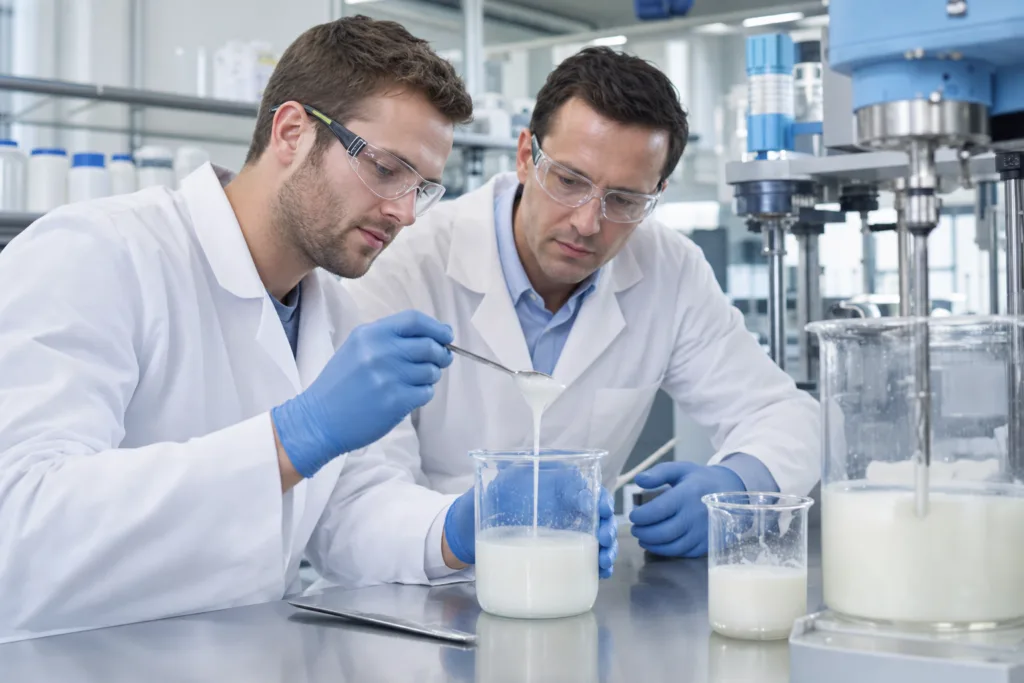
Low-VOC processing is one of the main reasons many factories evaluate waterborne adhesives. In regulated or shared-production environments, reducing solvent load can simplify air-quality management and improve workplace conditions. For context on emissions control and waterborne selection, EPA guidance on EPA guidance on low-VOC industrial adhesive selection and VOC reduction measures explains why waterborne systems are often used as part of VOC control strategies.
Still, VOC reduction alone should not determine the specification. A formulation that looks attractive on emissions may still fail if it cannot wet the substrate, if drying is too slow for the line, or if the joint is exposed to humidity, washdown, or temperature cycling. We recommend treating VOC as one filter in a larger selection process that also includes bond durability, dry time, application method, and final-use environment.
Where Water-Based Adhesives Work Best
Waterborne systems are often strongest in applications where the substrates are porous or moderately receptive and where assembly speed can be matched to drying behavior. Common examples include paper and packaging, labels, bookbinding, furniture edge work, textile and fabric assembly, foam lamination, and light-duty industrial assembly. In these uses, the adhesive’s film can form reliably because the assembly permits water removal and the substrates can support initial anchorage.
For many buyers, the appeal is not only environmental. Water-based formulations can support smoother coating, lower odor, and easier process cleaning. They also tend to be easier to integrate into lines that already use rollers, spray heads, slotters, or bead application, provided the system is tuned for the right viscosity and solids content.
Typical Strengths in Production
- Good performance on porous or semi-porous substrates
- Useful open time for assembly positioning
- Cleaner handling than many solvent systems
- Flexible formulation options for tack, viscosity, and film feel
- Potentially better fit for emissions-focused manufacturing policies
Where Water-Based Systems Are Often a Good Fit
| Application Area | Why It Fits | Process Note |
|---|---|---|
| Paper and packaging | Porous substrates support water removal and quick anchoring | Line speed must still match dry-down |
| Furniture and wood assembly | Wood can tolerate and assist moisture removal | Clamp pressure and coverage consistency matter |
| Labels and graphics | Coating control and clean appearance are important | Adhesion balance must match release and peel needs |
| Textiles and fabric lamination | Flexibility and large-area coverage can be useful | Watch for strike-through and hand feel |
| Light assembly | Moderate strength with manageable application options | Environmental exposure must remain controlled |
Where Water-Based Adhesives Struggle
The limitations of waterborne systems usually appear when the process or environment prevents reliable water removal or puts the bond into service conditions it cannot tolerate. Nonporous substrates are a common challenge because they do not absorb water, so the adhesive must dry only by surface evaporation or diffusion. Fast production lines can also be a problem if the adhesive has not reached sufficient green strength before the assembly moves on.
Moisture exposure is another major concern. If the interface retains water or later sees prolonged humidity, the bond can lose strength over time. NIST research on why moisture at the interface can weaken adhesive bonds over time is a useful reminder that water at the interface is not just a processing issue; it can be a durability issue. That is why we always ask whether the finished product will live in a dry warehouse, a humid appliance cabinet, a washdown area, or an outdoor environment before recommending a water-based system.
Common Limiting Conditions
- Nonporous surfaces such as many plastics, coated metals, or glass
- High humidity during application or curing
- Fast line speeds with little dwell time
- Assemblies exposed to standing water, wash cycles, or condensation
- Joints that need very high temperature resistance
Substrate Compatibility: What to Check Before You Specify a Water Based Adhesive
Substrate fit is the most important technical filter in many projects. Paper, cardboard, wood, and some foams can be receptive because they help absorb or release water. Fabric can also work well if strike-through, stiffness, and staining are controlled. By contrast, low-surface-energy plastics, heavily coated surfaces, oily metals, and polished nonporous materials typically need more careful surface preparation or a different adhesive family.
For mixed-material assemblies, the challenge becomes even more specific. A formulation that bonds paper to paper may not behave the same way on plastic-to-metal assemblies, especially if the metal is treated or coated. In these cases, our plastic-to-metal bonding strategies are relevant because the adhesive choice must account for both adhesion chemistry and differential movement between the substrates.
When galvanized steel enters the equation, surface chemistry becomes even more sensitive. Zinc surfaces can bring unique inhibition or wetting concerns, so a project involving coated metal should not be treated like plain steel. Buyers who are working with coated metal assemblies can use the principles in our bonding galvanized steel challenges guide to understand why surface condition and primer strategy may matter as much as the base adhesive type.
Compatibility Questions We Ask in Sampling
- Is the substrate porous, semi-porous, or nonporous?
- Is the surface clean, coated, primed, or contaminated with release agents?
- Will the bond be loaded in peel, shear, or vibration?
- Will the assembly see heat, humidity, or direct water exposure?
- Is the bond expected to remain flexible or rigid?
Drying vs. Curing: Why Water Removal Controls the Bond
One of the most common misunderstandings about a water based adhesive is that it “cures” in the same way as a reactive adhesive. In many cases, the primary mechanism is drying and film formation rather than a chemical cure that proceeds independently of solvent or water loss. That means the open time, dry time, and final bond formation are strongly linked to airflow, coating thickness, substrate porosity, temperature, and humidity.
Technical work on waterborne latex film formation shows that bond development depends on particle packing, deformation, and coalescence as water leaves the system. In other words, the adhesive must not only lose water; it must also form a coherent film at the interface. When drying is slowed by humid conditions or by a wet substrate, the film may form late or imperfectly, which affects both throughput and final strength.
That is why we advise production teams to map the complete process window: how long the adhesive can stay open, how much time is needed before handling, whether clamping or compression is required, and whether the line can tolerate a slower dry-down period without bottlenecks.
Factors That Change Drying Behavior
- Coat weight and bead size
- Ambient temperature and relative humidity
- Substrate porosity and thermal mass
- Air movement and dryer design
- Adhesive solids content and viscosity
Moisture Resistance, Heat Resistance, and Long-Term Durability Limits
Water-based adhesives can perform very well in indoor or controlled environments, but long-term durability depends on more than initial bond strength. If the bond sees moisture repeatedly, the interface can weaken. If the assembly experiences heat above the softening range of the dried film, creep or bond loss can occur. If the bonded parts expand and contract differently, a rigid film can crack, while an overly soft film can deform.
This is where selection becomes a trade-off exercise. A more flexible waterborne system may handle vibration and movement better, but it may not provide the same heat resistance as a more rigid chemistry. A formulation that dries quickly may help production, but if it forms a brittle film, edge lift or cracking may appear later. Buyers should ask not only “does it bond?” but also “what happens after months of humidity, temperature cycling, and mechanical stress?”
Failure Modes to Watch
- Re-emulsification after water exposure
- Edge lift on wide-area laminations
- Weak wet-out on low-energy surfaces
- Brittleness after full dry-down
- Bond creep under heat or sustained load
Water Based Acrylic Adhesive vs. Other Water-Based Systems
Among waterborne chemistries, acrylic formulations are often selected when buyers want a balanced combination of adhesion, aging stability, and process flexibility. A water based acrylic adhesive may be a strong fit for labels, coatings, certain laminations, and assemblies where clarity or stable long-term performance is valued. Compared with many latex-based systems, acrylics can offer a different balance of tack, weathering behavior, and resistance profile.
That said, acrylic is not universally superior. Latex systems may provide a better feel or faster film build in some packaging or paper uses. Hybrids may outperform simple acrylics when flexibility, wetting, and cost-performance all have to be balanced. The right choice depends on substrate pair, load type, drying conditions, and the acceptable cost per bond.
How to Compare Waterborne Chemistry Choices
| System Type | Typical Advantage | Typical Trade-Off |
|---|---|---|
| Acrylic | Balanced aging and good formulation flexibility | May need careful tuning for tack and dry speed |
| Latex | Good film formation and practical handling | Can be moisture-sensitive if the interface remains wet |
| Hybrid | Useful balance of properties | More project-specific development may be needed |
Viscosity, Coating Method, and Equipment Considerations
Choosing the right chemistry is only half of the job. The adhesive must also be compatible with the application method. Roll coating, spray application, bead dispensing, curtain coating, and slot application all place different demands on viscosity, shear behavior, and leveling. A formulation that performs well in a lab cup can still fail in production if it bridges nozzles, runs too much, or dries too slowly on the line.
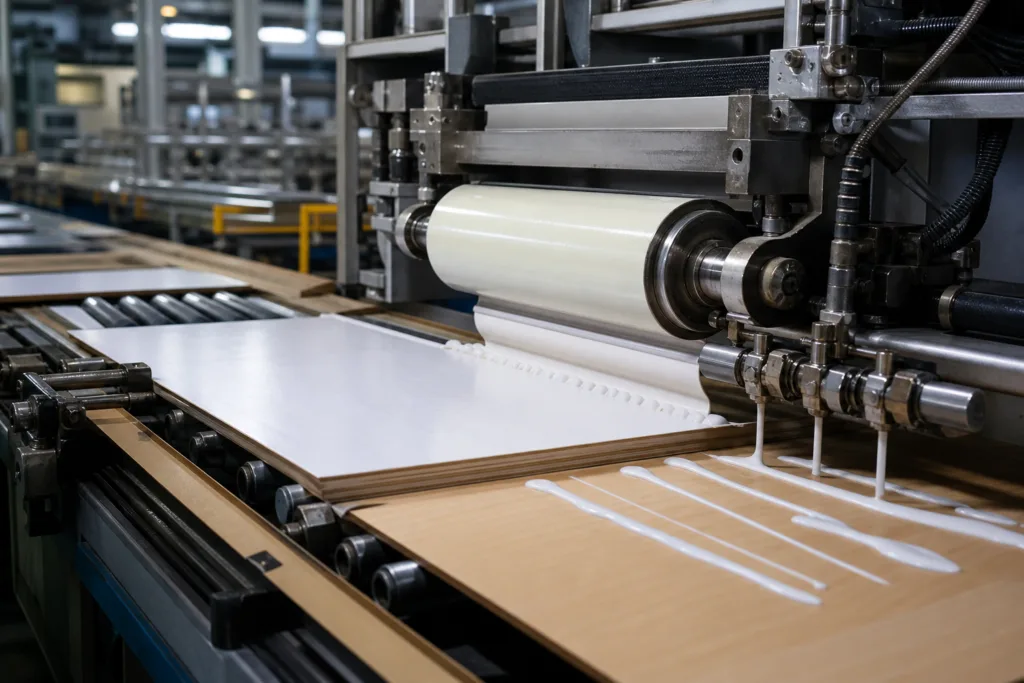
From a manufacturing perspective, waterborne systems often require tight control over solids content and rheology. If the viscosity is too low, coverage and bond line control may suffer. If it is too high, equipment may struggle to pump or atomize it. For buyers comparing processing choices, our adhesive vs. sealant decision rules can help clarify whether the product should behave like a bonding adhesive, a gap-filling material, or a flexible sealing system.
When the assembly needs surface contact and uniform spread, waterborne adhesives can be efficient. When the joint has a larger gap, a moving interface, or a weather-exposed seam, a sealant or a more elastic system may be a better fit than a conventional adhesive film.
Production Speed and Process Window
Water-based systems affect line efficiency in a very direct way. Because the bond depends on water removal, any increase in coat weight, humidity, or substrate moisture can extend the required wait time before handling. That can reduce throughput if the production line was originally designed for a faster-drying system such as hot melt or a reactive adhesive.
To manage this, production teams should define a realistic process window. How long can parts wait before assembly? Is forced air needed? Can the line tolerate a longer clamp time? Do parts need to be staged before final packaging? These are not small details; they determine whether the adhesive is operationally viable.
In our own project reviews, we often see that a technically adequate formulation is rejected because the production flow cannot accommodate the dry-down time. That is why a good specification includes not only adhesion requirements, but also takt time, curing environment, and handling constraints.
Common Failure Modes and How to Prevent Them
Most failures with waterborne adhesives are process-related rather than chemistry-related. Poor wetting can result from contamination, low surface energy, or incorrect viscosity. Slow drying often comes from heavy coat weight, trapped moisture, or poor airflow. Edge lift can appear when the dried film does not maintain enough flexibility or when the substrate is moving after bonding. Re-emulsification can happen when the film is exposed to moisture too early or too often.
One important lesson for procurement teams is that a “good sample” is not the same as a validated production solution. A bench sample may look strong after a few hours, but the real test is whether the same bond survives line conditions, batch variation, and environmental aging.
How We Reduce Risk in Sampling
- Check the substrate condition before testing
- Use the intended coat weight and application method
- Replicate the real dry time and clamp time
- Test after humidity or temperature exposure when relevant
- Inspect edge condition, not just immediate bond strength
How to Select the Right Water Based Adhesive for Your Application
A selection process should begin with the end use, not the chemistry name. Start by defining the substrate pair, the required bond type, the stress mode, the environment, and the production process. Then work backward into viscosity, solids content, flexibility, and dry speed. This order helps prevent over-specifying a formulation that is technically impressive but operationally unsuitable.
At ZDS Adhesive, we typically treat the specification as a system problem. The adhesive must fit the substrate, the equipment, the line speed, and the end-use environment at the same time. If any one of those is ignored, the project is likely to generate avoidable failures.
Selection Criteria We Recommend
| Criterion | What to Decide | Why It Matters |
|---|---|---|
| Substrate type | Porous, semi-porous, or nonporous | Controls wetting and drying behavior |
| Service environment | Dry, humid, wet, hot, or cyclic | Determines durability limits |
| Application method | Roll, spray, bead, or coat | Determines usable viscosity range |
| Required open time | Short or extended working window | Affects line speed and handling |
| Final mechanical need | Flexible, rigid, or impact tolerant | Influences resin choice and film design |
What to Ask a Manufacturer Before You Commit
Buyers should not only ask for a product grade; they should ask for manufacturing and support information. Important questions include whether the adhesive can be customized for viscosity, whether the package size matches the line, what the typical shelf life is under recommended storage, whether the system can be made more flexible or faster drying, and what quality checks are used from batch to batch.
We also encourage procurement teams to ask about MOQ, lead time, and sample support early. If a supplier cannot clearly explain how the product will be tested, stored, and scaled, that is a risk signal. For projects where formulation development is likely, communication quality matters just as much as chemistry choice.
Questions Worth Asking in Supplier Evaluation
- Can the formula be adjusted for coat weight or sprayability?
- What substrate pairs have been evaluated already?
- How is batch consistency checked before shipment?
- What packaging formats are available for production use?
- Can we test a small sample before committing to bulk supply?
Sample Testing and Validation Checklist
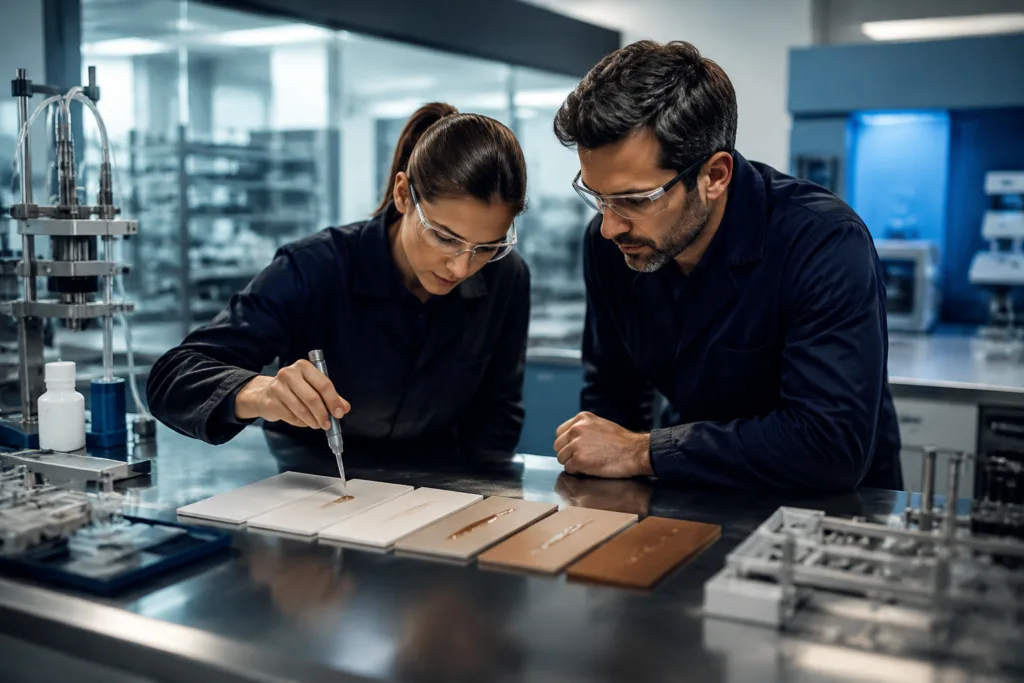
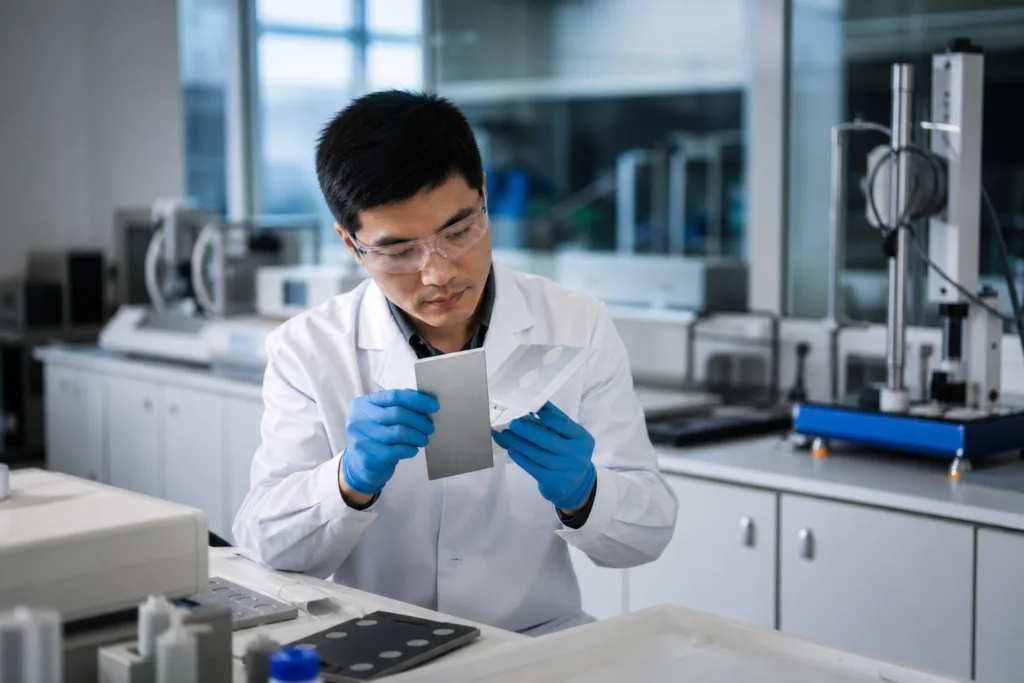
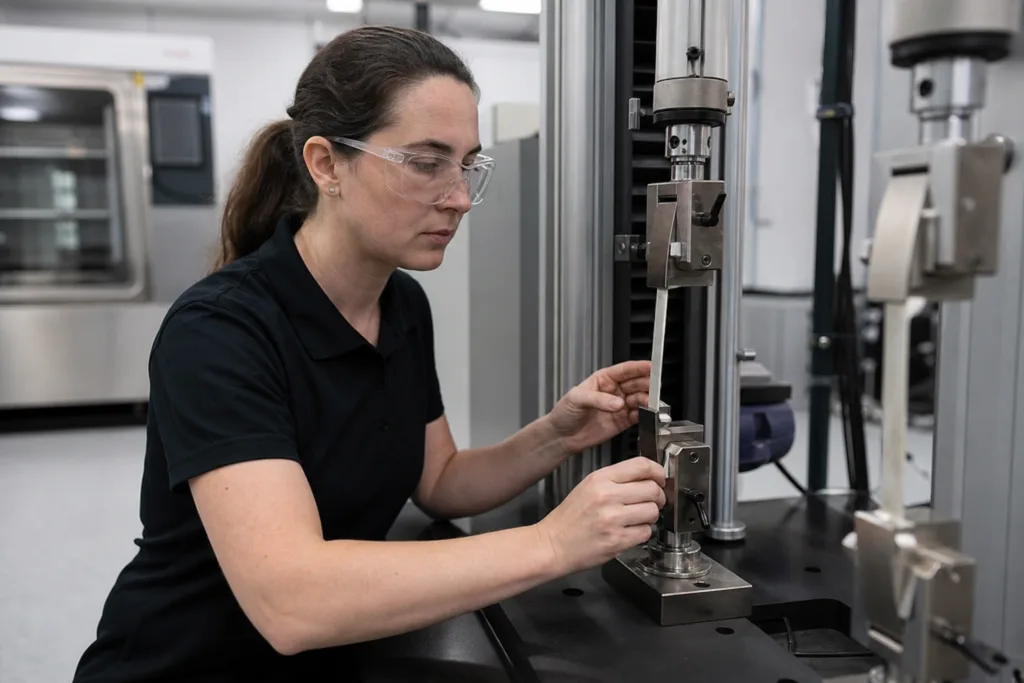
Before full adoption, test the adhesive under real or near-real production conditions. Use the same substrate preparation, the same coating amount, the same press or clamp pressure, and the same environmental conditions as the intended line. If the bond will face humidity, heat, or flexing, simulate those conditions during evaluation rather than assuming a room-temperature pull test is enough.
We recommend checking the bond immediately after drying, after 24 hours, and again after exposure to the expected environment. This helps reveal whether the initial bond is stable or whether the adhesive is vulnerable to delayed failure. If the project includes coated metal, plastic, or difficult surfaces, compare it against alternate chemistry options before locking in production.
Validation Checklist
- Substrate cleanliness and surface treatment
- Coat weight and spread uniformity
- Drying or curing time under actual conditions
- Initial handling strength
- Environmental resistance after aging
- Repeatability across multiple test batches
When to Choose a Water-Based System vs. Other Adhesive Types
Choose a water-based system when your substrates are compatible, the line can accommodate drying time, and the service environment is moderate. Choose solvent-based systems when difficult wetting, faster set, or certain nonporous combinations make waterborne performance too risky. Choose hot melt when immediate handling and speed matter more than long open time. Choose reactive adhesives when you need stronger chemical cure behavior, higher final performance, or better resistance in demanding service conditions.
In some projects, the right answer is not a single adhesive type but a system change. For example, a project may start as a waterborne lamination and later require a different chemistry for edge sealing or structural reinforcement. Understanding the boundary between adhesive categories helps prevent mismatched specifications and production surprises. For buyers comparing categories, our contact cement application limits article is useful because it highlights where fast tack and broad surface bonding can help, and where process or environmental limitations begin to matter.
Conclusion
A water based adhesive can be an excellent industrial choice, but only when the substrate, environment, and production process all support its drying-driven bond formation. It is often a strong fit for paper, wood, labels, fabrics, and light assembly, especially when emissions reduction and cleaner handling matter. It is less suitable when the joint is nonporous, when the line is too fast for dry-down, or when the service environment involves prolonged moisture or heat.
For technical buyers, the best decision comes from treating the adhesive as part of a process system. Evaluate surface condition, coating method, cure or dry window, durability requirements, and supply needs together. That approach leads to fewer failures, better throughput, and a more realistic cost-performance result.
FAQs
Is water based adhesive strong enough for industrial use?
Yes, in the right applications. Water-based adhesives can provide reliable industrial performance on paper, wood, fabric, some foams, and certain light assembly tasks. Their strength depends heavily on substrate compatibility, drying conditions, and service environment, so they should be validated under real production and aging conditions before full-scale use.
Can water based adhesive bond plastic?
Sometimes, but plastic bonding is one of the more challenging use cases. Success depends on the plastic type, surface energy, additives, and whether the surface is treated or primed. Low-energy plastics usually require careful testing, and in some cases a different adhesive family is a better fit.
Why does a water based adhesive dry slowly on my line?
Slow drying is usually caused by a combination of heavy coat weight, high humidity, limited airflow, low substrate porosity, or low temperature. Because the bond forms as water leaves the system, any condition that slows evaporation also slows handling strength and can reduce throughput.
Will a water based adhesive resist moisture outdoors?
In many cases, not as well as more moisture-resistant systems. Waterborne adhesives can perform well indoors or in controlled conditions, but repeated wet exposure, standing water, or persistent humidity can weaken the interface over time. Outdoor use requires careful evaluation of the exact product and service conditions.
What should I ask for before placing a bulk order?
Ask for substrate compatibility data, viscosity range, application method guidance, dry or cure profile, packaging options, MOQ, storage conditions, shelf life, and batch QC details. A good supplier should also be able to support sample testing and explain how the formula can be adjusted if your process needs change.
When should I choose something other than a water based adhesive?
Choose another adhesive type when you need very fast handling, strong performance on nonporous substrates, higher heat resistance, or better tolerance to wet environments. Hot melt, reactive, solvent-based, or specialized sealant systems may be better depending on the mechanical load, production speed, and exposure conditions.