How to Select an Electronic Potting Adhesive
Choose an electronic potting adhesive by first defining the component geometry, substrate pair, required encapsulation coverage, fill gap, operating loads, electrical and thermal requirements, and production process. Then compare candidate formulations using the current technical data sheet (TDS) and safety data sheet (SDS), supported by supplier evidence and representative assembly trials. Review cure mechanism, dispensing behavior, dielectric performance, thermal properties, flexibility, chemical exposure, inspection, rework constraints, packaging, and supply fit. For a related technical consideration, electronics adhesives for circuit boards.
No chemistry is universally best. Epoxy, silicone, polyurethane, and UV-curable materials should be shortlisted only when their formulation-specific data and process trials match the assembly. The wider category of electronics adhesives for circuit boards may include materials intended for bonding, coating, sealing, or potting, so the product’s stated use and application instructions must be checked before sampling.
Define the Encapsulation Function Before Comparing Materials
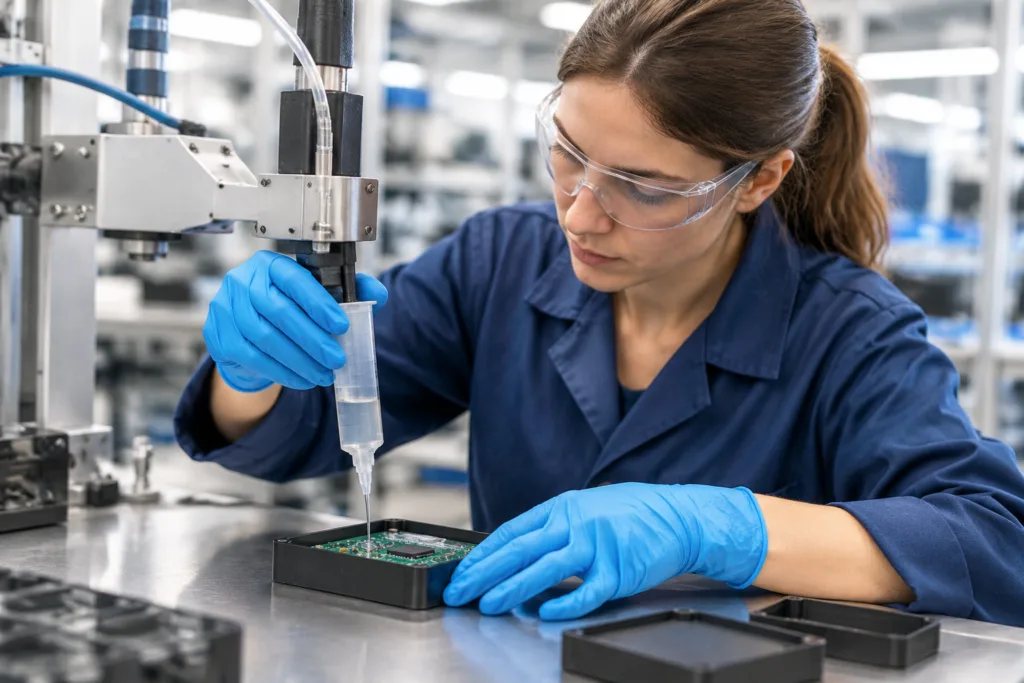
In practical manufacturing terms, potting is the controlled filling of a component, cavity, or enclosure with a material that cures around or over the intended assembly. An electronic potting adhesive may also provide adhesion to selected surfaces, while a potting compound can be used primarily as an encapsulating fill. These terms overlap in supplier literature; the name alone does not establish dielectric, thermal, mechanical, or environmental performance.
First decide what the material must do:
- Pot or encapsulate: fill the defined volume and cover the required components without blocking connectors, sensors, optical paths, vents, or service interfaces.
- Bond selected parts: hold specific interfaces where the adhesive layer, surface preparation, and load path can be controlled.
- Seal an enclosure: close a joint or opening while accommodating the enclosure design and its expected movement.
- Protect a surface: apply a thin coating rather than filling a cavity. Conformal coating and potting are different process choices and should not be treated as interchangeable.
This distinction affects material volume, flow, cure access, inspection, repair, and the consequences of voids. A material suitable for a thin bead may not wet or cure acceptably through a deeper fill. A product that adheres to one substrate may not adhere to the complete assembly, particularly where PCB finishes, metals, plastics, ceramics, coatings, and mold-release contamination differ.
Start With the Assembly and Substrate Pair
Create a requirements baseline from the actual assembly drawing and process route before requesting samples. Record the component materials, PCB finish, enclosure material, surface condition, clearances, sensitive parts, heat paths, vents, trapped-air locations, fill height, and areas that must remain unpotted. Include cleaning chemistry, drying controls, masking, damming, and any limits imposed by connectors, switches, sensors, optics, or moving parts.
Adhesion must be verified for the complete substrate pair and not inferred from the chemistry family. Ask the supplier for relevant substrate compatibility or adhesion evidence, then run controlled trials using representative materials and finishes. Compare wetting, coverage, cure state, dimensional fit, and functional behavior. Where the assembly includes dissimilar materials, assess whether the cured material’s stiffness or shrinkage could transfer stress during cure or temperature changes. Do not approve a candidate from a coupon result alone when the production geometry changes flow, heat removal, cure access, or restraint.
Define acceptance criteria before trials. These may cover complete coverage, allowable overflow, absence of unacceptable bubbles or voids, confirmed cure, connector operation, sensor response, insulation behavior, and dimensional conformity. The criteria must reflect the assembly’s function and service profile rather than a generic expectation that a filled cavity is acceptable.
Screen Epoxy, Silicone, Polyurethane, and UV-Curable Options
Use chemistry families to organize the first screen, not to assign fixed properties. The selection depends on the specific formulation, geometry, cure route, substrate pair, and environment.
| Selection criterion | Epoxy | Silicone | Polyurethane | UV-curable | Evidence to verify |
|---|---|---|---|---|---|
| Mechanical fit | May suit assemblies needing a comparatively rigid cured system; confirm stress and adhesion behavior. | May suit applications where compliance is being evaluated; confirm encapsulation and substrate fit. | May suit applications requiring a formulation-specific balance of compliance and support. | May suit accessible areas when the cured behavior fits the assembly. | Current product data, cured geometry, substrate trials, and assembly testing. |
| Cure access | Confirm the specified cure route and access through the full fill. | Confirm the required exposure and conditions for the actual geometry. | Confirm the product-specific cure route, mixing requirements, and access. | Check light access, shadowed regions, and any stated secondary cure. | Current TDS instructions and cure confirmation from representative depth trials. |
| Flow and fill | Assess whether the formulation reaches the required spaces without unacceptable voids. | Assess flow, wetting, and retention in the intended geometry. | Assess dispense behavior, wetting, and air entrapment in production-relevant cavities. | Assess flow before exposure and coverage of regions that may block light. | Published viscosity or rheology data where available, dispense trials, venting plan, and inspection. |
| Electrical and thermal needs | Confirm dielectric and thermal data for the formulation and assembly. | Confirm dielectric and thermal behavior under the defined service conditions. | Confirm formulation-specific electrical and thermal evidence. | Confirm electrical and thermal suitability after the stated cure process. | Test methods, specimen conditions, assembly-level analysis, and functional validation. |
| Service and rework | Evaluate exposure resistance and removal implications for the actual assembly. | Evaluate exposure, movement, and access requirements for the actual assembly. | Evaluate chemical and environmental exposure and any supplier-supported removal method. | Evaluate cured-material access and the effect of exposure on the assembly. | Service definition, supplier guidance, substrate-specific trials, and change controls. |
Epoxy may be considered where the assembly requires a comparatively rigid cured system, but rigidity, adhesion, thermal behavior, cure schedule, and removal implications must be confirmed for the product. Silicone may be screened where compliance or stress-sensitive component protection is important; this does not establish suitability for every substrate, exposure, or encapsulation depth. Polyurethane may be relevant where the process and required cured behavior fit the formulation; a flexible polyurethane option should be assessed through its own TDS, SDS, and trials, as outlined when evaluating flexible polyurethane potting compounds. UV-curable materials require particular attention to light access, shadowed regions, component geometry, and any stated secondary cure or handling conditions.
Thermal requirements also need separation from general potting selection. If the assembly must transfer heat through the encapsulant, define the heat source, path, interfaces, allowable temperature, and measurement method. Use product-specific thermal data and assembly-level analysis; the selection process for thermally conductive adhesive selection should not be substituted for evidence on an unspecified potting formulation.
Evaluate Cure Mechanism and Process Window
Classify each candidate by its actual cure mechanism and production requirements. 1-component, 2-component, moisture-, heat-, light-, and other cure routes impose different controls for mixing, dispensing, working time, exposure, temperature, humidity, and post-cure handling. Do not transfer a cure time, temperature, mix ratio, viscosity, or thickness limit from 1 product to another.
For a 2-component material, confirm the supplier’s specified ratio, mixing method, equipment compatibility, and cure verification approach. For moisture- or light-dependent systems, check whether the deepest or most shadowed region receives the required exposure. For heat-dependent systems, confirm that the component, enclosure, and process can tolerate the specified conditions. Pilot trials should measure dispense repeatability, wetting, fill progression, bubbles or voids, cure state, overflow, and functional fit before the candidate advances to qualification.
Control Dispensing, Flow, Bubbles, and Voids
After the initial chemistry screen, translate the assembly drawing into a dispensing plan. Record the required fill volume, cavity depth, bond-line or gap dimensions, access points, vent locations, damming features, and areas that must remain clear. A candidate may wet the visible surface yet fail to reach a narrow channel or leave trapped air beneath a component. Flow must therefore be assessed in the production-relevant geometry, not only in an open cup or shallow coupon.
Viscosity, rheology, working time, and dispense behavior are product-specific. Review published TDS data where available and confirm equipment compatibility with the supplier. Pilot work should control material condition, dispense pressure, nozzle, shot size, mixing or agitation, travel path, and time between dispensing and cure. Use staged filling, venting, vacuum assistance, or other process controls only when supported by the product instructions and equipment assessment.
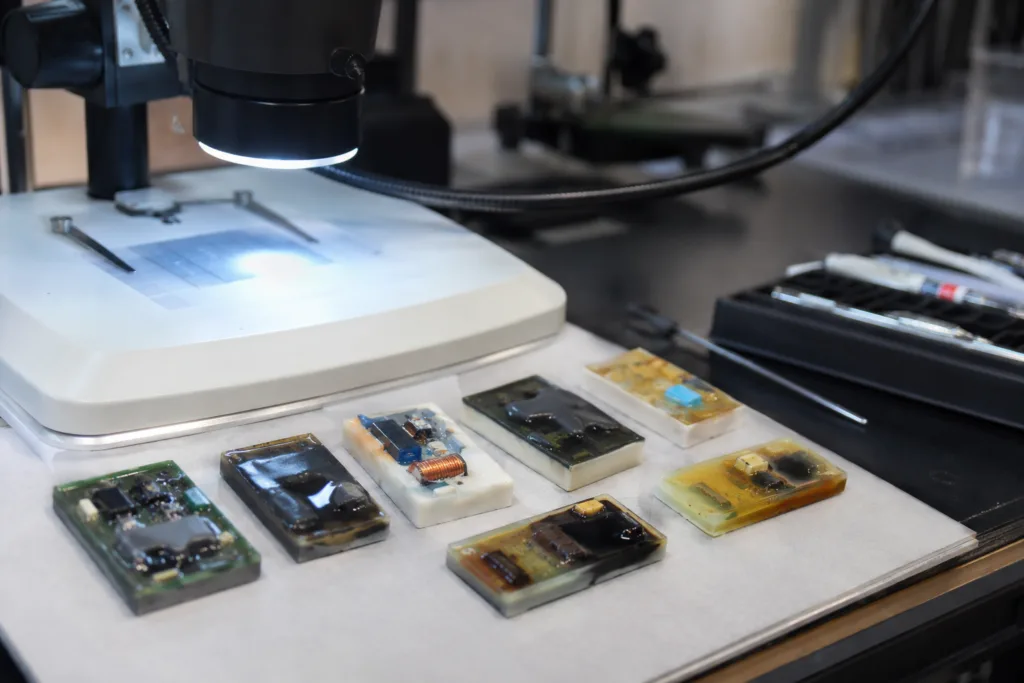
Inspect for incomplete wetting, overflow, bubbles, voids, meniscus defects, contamination, and dimensional interference. Select an inspection method that can detect the relevant defect in the actual assembly, such as visual inspection, sectioning of representative samples, or another justified method. Define what is acceptable before production trials begin. A void near a connector, heat path, high-field region, or stress-sensitive component may have a different consequence from an isolated void in a nonfunctional area.
Match Electrical, Thermal, Mechanical, and Environmental Requirements
Electrical suitability requires more than a general statement that the cured material is insulating. Request formulation-specific dielectric data, including the test method, specimen, conditioning, and revision date. Relate that evidence to the assembly voltage, clearances, creepage, interfaces, contamination controls, and intended service conditions. Where electrical function is safety-critical or highly sensitive, define assembly-level testing and acceptance criteria with the responsible engineering and quality teams.
Thermal review should identify the heat source, heat path, interfaces, enclosure constraints, allowable component temperature, and measurement method. Thermal conductivity data alone does not establish assembly performance. Compare the material evidence with the actual fill geometry and thermal resistance model, then confirm behavior through representative functional or thermal trials. A material chosen for thermal transfer must still meet the required cure, adhesion, electrical, mechanical, and process conditions.
Mechanical and environmental requirements should be expressed as service exposures rather than broad labels. Define temperature change, vibration, shock, humidity, fluids, cleaning agents, chemical contact, pressure, optical constraints, and expected handling loads. Consider the interaction between the cured material and dissimilar substrates during cure and temperature changes. For stress-sensitive assemblies, review application-specific information on silicone gels for component protection, while treating any product suitability, exposure resistance, and cured behavior as matters for current documentation and trials.
Build a Verification and Qualification Workflow
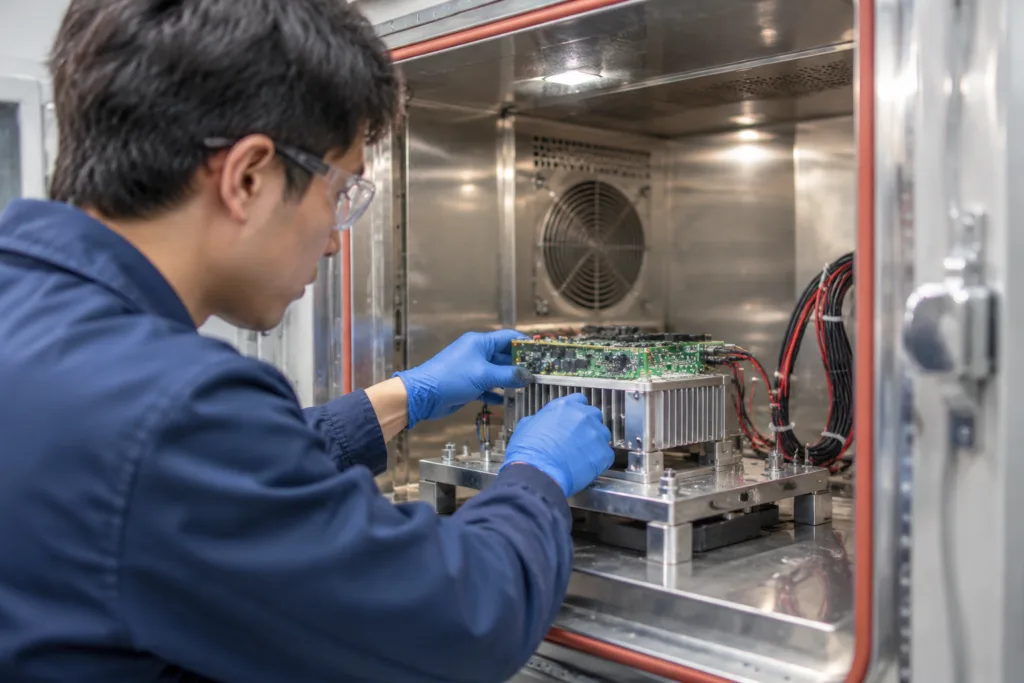
A defensible workflow moves from documents to representative evidence:
- Document review: obtain the current TDS and SDS, identify the product revision, and record cure, handling, dispensing, electrical, thermal, storage, and hazard information relevant to the assembly.
- Substrate screening: test actual PCB finishes, metals, plastics, ceramics, coatings, and enclosure materials, including the planned cleaning and surface condition.
- Representative process trials: dispense production-relevant volumes and geometries, then assess wetting, fill, air entrapment, overflow, cure state, dimensional fit, and component function.
- Validation testing: apply the defined electrical, thermal, mechanical, chemical, moisture, and environmental tests using documented specimens, conditions, methods, and acceptance criteria.
- Production release: establish process controls, inspection records, batch traceability, change notification, nonconformance handling, and ongoing verification requirements.
Use failure results to distinguish among material mismatch, surface preparation, dispensing variation, cure failure, inspection limits, and assembly design. Do not treat a failed trial as evidence that an entire chemistry family is unsuitable, and do not treat a passing coupon as production approval. Any proposed rework or removal method requires supplier guidance and substrate-specific trials because cured material can constrain access and may damage components or surfaces during removal.
Review SDS, TDS, Packaging, and Supply Fit
Engineering should request the current TDS and SDS before sampling. The TDS should be reviewed for intended use, cure mechanism, application instructions, relevant physical and performance data, test conditions, and stated limitations. The SDS should govern hazard communication, handling, ventilation, personal protective equipment, storage precautions, spill response, and disposal. Do not replace those instructions with generic assumptions.
Procurement should also request the offered packaging format, lot or batch identification, storage requirements, shelf-life statement where documented, quality documentation, change-notification process, and supply terms. Confirm that the packaging matches the dispensing equipment and planned volume. Record the exact product identity and revision used in trials so that a later packaging, formulation, or process change can be evaluated before implementation. Claims about regulatory or industry compliance should be accepted only when current documentation covers the required product, scope, jurisdiction, and application.
Before production approval, combine the document review, representative process results, inspection records, functional data, environmental evidence, and supplier change controls in 1 traceable qualification record. This creates a practical decision path for engineering, quality, manufacturing, and procurement without assuming that a product category guarantees reliability.
What is electronic potting adhesive used for?
It is used to fill or cover defined electronic assemblies and may also adhere to selected surfaces. The required coverage, cure, electrical behavior, and environmental performance must be verified for the specific formulation and assembly.
How do epoxy, silicone, polyurethane, and UV-curable potting materials differ?
They differ by formulation in cure mechanism, mechanical behavior, flow, compliance, exposure resistance, optical access needs, and process requirements. Chemistry family names do not establish fixed performance.
How can dielectric and thermal suitability be verified before production?
Review formulation-specific TDS data and test conditions, then evaluate the representative assembly under defined electrical and thermal requirements. Thermal data should be checked with assembly-level analysis or testing.
Can cured electronic potting material be removed or reworked?
Removal and rework are application-dependent. Confirm supplier guidance and conduct substrate- and component-specific trials before approving any method.
What should engineers and procurement teams request in the TDS and SDS?
Request current product identity, cure and application instructions, relevant test data and conditions, limitations, hazards, handling, storage, disposal, packaging, traceability, and change-notification information.
Is potting adhesive suitable for every electronic assembly?
No. Suitability depends on the assembly, substrate pair, geometry, process, operating environment, electrical and thermal requirements, inspection plan, and qualification evidence.
To define a candidate and validation path, contact the ZDS technical team with the substrate pair, process, operating environment, validation needs, quantity, and packaging requirements.