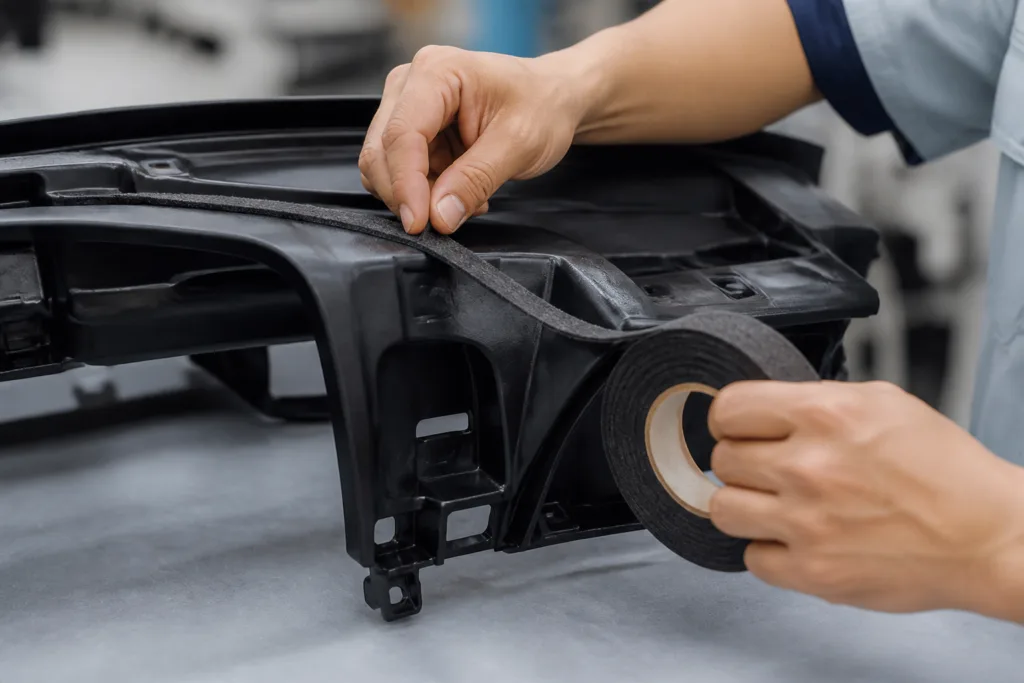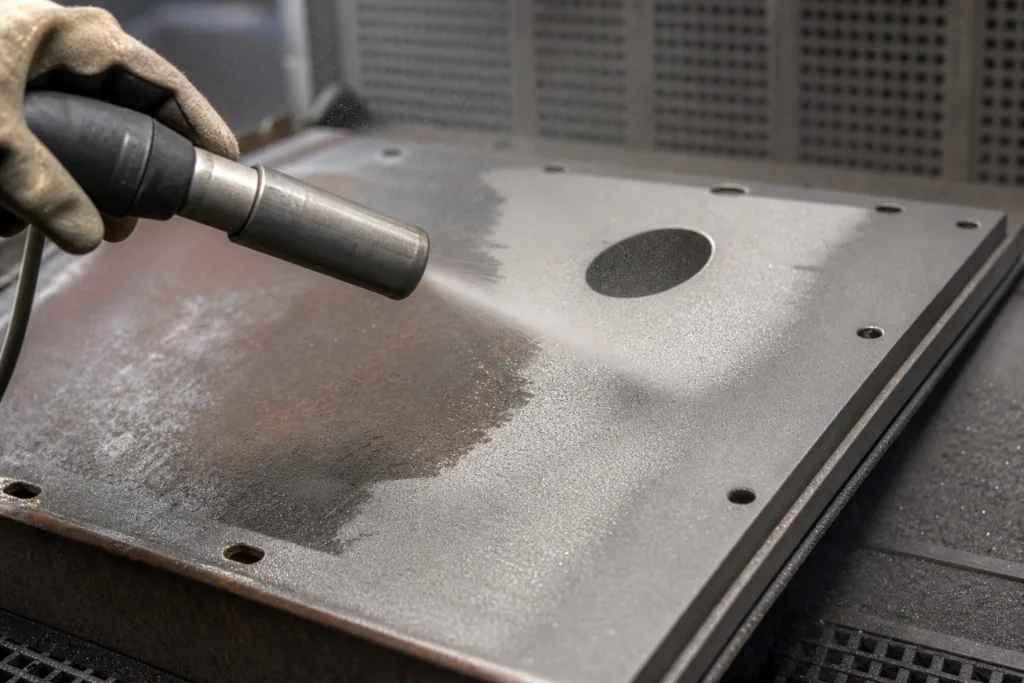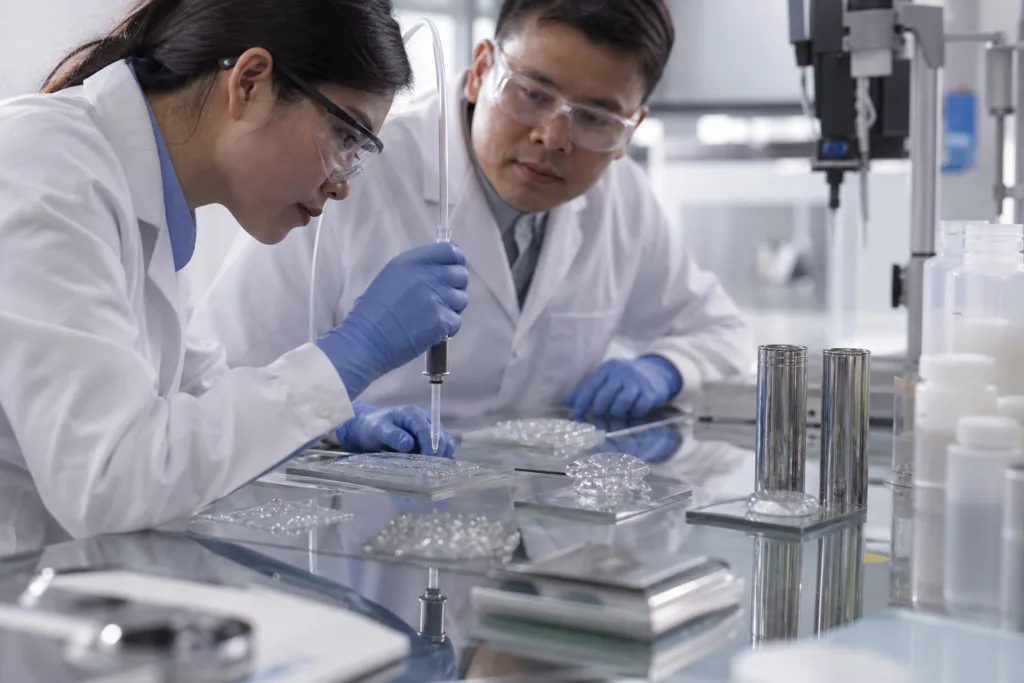
A dispensing machine is not a universal tool in industrial adhesive production. The same platform can often be adapted for epoxy, silicone, or UV adhesive work, but only if the machine is configured around the chemistry, cure behavior, and process window of the material being used. For engineers and procurement teams, the real question is not whether a system can dispense adhesive, but whether it can do so repeatably without damaging throughput, bead quality, or final bond performance.
For buyers comparing equipment, our accurate adhesive dispensing equipment selection guide is a useful starting point because it connects substrate needs, cure method, and production rhythm to the right machine architecture. From our adhesive manufacturing perspective, that same logic applies when we support OEM and production customers: formulation behavior, viscosity range, pot life, and fixture timing all influence whether a system should be built for positive displacement metering, pressure-fed dosing, mixing control, or UV cure coordination.
What a Liquid Dispensing Machine Does in Industrial Adhesive Production
In industrial assembly, a liquid dispensing machine meters adhesive to a target location in a controlled amount, at a controlled rate, and with enough repeatability to support stable quality. Depending on the process, it may be used for dotting, bead laying, potting, underfill, edge sealing, gasketing, component bonding, or conformal application. In practice, the machine is part of the process chain, not a standalone piece of hardware. It must match the adhesive’s flow characteristics, the part geometry, the substrate surface condition, and the line’s takt time.
Different adhesive systems place different demands on the machine. A two-part epoxy often needs accurate ratio control and careful pot life management. Silicone may need a system that tolerates high flexibility and filler content without losing flow stability. UV adhesive usually depends on low viscosity, clean transfer, and a cure path that matches the line speed and part transparency. That is why a dispensing machine set up for one chemistry can perform poorly with another if the pump, nozzle, pressure profile, or mixing method is not adjusted.
For production teams, this means equipment selection should be based on process fit rather than on one universal spec sheet. The right setup improves bead consistency, reduces waste, supports cleaner start-stop behavior, and lowers the risk of hidden defects such as voids, stringing, incomplete fill, or undercure.
Why Epoxy, Silicone, and UV Adhesives Behave Differently During Dispensing
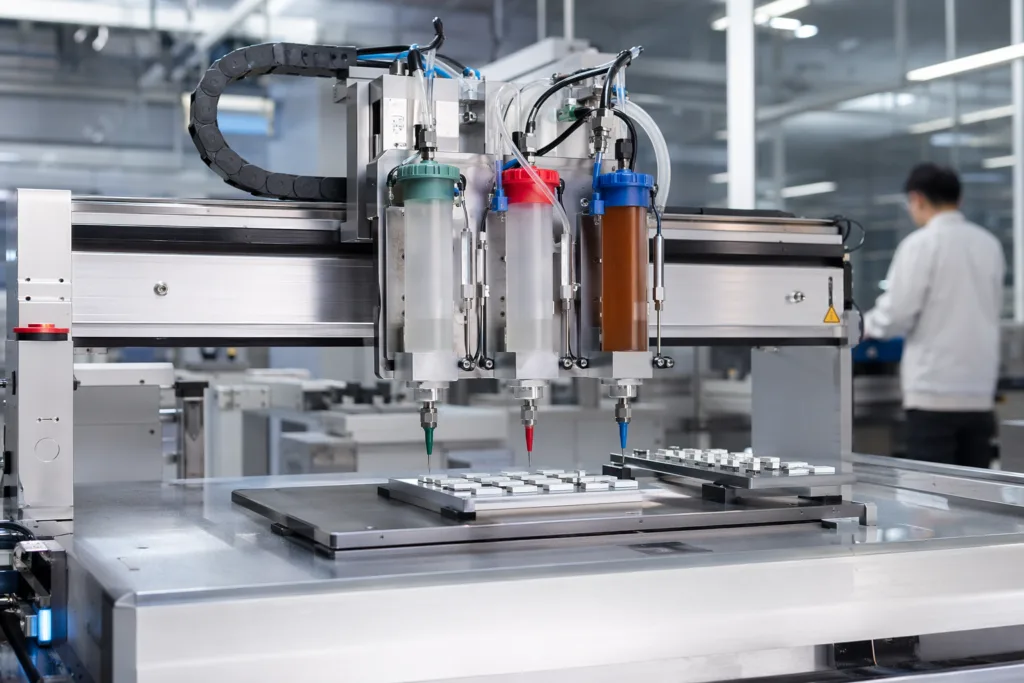
Adhesive chemistry determines flow behavior. In practical terms, that means the same machine settings do not deliver the same result across all three systems. Our experience in formulation and application support shows that rheology, thixotropy, cure trigger, and surface wetting behavior all affect how the adhesive moves through hoses, valves, static mixers, needles, and nozzles. In technical terms, even small differences in yield stress or viscosity profile can change how much pressure the system needs to start flow and how stable the bead remains after deposition. A useful technical reference on rheology and viscosity basics helps explain why these flow differences matter so much in machine setup.
Epoxy often has a broader formulation range than many buyers expect. Some versions are low-viscosity and self-leveling, while others are heavily filled and used for gap filling or structural bonding. Silicone adhesives can be very flexible and may contain fillers that affect pumpability and stringing behavior. UV adhesives are usually selected for rapid processing, but their low viscosity and light-cure requirement create a different control challenge: the machine must deliver material accurately while the line preserves enough light access for cure.
This is why the configuration logic changes by chemistry. For epoxy, the machine may need ratio control, temperature conditioning, and a mixer built for two-part compatibility. For silicone, flow stability and clean cut-off can matter more than aggressive pressure. For UV, the dispensing step and curing step need to be synchronized more tightly than with thermal or moisture-cure systems.
Epoxy Dispensing Equipment: Handling Viscosity, Two-Part Metering, and Pot Life
Epoxy is often used where strength, chemical resistance, electrical insulation, or structural reinforcement is required. It can also be filled to improve thermal conductivity, reduce shrinkage, or modify mechanical behavior. Because epoxy formulations vary widely, epoxy dispensing equipment usually needs the most careful setup of the three adhesive types discussed here.
Metering and mixing requirements
Two-part epoxy systems require accurate proportioning. If the resin and hardener are not delivered at the correct ratio, the cured adhesive can become brittle, undercured, soft, or inconsistent from part to part. That is why the machine should be configured for ratio stability first, then for output rate. Depending on viscosity and application volume, this may mean gear pumps, progressive cavity pumps, piston systems, or a metering architecture chosen specifically for the formulation’s resistance to flow.
The mixer choice is equally important. Static mixing is often suitable for smaller shots and moderate throughput, while dynamic mixing is more useful when higher volumes, filler loads, or tighter homogeneity are needed. The system must also allow enough residence time for full blending without creating excessive pressure drop. When the adhesive is highly filled, the line design should minimize dead zones and keep the material moving consistently through the system.
Pot life and line rhythm
Epoxy pot life affects the entire production rhythm. Once the components are mixed, the adhesive begins reacting, so the machine must dispense within a predictable working window. Long hose runs, poor scheduling, or unnecessary stoppages can lead to viscosity rise inside the system and more frequent cleaning. This is why production engineers should test not only the initial mix quality but also the behavior of the material after pauses, retries, and start-stop cycles. For projects centered on structural bonding, our internal guide on epoxy resin handling and cure behavior is useful when evaluating the relationship between formulation choice and machine timing.
Temperature control and viscosity management
Epoxy may require preconditioning if the formulation is thick or if the plant environment is too cold for stable flow. Mild heating can improve pumpability, but it must be controlled carefully because excessive heat can shorten pot life and raise the risk of premature gelation. In practice, the best epoxy setup often balances fluidity, open working time, and final cure requirements rather than chasing the lowest possible viscosity.
For procurement teams, the key point is this: epoxy systems are rarely plug-and-play. The more demanding the bond line, the more important it is to test the adhesive on the actual machine before approving a final configuration.
Silicone Dispensing Systems: Managing Flexibility, Filler Content, and Flow Stability
Silicone adhesives are used where flexibility, thermal cycling resistance, moisture resistance, or movement tolerance is important. They are common in electronics sealing, LED assembly, appliance gasketing, and applications where the bond line must absorb vibration or differential expansion. A liquid dispensing machine for silicone must therefore prioritize stable flow and accurate deposition without excessive shear or stringing.
Why silicone is different on the machine
Silicone materials can behave very differently from epoxy under shear. Some formulations are highly thixotropic, meaning they thin under movement and recover afterward. Others are softer and more prone to tailing or drawstring effect if nozzle cut-off is not well managed. Filled silicone may also require more robust pumping to avoid pulsation or inconsistent bead shape.
For this reason, the machine should be evaluated for its ability to maintain steady pressure and clean shutoff. If the valve design is not suited to the material, the operator may see splashing, drooling, or irregular bead edges. In assembly work where appearance and seal integrity both matter, those issues can become reject drivers quickly.
Moisture curing and production handling
Many silicone systems cure by moisture exposure. That means the process is sensitive not only to the machine, but also to plant humidity, bead size, substrate geometry, and exposure area. Thick beads may skin over while remaining uncured inside, so the machine should deposit a geometry that matches the cure path. Where relevant, our material support team also considers the moisture-curing mechanism in system planning, and our article on moisture-curing process considerations is a helpful reference for buyers comparing one-component or moisture-reactive workflows.
From a production standpoint, the best silicone setup is usually one that produces repeatable bead volume, stable cut-off, and minimal trapped air. If the line involves flexible parts, the adhesive must also recover after movement without losing seal continuity.
UV Adhesive Dispensing Systems: Low Viscosity Handling and Cure-Exposure Coordination
UV adhesives bring a different set of process requirements. They are often chosen for rapid assembly, clean aesthetics, and fast fixture release. Their low viscosity can make them easy to meter, but that same property can create challenges such as dripping, migration, and poor edge control if the nozzle or valve is not tuned correctly. More importantly, the adhesive cannot be evaluated only by its dispense quality; the curing step must also be planned with equal care.
Dispensing accuracy and light access
UV adhesive performance depends on how much light energy reaches the cured area. If the substrate blocks light or the bead is too thick, the adhesive may remain tacky in shadowed regions even if the surface looks cured. That is why the dispensing machine must be paired with the correct cure station and with part geometry that allows light to penetrate the adhesive path. The relationship between cure depth and part transmission is well described in the literature on light transmission and cure depth limits, and the same principle applies in factory production.
In other words, a UV adhesive is not simply “dispense and done.” The machine must place the material accurately, and the line must provide the right exposure intensity, timing, and part orientation for full cure. Transparent or transmissive substrates are often easier to process, while opaque or heavily shaded assemblies require more careful design.
Production speed and cure coordination
UV systems can support fast production, but only when the adhesive path is short enough and the exposure step is tightly integrated into the line. If the machine runs too fast for the cure station, or if the bead is too large for the cure depth, the process may appear efficient while hiding a reliability problem. Buyers often underestimate this point because the material seems easy to dispense. In reality, the cure window is what defines success.
For teams comparing fast-cure options, our technical article on UV and instant-cure acceleration methods shows how exposure strategy, initiator behavior, and application geometry can affect throughput. That thinking is useful when planning UV adhesive equipment as well: the dispense system and the cure strategy should be designed together.
Key Machine Configuration Differences That Matter in Real Production
Although one platform may be adapted to multiple adhesive types, the final configuration should change with the material. The most important settings are pump type, metering accuracy, mixing method, nozzle design, and pressure control. If these are not matched to the adhesive, the machine may still run, but the production result will be unstable.
| Configuration Area | Epoxy | Silicone | UV Adhesive |
|---|---|---|---|
| Primary challenge | Ratio control and pot life | Flow stability and cut-off | Low viscosity and cure access |
| Pump focus | Accurate metering under varying viscosity | Stable feed with minimal pulsation | Clean low-volume transfer |
| Mixing need | Often two-part static or dynamic mixing | Usually single-component, sometimes mixed systems | Usually single-component, cure synchronized separately |
| Nozzle concern | Dead volume and mix quality | Stringing and cut-off | Drip control and bead precision |
| Process risk | Under/over-cure from ratio drift | Tailing, seal defects, inconsistent bead shape | Shadow cure failure or migration before exposure |
When our team evaluates an automated platform, we look closely at how it handles repeatability during start-up, during pauses, and at the end of a run. A system may look capable in a demo but still struggle with production realities such as partial curing, nozzle wetting, or variation in shot size. If the equipment decision is being made for a new line, our automated dispensing system performance article helps frame the difference between basic motion control and true process control in adhesive production.
Viscosity, Thixotropy, and Temperature Control
Viscosity is one of the most important variables in adhesive dispensing, but it is only part of the picture. Thixotropy, filler type, temperature sensitivity, and shear response all affect the way material flows through the machine. A formulation that looks manageable in a beaker may behave very differently once it moves through hoses, valves, and a nozzle under production pressure.
Epoxy often shows a strong relationship between temperature and pumpability. Silicone may hold its shape well once laid down, but can still require pressure tuning to avoid inconsistent flow. UV adhesive may seem easy to handle because it is typically low viscosity, but the same fluidity can increase risk of drip and migration. In every case, the machine setting should support the material’s natural flow profile rather than fight it.
For buyers, the practical takeaway is that temperature control is not only about heating. It is about maintaining a stable and reproducible rheology across shifts and seasons. If the adhesive is too cold, the shot size may drift. If it is too warm, pot life may shorten or the cure window may become harder to manage. Stable process temperature is one of the quietest but most valuable controls in a well-run dispensing line.
Mixing Requirements: Static Mixing, Dynamic Mixing, and Ratio Control
Two-part adhesives need special attention because the machine is not just moving liquid; it is creating the final reactive mixture. This is especially true for epoxy and some polyurethane systems. A reliable dispensing machine must meter both components at the correct ratio and combine them with enough uniformity to prevent uncured streaks or soft spots in the bond line.
Static mixers are simple, compact, and often effective for smaller output and moderate viscosity ranges. Dynamic mixers provide more active blending and can be useful when fillers, high viscosity, or tighter consistency demands make passive mixing insufficient. The right choice depends on shot size, throughput, cleanup requirements, and acceptable pressure drop.
One reason buyers sometimes overfocus on pump size is that the mixer often defines the real quality limit. If ratio control is good but the mixing geometry is poor, the adhesive may leave the nozzle looking acceptable while still curing inconsistently. That risk is especially important in structural or high-reliability applications.
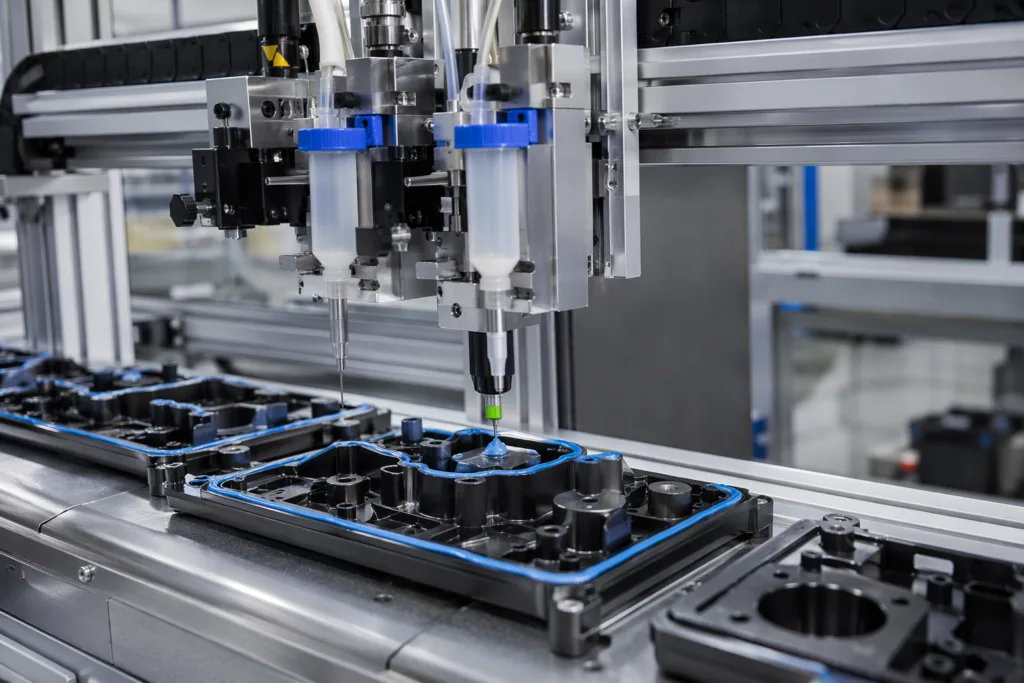
For production planning, we recommend thinking about the mixer as a consumable process component. It influences bead quality, cleaning frequency, waste volume, and startup delay. A machine that supports easy mixer replacement and predictable purge behavior can save time across a long production run.
Cure Trigger and Production Rhythm
Cure behavior shapes line rhythm. Epoxy offers working time but may require fixture waiting or heat support. Silicone often cures through moisture and therefore depends on bead geometry and environmental exposure. UV adhesive can cure rapidly, but only when the light path is protected and the exposure equipment is properly integrated. Because of this, the machine configuration should be checked against the downstream cure method before the line is approved.
Pot life matters most for mixed systems. If the production cell pauses too often, the adhesive inside the system may thicken or begin to set. Open time matters during part assembly because the adhesive must remain workable long enough for alignment, but not so long that throughput suffers. For UV systems, the equivalent consideration is exposure timing and shadow management rather than pot life.
In practice, this means the best dispensing machine is not always the one with the highest speed. It is the one whose speed matches the adhesive’s usable window and the cure method’s constraints. That is why we encourage trial runs before finalizing line design.
Process Control Factors: Pressure, Shot Size, Repeatability, Bubble Prevention, and Clean Shutdown
Stable production depends on small details. Pressure must remain consistent enough to maintain bead size without overloading the part. Shot size should be adjustable without frequent recalibration. Repeatability must hold from the first part to the last. Bubble prevention matters because trapped air can reduce bond area, weaken potting, or compromise appearance. Clean shutdown is important because many adhesive failures begin at the end of a run, not the beginning.
Epoxy systems are particularly sensitive to trapped air in two-part mixing. Silicone can show stringing if cut-off is poor. UV adhesive may migrate if it is too thin and the part is not cured promptly. Each of these failure modes is manageable, but only if the machine’s control logic and hardware are selected carefully.
We also encourage buyers to examine cleaning procedures before approval. Solvent handling, purge method, ventilation, and operator protection all influence maintenance quality. For teams that need a safety-oriented reference while planning cleaning workflows, solvent safety and PPE guidance is a useful reminder that process maintenance is also a workplace safety topic.
Choosing the Right Automated Liquid Dispensing System for Each Adhesive Type
The correct automated liquid dispensing system depends on what the adhesive must do after it leaves the nozzle. If the material will be used for structural bonding, the machine needs strong ratio control and repeatability. If the application is sealing or gasketing, the system should deliver smooth bead geometry and clean cut-off. If the adhesive is UV-curable, the line must preserve light access and manage cure timing.
For epoxy, look for stable metering, good mixing, and the ability to handle viscosity changes without losing ratio accuracy. For silicone, look for smooth flow, low pulsation, and cut-off behavior that preserves bead shape. For UV adhesives, look for precise low-volume dispensing, low drip risk, and an integrated cure process that fits the substrate and line speed.
In our own manufacturing and support work, ZDS Adhesive often helps customers reduce risk by aligning material selection with equipment constraints before scale-up begins. That may include adjusting viscosity, filler package, cure profile, or packaging format so the adhesive is easier to run on the target machine without sacrificing performance.
Common Application Scenarios in Electronics, Automotive, LED, and Industrial Assembly
Electronics production often needs precise dots, narrow beads, potting, or underfill. Here, stability and clean application matter more than raw output. Automotive and industrial assembly may require stronger structural bonding or vibration resistance, which pushes the process toward more robust metering and mixing. LED manufacturing often combines silicone sealing, thermal management, and optical constraints, making both material transparency and bead shape important. UV adhesive is especially common where fast handling and clean assembly are priorities, but the cure path must remain reliable across batch variation and part design.
One reason these applications are so different is that the adhesive is not serving the same function in each one. In a battery module, the focus may be insulation, gap control, or thermal management. In an appliance, the goal may be sealing and durability. In a sensor assembly, precision and low stress may matter most. The same machine may be used across all of these, but only if the configuration reflects the real function of the adhesive.
For buyers comparing system fit by end use, the broader discussion of precision dispensing for electronics and medical production helps illustrate why micro-volume control, cleanliness, and repeatability become critical in high-value assemblies.
Typical Failure Modes When the Dispensing Machine Is Mismatched to the Adhesive
When equipment and chemistry are mismatched, the failures are usually visible in the process before they appear in the field. Epoxy may cure unevenly, gel inside the mixer, or show weak bond strength due to poor ratio control. Silicone may bead poorly, string excessively, or leave inconsistent seal height. UV adhesive may flow beautifully but fail in hidden zones because the cure light cannot reach the full depth.
Other common issues include air entrapment, nozzle clogging, pressure spikes, inconsistent shot weight, and waste from over-purging. Some of these problems come from machine design, while others come from not matching the formulation to the process window. A material that is too viscous, too fast-curing, or too translucent for the intended use can create trouble even on a well-built machine.
That is why troubleshooting should begin with both the adhesive and the machine at the same time. It is rarely enough to ask whether the dispenser is “good.” The more useful question is whether the dispenser is good for this chemistry, this substrate, this cure method, and this production rhythm.
Testing and Validation Before Production
Before full production, we recommend a structured validation step. Start with material compatibility checks, then run sample shots at the intended temperature and pressure, and finally observe cure and bond performance on the actual substrate. This avoids surprises such as hidden voids, slow fixture, poor wet-out, or overfill. If the assembly is critical, repeat the test across multiple shifts or environmental conditions to understand variation.
For two-part systems, verify ratio accuracy and consistency over time. For UV adhesives, verify the cure depth on the real part geometry, not just on flat test coupons. For silicone, check bead shape, flexibility after cure, and resistance to sag or flow after application. Throughput verification is equally important; a system that performs well at low speed may still struggle at target output.
Buyers often ask whether one machine can handle multiple adhesives. The answer is yes in some cases, but only if the platform supports the right pump, valve, cleaning protocol, and cure workflow. If the plant plans to use one machine for several chemistries, the validation plan should be more rigorous, not less.
How an Adhesive Manufacturer Supports Dispensing Process Development
From an adhesive manufacturer’s point of view, dispensing success starts with the formulation. If the adhesive is too thick for the available pump, the line will struggle. If it cures too quickly, the mixer may plug. If it flows too freely, the bead may collapse before cure. This is why custom formulation can be a major advantage when the machine has fixed process limits or when the assembly has unusual geometry.
At ZDS Adhesive, we typically support customers by reviewing substrate type, target bond performance, cure method, application volume, and machine constraints together. That may lead to a viscosity adjustment, a change in filler package, a cure speed modification, or a packaging choice that simplifies feeding into the dispensing system. The goal is not just to make an adhesive that works in the lab, but one that runs consistently in production.
For buyers sourcing from an OEM or private label perspective, this also affects packaging, MOQ planning, and quality control. A better fit between material and machine can reduce scrap, shorten setup time, and improve batch-to-batch repeatability once the line is scaled.
Buyer Checklist: Questions to Ask Before Selecting Epoxy Dispensing Equipment
Before approving a machine, ask the supplier or internal engineering team these questions:
- What viscosity range can the system handle at our actual operating temperature?
- Does the machine support the adhesive’s cure method and working time?
- Can the pump maintain stable ratio control for two-part materials?
- Will the nozzle or valve produce clean start-stop behavior without stringing or drips?
- How easy is it to clean, purge, and restart after pauses?
- Can the system be validated with our real substrate, bead size, and throughput target?
- Do we need custom formulation to improve pumpability, pot life, or cure speed?
If the answers are vague, the project may still be at risk. Good equipment selection should reduce uncertainty, not move it downstream.
For structural projects, buyers often also compare downstream bond performance and heat-management needs. In those cases, the material choice and machine choice should be reviewed together with the final assembly function, not separately.
Conclusion
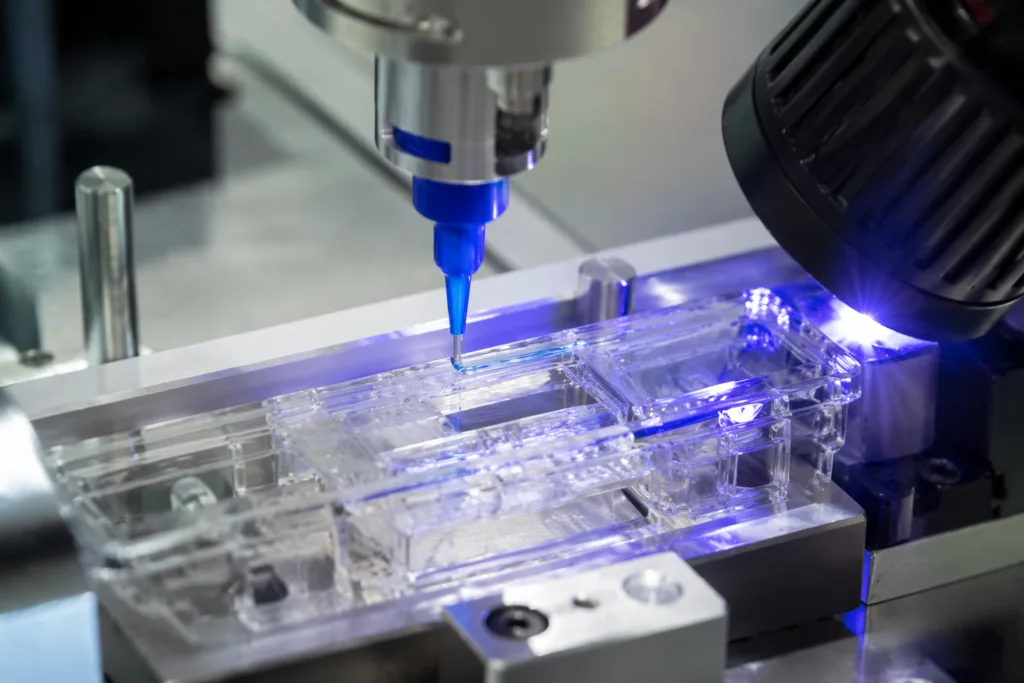
A dispensing machine can support epoxy, silicone, and UV adhesive applications, but only when it is configured around the adhesive’s rheology, cure mechanism, and production demands. Epoxy usually needs careful ratio control, mixing quality, and pot life management. Silicone needs stable flow, clean cut-off, and bead consistency. UV adhesive needs low-viscosity handling plus cure-exposure coordination. When the machine and chemistry are matched, production becomes more repeatable, cleaner, and easier to scale.
For engineering teams and procurement teams alike, the best approach is to evaluate the adhesive, the dispenser, and the line rhythm as one system. That is the most reliable way to protect throughput, quality, and long-term production stability when selecting a dispensing machine for industrial adhesive work.
FAQs
Can one dispensing machine handle epoxy, silicone, and UV adhesives?
Sometimes, but only if the platform can be configured for the different flow behaviors, cure methods, and metering requirements. Epoxy often needs ratio control and mixing, silicone may need stable flow and clean cut-off, and UV adhesive needs low-viscosity handling plus a cure process that fits the part geometry. A single machine can be versatile, but the setup should still be validated separately for each material.
What matters most when choosing a dispensing machine for epoxy?
For epoxy, the most important factors are metering accuracy, mixing quality, pot life management, and the ability to handle the adhesive’s viscosity at the actual production temperature. If the epoxy is filled or structural, the machine also needs enough pressure stability to avoid ratio drift or incomplete blending.
Why is silicone harder to dispense cleanly than it looks?
Silicone can be flexible, thixotropic, or filled, which makes its flow behavior less predictable than a simple low-viscosity liquid. If the valve or nozzle is not suited to the material, the result can be stringing, tailing, droplet formation, or uneven bead shape. Clean shutoff and steady pressure are especially important.
What is the main dispensing challenge with UV adhesive?
The biggest challenge is not just placing the adhesive accurately, but making sure the cure light reaches the full adhesive path. Low viscosity can make UV adhesive easy to move, but shadowing, bead thickness, and substrate opacity can still prevent full cure. Dispensing and curing must be planned together.
Do I need a custom adhesive formulation for my dispensing line?
Not always, but custom formulation can help if the material is too thick, cures too fast, strings too much, or does not wet the substrate well on your machine. From a production perspective, a small adjustment in viscosity, filler package, or cure profile can make the difference between frequent adjustment and stable output.
How should I validate a new dispensing setup before full production?
Start with sample runs on the real substrate, then check shot size, bead shape, air entrapment, cure quality, and repeatability over multiple cycles. For two-part materials, confirm ratio consistency. For UV systems, verify cure depth under the actual line conditions. A structured trial is the safest way to avoid hidden production defects.