In electronics and medical manufacturing, precision dispensing equipment is not simply a machine choice; it is a process-control decision that affects product quality, repeatability, contamination risk, and long-term production stability. When a bead, dot, line, or fill volume is too large or too small, the result can be cosmetic at first, but it often becomes functional later: weak bonds, trapped bubbles, sealing leaks, electrical interference, rework, or part rejection. For engineers and buyers, the real value of precision dispensing is the ability to control material placement consistently across shifts, operators, and production lots.
For projects that need better dose control, material compatibility, or scalable production planning, accurate adhesive dispensing equipment selection is often the right starting point because the equipment choice must match viscosity, cure behavior, substrate geometry, and quality targets. From our manufacturing and application-support perspective at ZDS Adhesive, this is also where sample testing, formulation adjustment, and production-ready packaging become important, especially when customers need stable performance from pilot runs through bulk output.
What Precision Dispensing Equipment Means in Modern Manufacturing
Precision dispensing equipment refers to systems that meter and place fluids in controlled amounts with repeatable output. In industrial terms, that can include adhesives, sealants, underfills, potting compounds, encapsulants, thermal interface materials, coatings, and other reactive or non-reactive liquids. The “precision” part is not only about a smaller deposit. It also includes shot size stability, path accuracy, clean start-stop behavior, bubble management, and the ability to repeat the same result thousands of times.
In a manufacturing line, precision matters because many modern assemblies use smaller components, tighter spacing, thinner substrates, and higher functional density than before. A slight over-dispense may overflow onto connectors or optical areas. Under-dispense may leave gaps that reduce strength or create leakage paths. Poor cut-off can string material between points. Unstable flow can change cure results and make process validation harder. Precision dispensing equipment helps reduce these problems by turning fluid handling into a controlled, measurable process rather than an operator-dependent task.
Why Micron-Level Control Matters
Micron-level control does not always mean the system literally deposits features measured only in microns. In practice, it means the process can manage very small positional and volumetric variations relative to the size of the feature being dispensed. That is especially important in electronics and medical manufacturing, where the functional zone may be small and the tolerance for excess material is limited.
When dispensing around fine-pitch electronics, optical interfaces, microfluidic parts, sensors, or catheter components, even a small offset can change performance. The same is true when the material itself is sensitive to shear, temperature, or moisture. A reliable dispensing process must therefore control flow behavior as much as volume. In technical terms, that is why rheology matters: viscosity, yield stress, and non-Newtonian behavior can all change how a material moves through a valve or needle and how it settles after placement. NIST’s overview of viscosity and flow behavior in dispensing fluids is a useful reminder that fluid properties are part of the process, not a side note.
Why Dispensing Precision Becomes Critical in Electronics and Medical Applications
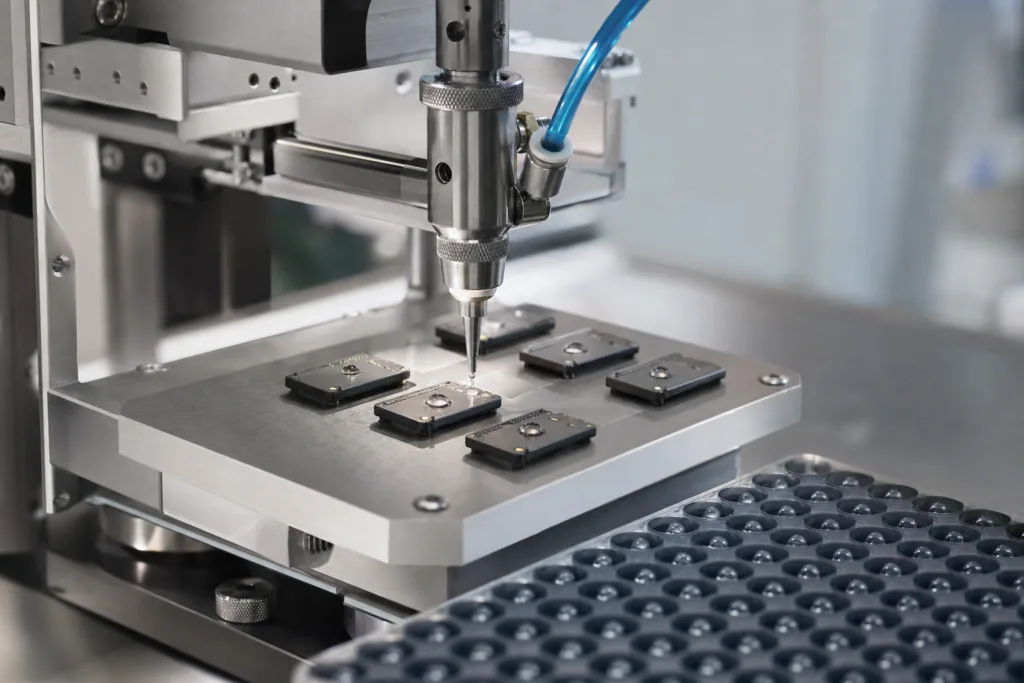
Electronics and medical products share a common challenge: failure is often expensive, difficult to detect early, and sometimes unacceptable for safety or compliance reasons. Precision dispensing equipment helps address that challenge by improving placement accuracy, reducing rework, and supporting validated production conditions.
In electronics, the main concerns are electrical reliability, thermal performance, vibration resistance, and protection against moisture or contamination. In medical devices, the priorities often include cleanliness, traceability, low particulate generation, consistent dose control, and compatibility with sterilization or clinical use conditions. The same equipment concept can serve both industries, but the process requirements are not identical. That is why the selection criteria must be application-specific.
Electronics: Small Parts, Tight Spacing, High Consequence
Electronics assemblies often involve PCB modules, LED packages, batteries, sensors, connectors, and small mechanical supports. These assemblies usually demand controlled fluid placement because materials can interfere with contacts, optics, or thermal paths if applied incorrectly. Precision dispensing equipment helps control bonding lines, potting depth, fillet shape, and encapsulation coverage without flooding adjacent features.
For example, if a bonding adhesive spreads beyond the intended area, it may affect reworkability or create interference during downstream assembly. If a potting compound traps air, it can reduce protection and reliability. In high-volume production, small variation across thousands of units can matter more than one large defect, because drift gradually changes yield and adds hidden cost.
Medical: Clean Process Control and Repeatable Delivery
Medical manufacturing places additional emphasis on process control. A device may require consistent filling, sealing, or bonding volumes to ensure safe performance and regulatory readiness. Precision dispensing equipment supports that need by reducing manual variation and helping manufacturers document the process more clearly.
In this sector, the equipment must also support contamination control. Material handling, closed reservoirs, clean changeover practices, and controlled dispense paths all matter because residue or stray particles can compromise the product. In many medical workflows, the question is not just “Can the system dispense accurately?” but “Can it do so repeatedly, cleanly, and within a controlled quality system?” That is where controlled manufacturing expectations such as the medical device quality system requirements become relevant to the buyer’s decision.
Common Materials Used in Precision Dispensing
Precision dispensing equipment is only one part of the system. The material itself must be compatible with the pump, valve, needle, pressure settings, and cure window. At ZDS Adhesive, we often evaluate the dispensing method alongside the chemistry because a formulation that works well in a syringe may not behave the same way in a production line.
| Material Type | Typical Manufacturing Role | Dispensing Consideration |
|---|---|---|
| Adhesives | Bonding, structural support, positioning | Viscosity, open time, cure speed, stringing |
| Sealants | Moisture blocking, gasketing, gap sealing | Flow stability, slump resistance, adhesion to substrate |
| Potting compounds | Protection, insulation, environmental resistance | Bubble control, flow into cavities, exotherm, shrinkage |
| Encapsulants | Component protection, stress buffering | Low-stress fill, cure uniformity, surface wetting |
| Coatings | Surface protection, insulation, barrier formation | Film thickness, coverage, edge control |
Low-viscosity fluids may require very stable pressure and fine control to prevent dripping or tailing. Higher-viscosity adhesives may need positive displacement systems, heated delivery, or optimized nozzle design. Filled materials may wear components more quickly or demand larger clearances. Reactive systems may have a narrow pot life or be sensitive to ambient humidity, which changes how the system should be set up and maintained.
Key Performance Factors Buyers Should Evaluate
When sourcing precision dispensing equipment, buyers should focus on measurable performance rather than general machine descriptions. The most useful questions are the ones that link the dispenser to the actual production task.
Shot Size Accuracy
Shot size accuracy refers to how closely the system delivers the intended amount of material each time. In electronics and medical work, this matters because overfill and underfill can both create downstream problems. A system that can repeat a target dose more closely tends to reduce material waste and rework.
Flow Stability
Flow stability is the consistency of material movement through the system. If flow changes because of pressure fluctuation, temperature drift, or material settling, the deposit shape changes too. That may lead to variable bond lines, poor surface coverage, or uneven encapsulation.
Repeatability
Repeatability is often more important than a single impressive test result. Production teams need a process that can hold the same result across many cycles. Even if the dispense volume is acceptable on one unit, inconsistent performance creates yield loss and makes validation harder.
Start-Stop Cleanliness
Many defects appear at the beginning or end of the dispense cycle. Dripping, stringing, and tailing can leave material where it should not be. For fine electronics, that can create contamination risk. For medical parts, it can compromise cleanliness and appearance.
Integration with Motion and Inspection
Precision dispensing equipment performs best when it is integrated with the right motion platform and, where needed, vision inspection. The dispenser alone does not ensure quality; the full system must support placement accuracy, path repeatability, and verification. This is especially important for complex geometries or multi-point dispensing patterns.
Electronics Manufacturing Use Cases
Electronics manufacturers use precision dispensing equipment in many different ways, but the core goal is usually the same: place the right material in the right amount without affecting surrounding features.
PCB Assembly and Component Fixation
In PCB assembly, precision dispensing can support component fixation, reinforcement, and selective bonding. The goal is often to secure parts without interfering with solder joints, connectors, or test points. A small positional error can have outsized consequences in dense layouts, so controlled volume and nozzle positioning are critical.
LED Potting and Optical Areas
LED modules often require careful potting or encapsulation to protect components while maintaining optical performance. Some projects also require low-shrinkage bonding to keep alignment stable and reduce stress on sensitive parts. In these cases, process control is as important as material selection, and the dispensing system must support clean placement without air entrapment. For assemblies where dimensional stability matters, low-shrinkage bonding for precision assemblies is a useful reference point for thinking about cure movement and alignment retention.
Battery Components and Wire Fixation
Battery packs and related electronics often need controlled adhesive placement for wire fixation, insulation support, and vibration resistance. In these applications, excess material can interfere with thermal pathways or assembly clearances, while insufficient material can reduce reliability. Precision dispensing helps maintain consistent placement on a production line where repeatability is essential.
Sensor Bonding and Underfill
Sensors and fine-pitch packages can be sensitive to stress and environmental exposure. Materials such as underfills and encapsulants must flow into tight spaces without voids while also managing cure stress. That is why some packaging processes require careful control of both the dispenser and the material behavior. For flip-chip and similar package structures, flip-chip underfill process reliability is a good example of how flow, wetting, and cure behavior combine into one quality problem.
Medical Manufacturing Use Cases
Medical applications tend to require more caution around cleanliness, documentation, and consistency. Precision dispensing equipment supports these requirements by reducing operator variation and helping the production team define a repeatable process.
Catheter Assembly and Device Sealing
Catheter assemblies and similar devices often involve small bond areas, flexible substrates, and seal integrity requirements. The dispenser must place material precisely without obstructing functional pathways or creating excess flash. If the material is too aggressive, too thick, or too volatile in cure behavior, it can complicate assembly and testing.
Diagnostic Devices and Microfluidic Parts
Diagnostic devices may involve microfluidic channels, sensor windows, or thin-film components that cannot tolerate excess adhesive. Precision dispensing equipment helps apply narrow lines, precise droplets, or selective seals while preserving function. Because these parts are often small, a minor overshoot can become a functional defect.
Sealing, Encapsulation, and Device Protection
For medical devices that need environmental sealing or encapsulation, precision dispensing helps control coverage and avoid voids. This is not just about appearance. Voids, incomplete fill, and uneven cure can create weak points or contamination pathways. If the process includes moisture-sensitive chemistry, handling conditions become part of the quality plan. In semiconductor-adjacent device work, the same logic applies to moisture sensitivity control in semiconductor packaging, where storage, exposure time, and handling discipline affect final performance.
Contamination Risks and Why Clean Dispensing Processes Matter
Contamination control is one of the strongest reasons to invest in precision dispensing equipment. In both electronics and medical manufacturing, contamination can be physical, chemical, or process-related.
- Physical contamination can include dust, fibers, cured residue, or loose particles.
- Chemical contamination can involve outgassing, unwanted residue, or cross-contamination between materials.
- Process contamination can happen when an operator changes needles, reservoirs, or parts without proper control.
To reduce these risks, manufacturers should think about closed material delivery, clean changeover procedures, compatible consumables, and good housekeeping around the dispensing station. Material containers should be selected with the production environment in mind, and the dispensing path should be kept as short and stable as practical. For medical and high-reliability electronics, “clean” is not just a room condition; it is a production habit.
How Precision Dispensing Reduces Waste and Improves Yield
Material cost is only part of the economics. Waste also includes rework labor, equipment downtime, inspection time, and failure cost. Precision dispensing equipment helps reduce waste by applying only the needed amount in the intended location.

When deposits are consistent, less material is discarded during startup, fewer parts are overfilled, and less manual correction is needed. In addition, controlled placement often improves yield because the downstream process becomes more predictable. That is especially important for higher-value materials such as specialty adhesives, low-stress encapsulants, thermally conductive compounds, or materials with limited pot life.
From a buyer’s point of view, the cost discussion should not focus only on machine price. It should include labor efficiency, scrap reduction, repair rate, and process stability. In many cases, precision dispensing pays back by reducing variability rather than by simply speeding up the line.
Process Validation, Traceability, and Production Qualification
For electronics and medical manufacturing, the process often needs to be qualified, documented, and maintained. That means the dispenser must support repeatability over time, not just during a short demonstration.
Validation usually asks a few practical questions: Does the system deliver the same output when the material batch changes? Does it stay stable as ambient temperature shifts? Can the line reproduce the result after maintenance or a nozzle change? Can the operator and production team trace issues back to a specific parameter set? These are process questions, not only equipment questions.
The FDA’s guidance on process validation and equipment qualification is relevant here because it reinforces a simple manufacturing principle: when output cannot be fully verified by later inspection, the process itself must be shown to be in control. Precision dispensing therefore has to fit into qualification, requalification, and maintenance routines that preserve that state of control.
Choosing the Right Dispensing System for the Material
Not every fluid should be handled the same way. The right system depends on viscosity, cure chemistry, sensitivity to shear, need for temperature control, and the target substrate.
Low-Viscosity Materials
Low-viscosity materials can be difficult because they may drip, wick, or spread too quickly. These materials often require careful pressure regulation and accurate valve timing. They are common in coatings, some sealants, and certain encapsulation steps where penetration into small spaces is needed.
High-Viscosity Adhesives and Filled Systems
Thicker adhesives and filled materials are often used where strength, gap fill, thermal transfer, or structural support is required. They may need positive displacement pumps, heated delivery, or larger nozzles. They can also be more sensitive to trapped air, so degassing and feed consistency matter.
Reactive Systems
Two-part epoxies, urethanes, silicones, UV-curable systems, and moisture-cure materials all have different handling needs. Some require tight mix ratio control. Others need short exposure to air or specific light exposure. In each case, the equipment must support the chemistry rather than fight it.
Substrate Type Matters Too
Glass, plastics, metals, ceramics, and flexible films do not behave the same way during wetting and cure. Surface energy, cleanliness, roughness, and thermal expansion all affect the final result. That is why our formulation and application review process at ZDS Adhesive often starts with substrate data, environmental exposure, and the customer’s actual dispense pattern rather than only the requested adhesive family.
Manual, Semi-Automated, and Fully Automated Dispensing
Dispensing precision changes as production scale increases. Manual systems may be appropriate for prototypes, low-volume builds, or frequent changeover situations. Semi-automated systems can improve control while still allowing flexibility. Fully automated systems are usually preferred when consistency, throughput, and traceability become more important than operator flexibility.
When Manual Dispensing Is Enough
Manual dispensing can work in early-stage development, but it is usually less repeatable and more dependent on operator skill. It may be acceptable for samples or small batches, especially when the material is forgiving and the application is not highly sensitive.
When Automation Becomes Necessary
Automation becomes more attractive when the deposit pattern is complex, the tolerance is narrow, the material is sensitive, or the production volume is high. For buyers comparing systems, automated dispensing for higher production consistency is not only about speed. It is about reducing variation, supporting documentation, and making line performance more predictable.
Dispensing Challenges by Material Type
Buyers often underestimate how different materials behave in the same machine.
- Low-viscosity fluids may flood, drip, or spread too far.
- High-viscosity adhesives may require more force, careful heating, or larger flow paths.
- Filled compounds may wear components and need more robust hardware.
- Reactive systems may shorten working time and require careful timing.
- Moisture-sensitive chemistries may require controlled storage and limited exposure before use.
That is why the right equipment choice should always be linked to the material data sheet and, ideally, to actual sample trials. A deposit that looks acceptable in a bench test can behave differently in production once temperature, humidity, line speed, and operator routines change. For demanding packaging applications, the chemistry and the dispensing setup must be matched as one system.
Common Defects Caused by Poor Dispensing Accuracy
Most dispensing problems show up as visible defects first, but they usually originate in process mismatch. Common issues include:
- underfill or overfill
- stringing and tailing
- voids or trapped bubbles
- overflow onto adjacent features
- poor wetting or incomplete coverage
- inconsistent bond lines
- material buildup at start-stop points
- cross-contamination between materials
Prevention starts with understanding the root cause. Is the material too viscous for the system? Is the nozzle too small? Is pressure fluctuating? Is the cure too fast or too slow? Is the substrate clean and stable? Good dispensing performance is the result of matching material, equipment, and process conditions, not just buying a more expensive platform.
How to Evaluate a Precision Dispensing Supplier or Equipment Partner
Whether you are buying equipment, materials, or a combined process solution, supplier evaluation should focus on manufacturing fit. Ask whether the partner understands your substrate, your environment, and your control needs. Ask how sample trials are performed, how data is documented, and how the process will be scaled from lab to line.
For adhesive-related projects, we often discuss not only the machine setup but also material formulation, packaging format, shelf life, and replenishment planning. That is because a dispensing system can only be as stable as the material supply behind it. If the material batch changes too much, the process drifts. If the packaging is poorly matched to the line, startup waste increases. If the cure profile is wrong, the result may be correct in the lab but unstable in production.
What Good Supplier Support Looks Like
- clear technical data and application guidance
- sample testing and trial support
- material and equipment compatibility review
- documentation for validation and qualification
- stable production and batch consistency
- practical recommendations for packaging and storage
Maintenance, Calibration, and Long-Term Repeatability
Precision dispensing equipment needs routine attention. Over time, wear, residue buildup, and calibration drift can degrade output even if the machine still appears to run normally. Maintenance is therefore part of process quality, not only equipment care.
Good maintenance programs include cleaning intervals, nozzle inspection, pump checks, calibration verification, and replacement schedules for wear parts. They also include operator training so that small changes in handling do not become large process deviations. If the process is highly sensitive, the calibration and maintenance routine should be documented and tied to production records.
Long-term repeatability is where many projects succeed or fail. A line that performs well for one week but drifts after a month is not truly precise in a manufacturing sense. Buyers should ask whether the system remains stable after normal use, not only after installation.
Specification Checklist for Electronics and Medical Buyers
Before procurement, teams should define the process requirements in practical terms. The following checklist helps connect the equipment to the application.
- What material will be dispensed, and what is its viscosity or cure type?
- What deposit shape and volume are required?
- What substrate is being bonded, sealed, or coated?
- What is the allowable tolerance for overfill, underfill, or placement error?
- Will the process need manual, semi-automated, or fully automated control?
- Is contamination control a priority?
- Does the process require validation, traceability, or qualification support?
- How will material storage, packaging, and shelf life affect line stability?
- What maintenance and calibration plan will be used?
If these questions are answered early, the buying team is less likely to choose a machine that looks capable but does not fit the actual process.
Conclusion
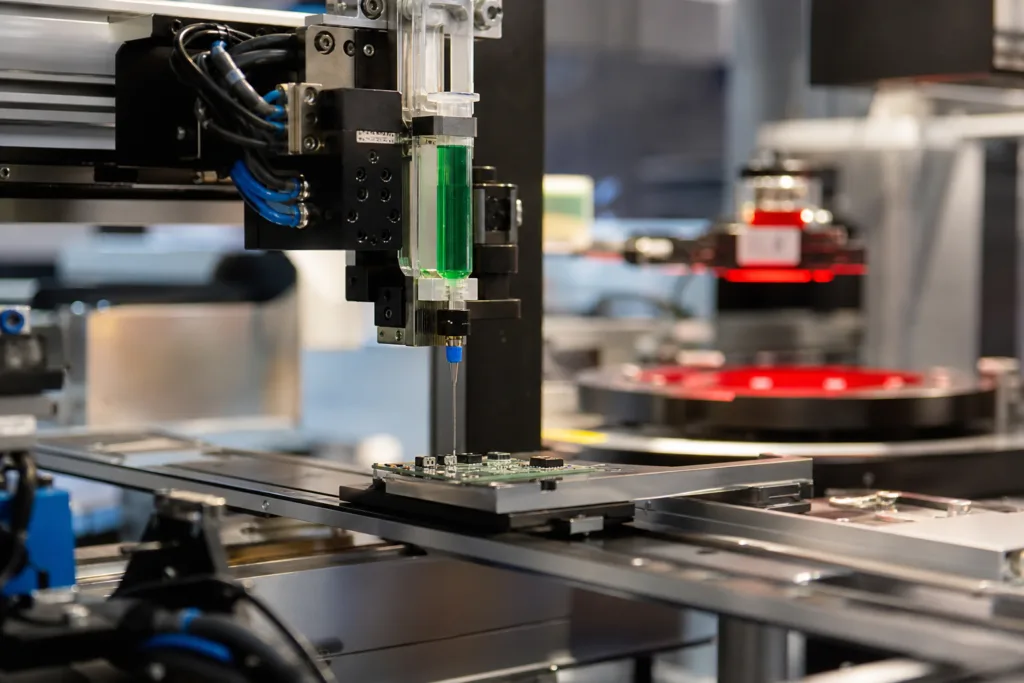
Precision dispensing equipment matters in electronics and medical manufacturing because it turns material placement into a controlled, repeatable process. That control improves quality, supports validation, reduces waste, and helps manage contamination risk. More importantly, it lets engineers and production teams match the dispensing method to the chemistry, substrate, and operating environment instead of forcing a generic setup to do a specialized job.
From our perspective as an adhesive manufacturer, the best results come when material selection, dispense system design, and production discipline are developed together. That is how precision dispensing equipment becomes more than a machine purchase: it becomes part of a reliable manufacturing process that can scale from samples to stable bulk production.
FAQs
When does precision dispensing equipment become necessary?
It becomes necessary when manual application can no longer hold the required volume, placement, cleanliness, or repeatability. This is common in small electronics, medical devices, sealed assemblies, and any process where excess material or underfill can cause functional problems.
What should buyers check first when selecting a dispensing system?
Start with the material type, viscosity, cure behavior, substrate, and required deposit size. Then evaluate whether the system can maintain repeatable flow, clean start-stop performance, and acceptable accuracy under real production conditions.
Can one dispensing system handle different adhesives and sealants?
Sometimes, but only if the system is designed for the range of viscosities and chemistries you plan to use. Different materials may need different pumps, valves, pressure settings, or changeover procedures, so compatibility should be tested rather than assumed.
How does precision dispensing help with contamination control?
It limits over-application, reduces stray material, and supports cleaner process flow. With better control over material path and dose size, manufacturers can reduce residue, prevent overflow, and lower the risk of cross-contamination during production.
Why is validation important for dispensing in medical manufacturing?
Because many medical processes cannot rely only on final inspection. The dispensing process itself must be shown to produce consistent output, remain stable after setup changes, and stay within control as part of the broader quality system.
What support should an adhesive manufacturer provide for dispensing projects?
A strong partner should help with sample evaluation, substrate compatibility, viscosity and cure matching, packaging planning, and bulk consistency. That support makes it easier to move from development trials to stable production without unnecessary rework.