Permanent label adhesive selection is rarely just a matter of “does it stick?” In industrial labeling, the right construction has to survive printing, converting, application, shipping, storage, and the full service life of the product. That means the adhesive must match the facestock, liner, substrate, temperature window, and environmental exposure without causing edge lift, flagging, or premature failure. For B2B buyers and engineers, the real question is how a label adhesive behaves under production and field conditions, not only how it looks on day one.
For teams comparing materials, the broader packaging and label structure matters just as much as the adhesive itself. Our packaging adhesive selection criteria article is a useful bridge when a project involves label stock, carton compatibility, or package-facing performance goals. At ZDS Adhesive, we evaluate how the adhesive chemistry, coating weight, and substrate pair work together, then support sample testing, OEM formulation adjustments, and bulk production planning so the final construction can hold up in real manufacturing and field use.
What Permanent Label Adhesives Are and Why They Behave Differently
A permanent label adhesive is designed to create a bond that is not intended to be cleanly removed after application. In practice, “permanent” does not mean the label can never be removed under any condition. It means the adhesive is formulated to develop a bond strong enough that normal handling, storage, cleaning, vibration, and weathering do not cause failure. When removal is attempted, it often leaves residue, tears the facestock, or damages the underlying surface.
This is different from removable label systems, where peel force is intentionally lower and long-term anchorage is not the main goal. A permanent label must usually balance three things at once: enough initial tack to grab quickly, enough peel strength to resist lift at the edges, and enough internal cohesion to avoid cold flow or creep over time. If one of those properties is too weak, the label may fail even if the other two look acceptable during a short bench test.
Why permanent adhesion matters in industrial and commercial labeling
In industrial use, labels often do more than carry branding. They may include barcodes, serial numbers, safety instructions, compliance information, traceability data, or maintenance records. If a label falls off, smears, wrinkles, or becomes unreadable, the risk is not only cosmetic. It can affect logistics, inspection, warranty tracking, and regulatory communication. That is why permanent label adhesive choices are tied closely to the end-use environment.
From a manufacturer’s perspective, we look at the full lifecycle: application speed, immediate handling, warehouse storage, transport vibration, exposure to heat or moisture, and the surface chemistry of the target substrate. A label used on a shipping carton does not face the same challenge as one applied to a powder-coated metal housing, a chilled beverage bottle, a polyethylene container, or an electronics enclosure that sees thermal cycling.
Common End-Use Scenarios for Permanent Label Adhesives

Permanent labels appear in almost every industrial sector, but the performance priorities shift by application. In packaging, labels need consistent initial grab and print compatibility. In electronics, they may need clean edge stability, solvent resistance, and reliable adhesion on small parts. In automotive and appliance applications, labels must tolerate heat, oil mist, abrasion, and long service life. In logistics, they must bond quickly and remain legible through stacking, friction, and seasonal temperature change.
Some of the most common scenarios include:
- Product identification and traceability labels on metal or plastic housings
- Compliance and safety labels on appliances, tools, and industrial equipment
- Asset tags and serialized inventory labels
- Packaging and shipping labels exposed to handling, scuffing, or humidity
- Battery, LED, and electronics labels that must remain stable under thermal stress
For many of these uses, the selection challenge is not maximum bond strength alone. It is reliable adhesion on a specific surface after a specific process window. That is why material testing should reflect the real substrate, the real application temperature, and the real storage condition, not just a generic lab panel.
Key Performance Requirements for Label Adhesive Systems
When buyers evaluate a label adhesive, they often focus on tack first. But a durable permanent label depends on a broader performance profile. The most useful way to think about it is as a balance between wetting, anchorage, cohesion, and resistance to environmental stress. If one property is over-optimized, the system can become difficult to process or unstable in service.
| Performance Factor | What It Influences | Typical Risk If Weak |
|---|---|---|
| Initial tack | Fast grab during application | Edge lift, poor wet-out, misalignment recovery issues |
| Peel strength | Resistance to removal from the substrate | Labels pop off under handling or aging |
| Shear resistance | Resistance to sliding or creeping under load | Cold flow, flagging, adhesive movement |
| Cohesion | Internal strength of the adhesive layer | Split residue, ooze, or bond collapse over time |
| Environmental resistance | Performance in heat, cold, moisture, UV, and chemicals | Early failure during shipping or service |
Initial tack vs final bond
Initial tack is the first “grab” the label feels when it touches the surface. Final bond is the strength that develops after wet-out and cure or aging, depending on the chemistry. A label adhesive with high initial tack is helpful on high-speed lines because it reduces the chance of lifting or rework. However, a strong initial grab does not guarantee long-term durability. Some systems wet quickly but do not build enough cohesive strength for extended service, especially on low-energy or uneven surfaces.
This is one reason our formulation work at ZDS Adhesive starts with the application environment, not just the adhesive family. We consider whether the project needs immediate hold, repositionability during placement, resistance to post-application movement, or a tighter balance between tack and shear.
Peel strength and shear resistance are both important
Peel strength describes how much force is required to lift a label from the substrate at a controlled angle. Shear resistance describes the adhesive’s ability to hold under a sliding load over time. A label can sometimes show acceptable peel results but still creep under load if the adhesive lacks body or cohesion. In permanent labels, this matters because the label is often under constant stress from gravity, handling, or thermal expansion mismatch.
For pressure-sensitive label stocks, standardized methods help buyers compare performance in a repeatable way. The peel behavior of a label stock is commonly assessed with peel adhesion test methods for pressure-sensitive label stocks, while long-term resistance to movement and creep is tied to shear testing. In our experience, those measurements are most useful when they are interpreted alongside the actual facestock, liner, coating weight, and target substrate rather than as standalone numbers.
Substrate Compatibility: Where Permanent Labels Succeed or Fail
No label adhesive performs equally well on every surface. Substrate chemistry, texture, energy level, and contamination all affect wetting and anchorage. Paperboard and coated paper surfaces are usually easier to bond to than oily metals or low-energy plastics. Glass can provide excellent long-term anchorage if the surface is clean, while painted surfaces can vary widely depending on coating cure, gloss, plasticizer migration, and surface energy.
Plastic substrates deserve special attention. Polyethylene and polypropylene are classic low-surface-energy materials, which means many general-purpose adhesives do not wet them well enough without a formulation change or an adhesion promoter. If a project involves PE, PP, or similarly difficult plastics, it is worth reviewing the principles in our bonding on low surface energy plastics guide before finalizing the label construction.
Paper, plastic, glass, metal, and painted surfaces
Paper and carton applications often prioritize clean printability, reliable tack, and economical converting. Plastic packaging may require flexibility to follow slight curvature without lifting. Glass typically needs clarity and resistance to moisture or condensation. Metal labels may need higher shear resistance and better thermal stability, especially if the surface sees heating and cooling cycles. Painted surfaces are tricky because one coating may behave like a high-energy surface while another may shed labels after aging.
Curvature also matters. A flat label on a flat substrate is much easier to stabilize than a label on a narrow radius or embossed surface. When the application must conform around a curve, the adhesive needs enough flow to wet the surface without becoming too soft in service. That balance is one of the main reasons we recommend real application trials on the actual geometry, not only flat-panel tests.
Surface condition is part of the bond design
Cleanliness, moisture, dust, release agents, and fingerprints can all reduce bond quality. Textured surfaces reduce true contact area, while condensation can interrupt wetting during application. If the label is applied to a cold part and then moved into a warm environment, trapped moisture or thermal mismatch can also affect long-term stability. In production, a technically suitable adhesive can still fail if the surface-preparation step is not controlled.
When the process is automated, application consistency becomes even more important. That is why many converters and OEMs review automated dispensing consistency alongside label stock and converting setup. Even though that article focuses on dispensing, the same production logic applies: consistent output starts with controlled material delivery, stable viscosity, and a repeatable application window.
Environmental Resistance Requirements Over the Product Life Cycle
A permanent label should be judged by the conditions it will face after installation, not only during application. Heat can soften some adhesive systems and cause creep. Cold can reduce wet-out and make the bond brittle. Humidity can attack the interface or weaken paper facestocks. UV exposure can age the adhesive, embrittle the label stock, or degrade print legibility. Chemicals such as oils, cleaners, fuels, or solvents can swell or soften the adhesive layer depending on chemistry.
For that reason, environmental resistance is not a single property. It is a cluster of behaviors that includes thermal stability, moisture resistance, aging resistance, and sometimes chemical resistance. Buyers should ask whether the label must survive only warehouse storage or the full life of a product in the field. Those are very different requirements.
Heat, cold, humidity, and UV exposure
Temperature range affects both application and service. Some adhesives bond well only within a narrow installation window, while others can be applied in colder conditions but may need more time to develop final strength. A label exposed to high heat should resist softening and edge slump. A label exposed to freezing conditions should avoid loss of adhesion or surface cracking. Humid environments can be especially challenging for paper-based labels, though some synthetic facestocks and moisture-stable adhesive systems perform much better.
UV exposure is often underestimated in indoor labeling because a product may spend months near windows, under lighting, or in outdoor storage before use. Aging does not always look dramatic at first; sometimes the first sign is a slight edge lift that grows into a larger failure over time. That is why accelerated aging and real-use validation both matter.
Chemical contact and service exposure
Permanent labels used in laboratories, automotive parts, industrial equipment, or cleaning-heavy environments may need resistance to water, surfactants, oils, or mild solvents. No adhesive is universally resistant to every chemical, so the choice should be made based on the expected exposure profile. For example, a label that only sees water spray has a very different requirement from one that may encounter hydraulic fluid or aggressive cleaning agents.
Aging Resistance and Long-Term Bond Stability
Long-term performance is one of the most important topics in permanent labeling, because many labels are expected to remain attached for years. Aging resistance describes how well the adhesive maintains its properties over time under heat, light, humidity, and mechanical stress. A label that looks acceptable immediately after application can still fail later if the formulation migrates, oxidizes, hardens, or loses wet contact with the substrate.
In practical terms, long-term stability depends on adhesive cohesion, plasticizer balance, polymer backbone stability, and the interaction between the adhesive and the substrate. A poorly balanced system may become brittle and crack, or too soft and creep. For that reason, shear testing is often used as a useful indicator of durability. Industry methods such as shear resistance and long-term label durability help quantify how well a pressure-sensitive system resists movement under load.
What buyers should ask during validation
When evaluating sample rolls, ask how the label performs after heat aging, humidity exposure, and storage on the actual product surface. Ask whether the adhesive was tested on clean substrate only or on a realistic production surface with trace contamination, texture, or curvature. Ask whether the print remains readable after handling and whether the adhesive layer shows ooze, shrinkage, or edge lift after time has passed.
These questions matter because permanent label failures often show up in the field as small process problems: a barcode that scans poorly, a serial label that curls at the edge, or a safety label that begins to peel after warehouse storage. A good validation plan catches those issues before launch.
Adhesive Chemistry Options Used in Permanent Label Systems
Permanent label systems are commonly built around pressure-sensitive adhesive chemistries, though the exact choice depends on the performance target. Acrylic-based systems are often used where aging resistance and environmental stability matter. Rubber-based systems may provide strong initial tack and economical performance in less demanding environments. Specialty systems can be formulated for higher heat resistance, low-temperature application, or difficult substrates.
From a manufacturing perspective, each chemistry brings trade-offs in tack, peel, shear, coating behavior, and aging. A formulation that coats beautifully may not be the one that gives the best long-term service. Likewise, a low-cost adhesive may work well on carton labels but fail on plastic housings or cold-chain packaging. This is where technical evaluation is more useful than general assumptions.
When processing speed affects adhesive choice
Production line speed can influence chemistry selection. Some systems are forgiving and easy to coat, die-cut, and rewind. Others require tighter control of temperature, viscosity, or drying conditions. When the label construction is part of a high-speed converting or labeling line, the adhesive must support that process without blocking, oozing, or causing liner release issues.
Hot-melt style processing can be useful in certain industrial adhesive structures, but it requires a well-defined processing window. Our article on hot melt processing windows is relevant when projects involve rapid set, temperature control, or converting efficiency, because the same logic applies to label constructions that must be produced consistently at scale.
How Application Temperature and Service Temperature Affect Performance
Two temperatures matter in label design: the temperature at application and the temperature during service. If the adhesive is applied too cold, it may not wet the substrate properly. If the substrate is too hot, the adhesive may flow excessively or distort the liner and facestock. Once the label is in service, the adhesive must tolerate the real environment without softening, cracking, or losing grip.
This is especially important in cold-chain logistics, outdoor equipment, electronics enclosures, and manufacturing environments with hot surfaces. A label that performs well in the lab at room temperature may behave very differently on a chilled bottle, a warm appliance housing, or a sun-exposed outdoor component.
Converting Process Considerations for Permanent Label Adhesives
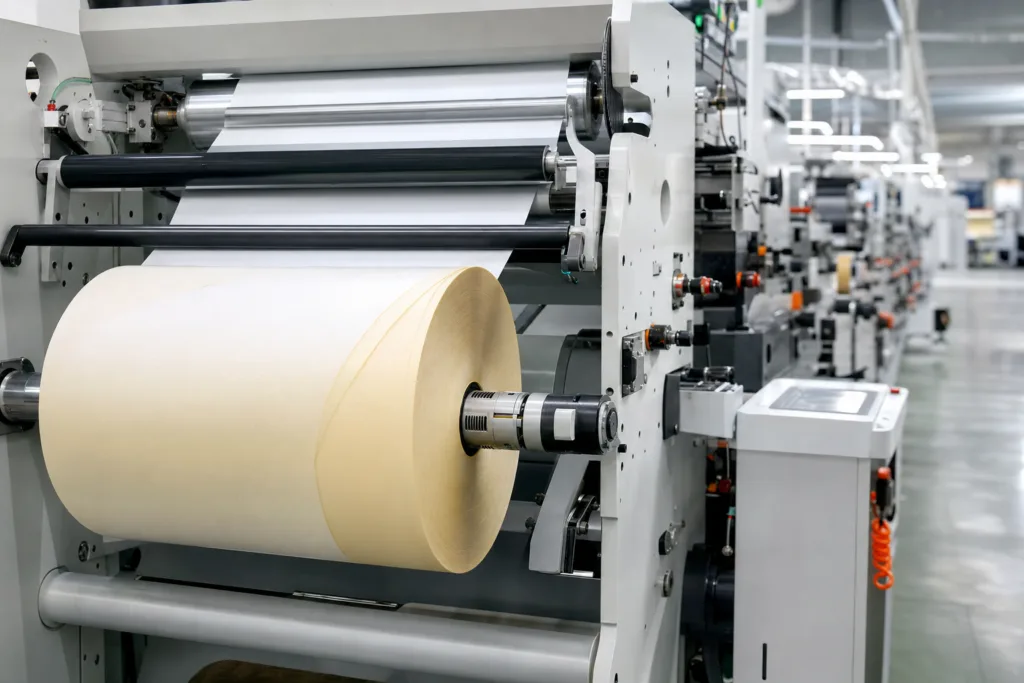
Even a well-designed adhesive can become a production problem if the coating and converting steps are not matched correctly. In label manufacturing, the adhesive layer must be applied at a controlled coating weight, dried or set consistently, paired with the right release liner, and then die-cut, slit, and rewound without blocking, smearing, or edge transfer. Each step can affect final performance.
Converting teams also need to coordinate adhesive selection with facestock, liner, die geometry, and end-use application speed. For a practical view of those production decisions, see our discussion of automated dispensing consistency and the related converting setup logic. Even though label coating is not identical to industrial dispensing, the core requirement is the same: stable delivery produces stable output.
Coating weight, release liner, die-cutting, and rewinding
Coating weight affects peel strength, tack, and the economics of the finished label. Too little coating can reduce bond reliability, while too much can cause squeeze-out, blocking, or poor die-cut quality. Release liner selection matters because the adhesive must release cleanly during application but remain stable in roll form during storage. Die-cutting must avoid cutting too deeply into the liner or too shallowly into the facestock, and rewinding must preserve edge quality without forcing adhesive transfer.
The flexographic and converting side of the label business is highly practical. For example, line setup may need to account for flexible dies, liner choice, and kiss-cut behavior. A useful external overview of these manufacturing points is the label converting and die-cutting considerations article from the Flexographic Technical Association, which aligns well with how converters think about construction, tooling, and finishing.
Printability and compatibility with label converters
Printed labels must hold ink, toner, or other decoration systems without smearing or interacting badly with the adhesive construction. Some label adhesives can cause curl, telegraphing, or edge contamination if the coating is too aggressive for the facestock or if drying is incomplete. That is why print trials should be part of the sample review, especially for variable-data labels, barcode labels, and packaging labels with tight visual requirements.
When a buyer works with an adhesive manufacturer rather than a finished-label reseller, the benefit is control over the construction. We can adjust viscosity, coat weight, open time, and cure behavior to better fit the converter’s line, the printer’s requirements, and the final substrate. That level of coordination reduces the risk of production surprises later.
How to Match Label Adhesive Performance to Product, Storage, and Shipping Conditions
The most efficient way to select a permanent label adhesive is to start with the full route the product will travel. Ask where the label is applied, how long it waits before shipping, how it is packed, whether it experiences vibration or compression, and what temperature or humidity extremes it will see. A warehouse label may need strong immediate tack and abrasion resistance, while a product label for export shipping may need stronger aging resistance and better moisture stability.
If the product will be exposed to multiple conditions, prioritize the worst-case scenario rather than the average one. A label that performs well in a controlled office environment may not be reliable on a part that cycles through refrigerated storage, truck transport, and warm retail display.
Application trials should reflect real use
We recommend testing on actual parts, actual label stock, and actual application conditions. Use the same surface cleaning method, the same application pressure, and the same dwell time that production will use. Then check the label at installation, after 24 hours, after temperature cycling, and after the expected storage or transport period. This simple process often reveals issues that laboratory-only testing misses.
In our formulation and support work, we often find that the first sample request changes after the customer sees how the label behaves on the real substrate. That is not a failure of the process; it is the point of the process. The earlier the project sees real conditions, the easier it is to make the right adjustment.
Testing and Validation Methods for Permanent Label Adhesives
Validation should combine mechanical testing, visual inspection, and practical handling checks. Peel and shear tests are important, but so are edge lift, residue, die-cut stability, print quality, and response to temperature and humidity. Buyers should also check how the label behaves after storage, because a label that passes immediately after production may change after weeks on a shelf.
For permanent labels, useful tests often include:
- Peel adhesion on the actual substrate
- Shear or creep resistance under load
- Hot and cold storage checks
- Humidity exposure or condensation testing
- Print durability and rub resistance
- Application trials at the intended line speed
When a project uses low-energy plastics, it may also be useful to compare untreated surface results with a treated or promoted surface. That comparison helps determine whether the label construction needs a formulation change, a surface treatment step, or both.
Common Failure Modes in Permanent Labels and How to Prevent Them
The most common failures are rarely dramatic at first. A label may lift slightly at a corner, slide after thermal cycling, wrinkle on a curved part, or leave a residue after a storage period. These small issues often trace back to one of a few root causes: poor substrate cleaning, a mismatch between adhesive and surface energy, an application temperature outside the recommended window, or an adhesive that is too soft or too brittle for the service environment.
Typical failure patterns
- Edge lift: often caused by low wet-out, curvature, contamination, or insufficient tack
- Creep or slide: often linked to weak shear resistance or excessive softening at temperature
- Poor adhesion on plastics: usually related to low surface energy and inadequate formulation fit
- Blocking or ooze in rolls: often caused by coating weight, storage heat, or poor cohesion
- Print or die-cut issues: may arise from construction mismatch rather than adhesive chemistry alone
Preventing failure starts with choosing the right adhesive family, but it continues through converting, storage, and application control. If the label stock is technically correct but the line conditions are inconsistent, the final result will still be unstable.
Production and Sourcing Considerations for B2B Buyers
For procurement and sourcing teams, the adhesive decision is also a supply decision. A label project can look good in sample form but still create trouble if the supplier cannot maintain coating consistency, roll quality, packaging stability, or lead-time reliability. Buyers should ask about MOQ, sample availability, batch-to-batch consistency, packaging formats, shelf life, and technical response time.
At ZDS Adhesive, we see the value of planning the product as a production system, not just a chemistry. That means understanding whether the buyer needs pilot quantities, OEM development, private label support, or stable bulk supply. It also means discussing storage conditions, reel dimensions, cure or drying constraints, and downstream application equipment before production begins.
What a good supplier conversation should cover
- Target substrate and surface condition
- Application method and line speed
- Temperature range during installation and service
- Required permanence, removability, or residue tolerance
- Environmental exposure and aging expectations
- Printing, die-cutting, and rewinding compatibility
- MOQ, lead time, packaging, and inventory planning
When to work with a manufacturer directly
If the project involves low-energy plastics, unusually high heat, moisture exposure, or a need for custom roll construction, working directly with a manufacturer is often more efficient than buying a generic product. Direct manufacturing support can help align formulation with coating behavior, improve technical communication, and reduce the number of trial-and-error cycles. For production teams, that often translates into fewer line interruptions and more stable output.
When the project also requires equipment planning for roll handling or conversion, our article on hot melt application equipment provides a useful reminder that process hardware and material choice should be designed together rather than separately. In other applications, plant teams may also review dispensing setup for adhesive production to better understand how repeatability, temperature control, and flow behavior affect final product quality.
Buyer Checklist for Selecting a Permanent Label Adhesive Supplier
Before approving a permanent label adhesive, confirm that the supplier can discuss both chemistry and production. A strong supplier should be able to explain why a specific adhesive family is appropriate, how it behaves on your target surface, what test method was used, and what production limits exist. They should also be able to recommend sample evaluation steps and explain which variables are most likely to affect performance.
- Does the adhesive match the target substrate and service environment?
- Has the label been tested on the actual material, not only on generic panels?
- Is the production line compatible with the adhesive’s viscosity and processing window?
- Can the supplier support formulation changes if the first sample is close but not ideal?
- Are storage, packaging, and shelf-life conditions clearly defined?
- Is batch consistency controlled with clear QC checkpoints?
Conclusion

Permanent label adhesives are a balancing act between immediate application behavior and long-term service reliability. The right label adhesive must wet the substrate, hold through shipping and use, resist heat and moisture, and remain stable across the product life cycle. In industrial projects, success comes from matching the adhesive chemistry to the substrate, the converting process, and the real-world environment rather than choosing by price or habit alone.
For B2B buyers, converters, and OEM teams, the best results usually come from early sample testing, realistic validation, and clear supplier communication. If you approach permanent labels as a performance system instead of a single material, you can reduce failure risk, improve production stability, and build a label construction that stays attached for the life of the product.
Frequently Asked Questions About Permanent Label Adhesives
What makes a label adhesive permanent instead of removable?
A permanent label adhesive is formulated to develop a bond that resists normal removal, handling, and aging. Compared with removable systems, it usually has stronger peel and shear performance and is more likely to leave residue or damage the facestock when removal is attempted. The exact behavior depends on the substrate, surface condition, and environmental exposure.
How do I choose a permanent label adhesive for plastic surfaces?
Start by identifying the plastic type because low-energy materials like polyethylene and polypropylene are much harder to bond than higher-energy plastics. Then test on the real part at the real application temperature. In many cases, surface treatment or an adhesion-promoting formulation is needed to achieve reliable long-term adhesion.
Why is shear resistance important for permanent labels?
Shear resistance shows how well the adhesive resists creeping or sliding under load over time. A label can have acceptable initial tack and peel strength but still fail if the adhesive softens or moves under stress. This is especially important for labels exposed to heat, vibration, or vertical loading.
What should I test before approving a label adhesive for production?
Test the adhesive on the actual substrate, under the actual application conditions, and for the actual service environment. Check peel, shear, edge lift, print durability, and behavior after storage or temperature cycling. If the application is sensitive, also review whether coating weight, liner choice, or application temperature changes the result.
Can you customize a permanent label adhesive for a specific project?
Yes. Customization may involve adjusting tack, peel, shear, viscosity, coat weight, or environmental resistance. In OEM and converter projects, we often adapt the formulation to the substrate, printing process, application speed, and packaging format so the final label construction matches production needs more closely.
What production factors can cause label adhesive performance to vary?
Common factors include coating weight variation, incomplete drying or setting, liner mismatch, die-cutting quality, storage temperature, and inconsistent application pressure. Even a good adhesive can appear unstable if the converting process or application line is not controlled tightly.