Choosing a clear silicone adhesive for glass is rarely just a question of “does it bond?” In real production, buyers need a material that stays visually clean, cures reliably on glass, tolerates movement, and maintains performance after heat, moisture, cleaning, and light exposure. That balance becomes especially important when the bond line is visible, the assembly has tight cosmetic requirements, or the application must perform for years without yellowing, haze, cracking, or edge lift.
For teams comparing glass bonding options, our optically clear adhesive selection guidance is a useful starting point because it frames the same core decision: appearance versus reliability, and how formulation, cure behavior, and substrate compatibility affect the final result. From our adhesive manufacturing perspective, we often help customers evaluate whether a silicone system should prioritize transparency, flexibility, weather resistance, dispensing behavior, or long-term durability, then adjust viscosity, cure profile, and packaging to fit the production line.
Why clear silicone adhesive for glass must balance appearance and reliability
Glass projects often fail for one of two reasons. Either the adhesive looks good at first but loses bond performance later, or it bonds strongly but creates a visible defect that product teams cannot accept. A clear silicone adhesive for glass sits between those two requirements. Silicone is attractive because it remains flexible, handles thermal movement well, and can maintain serviceability in environments where rigid adhesives would crack. But clarity depends on formulation quality, surface preparation, bead control, and cure management.
In practical sourcing, “clear” does not automatically mean optical-grade. A clear silicone may still show slight haze, microbubbles, edge distortion, or tint when it is applied in a thick bead or cured under poor conditions. That is why we recommend evaluating the adhesive in the real joint design, not only in a small lab smear.
What makes clear silicone different from other glass bonding options
Compared with epoxy, acrylic, or polyurethane systems, silicone is usually chosen when flexibility, weather resistance, and thermal movement are more important than maximum rigidity. Glass expands and contracts with temperature changes, and dissimilar substrates expand differently again. A rigid adhesive can build stress at the interface. Silicone, by contrast, can relieve stress and help preserve the bond under repeated cycling.
That advantage comes with trade-offs. Silicone usually does not provide the same structural stiffness as a high-strength epoxy. It may also require more careful attention to cure time, surface energy, and bead geometry. For decorative or visible assemblies, the adhesive must also maintain a clean line and avoid optical defects. In our development work, we treat this as a system design problem, not a single-material decision.
| Selection Factor | Why It Matters on Glass | Typical Silicone Advantage | Common Trade-Off |
|---|---|---|---|
| Transparency | Visible bond lines affect appearance | Can be formulated for clear appearance | Clarity can drop with bubbles or thick sections |
| Flexibility | Glass joints move with temperature and vibration | Stress relief and movement accommodation | Lower rigidity than structural adhesives |
| Weathering | Outdoor exposure is common | Good moisture and UV resistance potential | Must be qualified by actual aging tests |
| Dispensing | Cosmetic bead shape matters | Good processability in controlled systems | Need correct nozzle, viscosity, and setup |
Key performance requirements for clear glass assemblies
When we review a project requirement, we usually separate the performance target into five parts: appearance, adhesion, flexibility, environmental resistance, and production stability. If any one of these is missing, the project can fail in the field or on the line.
Transparency and visual consistency
Transparency is not just about a colorless appearance in the container. The cured bond line must remain visually stable across the real joint thickness. Formulation ingredients, filler content, and cure chemistry all influence clarity. A thick bead is more likely to show haze than a thin line, and trapped air or partial curing can make the bond look cloudy even if the chemistry is sound.
One useful comparison point is the relationship between silicone structure and optical behavior. Our silicone clarity and optical behavior discussion explains why formulation balance matters when light passage, haze control, and refractive matching affect the visible result. For glass bonding, the same principle applies: the adhesive should not create distracting distortion or a visible “wet line” that clashes with the product design.
Bond strength and stress management
Clear appearance matters only if the adhesive also anchors the joint through the expected service life. On glass, the most important question is often not ultimate strength alone, but whether the adhesive can hold when the assembly experiences repeated expansion, vibration, impact, or cleaning. Silicone’s flexibility helps reduce interfacial stress, especially where glass meets metal frames, painted housings, or mixed-material decorative components.
For projects that demand more heat-resistant silicone behavior in adjacent metal or frame areas, the technical principles used in high-temperature RTV silicone performance can be useful. Even when the substrate is glass, the surrounding structure may impose the same temperature and movement challenges that affect RTV selection.
UV resistance and weathering resistance
Many buyers ask whether a clear silicone will stay clear outdoors. The honest answer is that this depends on formulation and qualification, not on the word “clear” alone. Glass assemblies exposed to sunlight, rain, condensation, and temperature cycling can reveal slow changes that do not appear in short bench tests. A good evaluation should cover color stability, bond retention, and appearance after exposure, not only initial tack or early cure.
For environmental qualification, a relevant reference is ISO’s guidance on aging and weathering through glass, which underscores why heat, water, and artificial light exposure must be considered when judging sealant durability. In buyer terms, this means a clear silicone adhesive for glass should be tested after environmental exposure, not only judged when it first cures.
How clarity is affected by formulation and application thickness
Clarity is often lost in three places: the formulation itself, the dispensing process, and the final joint geometry. If the base polymer contains ingredients that scatter light, or if the product includes additives needed for other performance targets, the cured line can appear less transparent. Even a good formulation can look poor if it is applied too thickly or cured unevenly.
A thinner, controlled bond line generally looks cleaner than a wide, domed bead. That does not mean the thinnest possible line is always best. The joint still needs enough adhesive volume for wetting, stress distribution, and process forgiveness. The right answer is usually a bead profile that balances optical neatness with mechanical coverage.
Bubble formation, haze, and shrinkage
Bubbles are one of the fastest ways to spoil the look of a transparent joint. They can come from trapped air during mixing, from poor dispensing setup, from substrate contamination, or from a process that skins too quickly at the surface. Haze can also appear when the adhesive does not wet the glass uniformly, leaving tiny discontinuities that reflect light.
We see this often in projects where the customer has the right material but the wrong application method. For that reason, our bubble control and void prevention article is relevant even though it discusses potting: the same production logic applies to clear silicone on glass. The joint must be designed to reduce air entrapment, control flow, and avoid process-induced voids that become visible after cure.
Shrinkage is usually less dramatic in silicone than in many other chemistries, but even small movement during cure can affect the bond line appearance. If the adhesive pulls away from the edge or settles unevenly, the result may look like poor transparency even if the chemistry is acceptable.
Cure behavior on glass: moisture, speed, and humidity
Most clear silicone adhesive for glass projects rely on a moisture-cure mechanism or another cure system that is compatible with the production workflow. Cure speed matters because it affects fixture time, handling strength, and line throughput. But faster is not automatically better. If the surface skins too quickly, internal cure may lag and bubble removal can become difficult. If the cure is too slow, the assembly may shift before the bond sets, creating edge defects or misalignment.
Humidity, bead thickness, and ambient temperature all influence cure behavior. Thin sections may cure faster than thick sections because moisture can penetrate more easily. Larger beads or sealed geometries may need more time for the center to fully develop. In production, we recommend that buyers check the cure profile under the same humidity and temperature range they expect on the line, not just under a convenient lab condition.
Dispensing method and visual quality
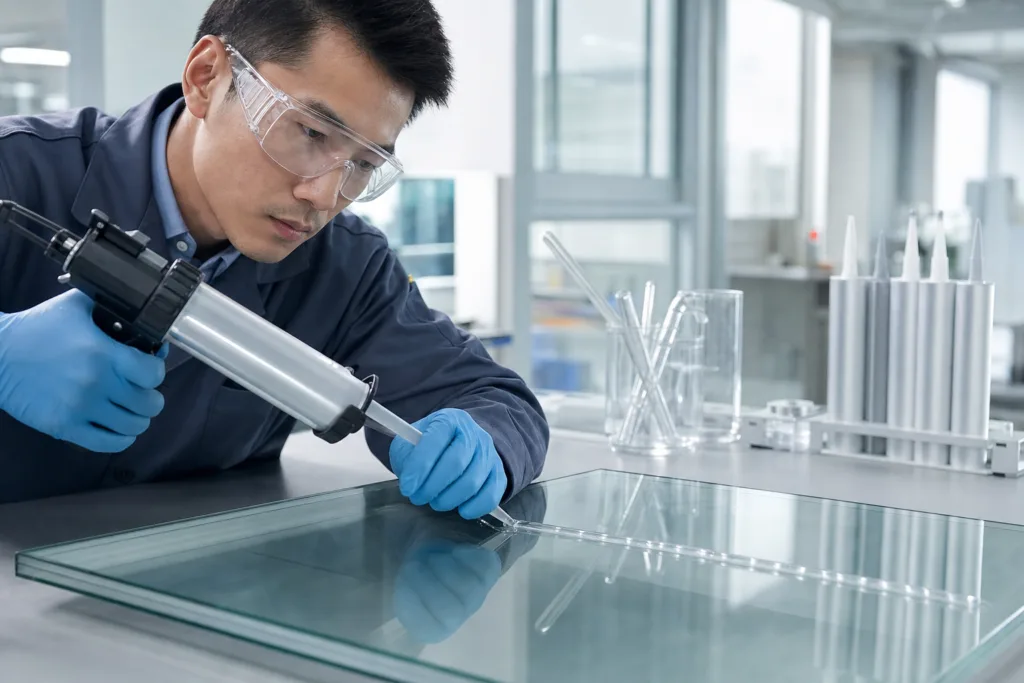
Good transparency is often tied to good dispensing. A stable nozzle, consistent pressure, proper pump selection, and the right bead speed can make a large difference in the final appearance. When a project requires a narrow, even line with minimal rework, the application system becomes part of the material specification.
Our dispensing setup for silicone adhesives resource is useful for teams planning production because it shows why equipment choice affects bead uniformity, air entrapment, and process repeatability. In many cases, a clear silicone is only as good as the machine that places it.
| Process Variable | Effect on Appearance | Effect on Performance | Buyer Checkpoint |
|---|---|---|---|
| Bead size | Controls visual line width | Influences gap fill | Match to joint geometry |
| Dispensing speed | Affects smoothness and continuity | Can trap air if too fast | Review in-line trial results |
| Humidity | Can change surface cure and finish | Controls cure progression | Test at actual plant conditions |
| Film thickness | Impacts haze and clarity | Influences total cure time | Verify full-depth cure |
Adhesion to glass and adjacent materials
Glass may be the primary substrate, but most assemblies include more than one material. Frames, trims, clips, spacers, decorative inserts, seals, or electronic components can all change the selection logic. Clear silicone should adhere well to glass, but the surrounding materials often determine whether a primer is needed, whether surface treatment is required, and whether the adhesive must resist oils, paint residues, or low-surface-energy plastics.

For mixed-material assemblies, the main challenge is compatibility across all contact surfaces. A silicone that bonds well to glass may need a primer or surface preparation on metal or painted parts. Some plastics can be more difficult because release agents, mold residues, or low surface energy reduce wetting. That is why we always ask customers for full substrate details before recommending a trial formula.
When primers help
Primers can improve adhesion where the surface is difficult, contaminated, or highly variable. They can also add process control in production if the substrate condition changes from lot to lot. However, primers introduce another step, another material, and another potential error. If the application is simple and the surface is well prepared, a primer-free system may be more efficient.
The decision should be based on actual test results. A quick manual pull test on a small sample, followed by aging and recheck, often gives better guidance than assumptions about chemistry alone.
Indoor, outdoor, architectural, appliance, and decorative use cases
Indoor glass assemblies often prioritize clarity and clean edge appearance. Outdoor assemblies usually need higher weathering confidence, stronger attention to UV exposure, and more tolerance for thermal expansion. Architectural glass projects can place heavy emphasis on long-term dimensional stability and moisture resistance. Decorative products, display panels, and appliance windows often care about a clean cosmetic line and resistance to cleaning chemicals.
Each environment changes the definition of “good enough.” A bond that looks perfect in a showroom may still fail if it sees repeated steam, sunlight, or vibration. A bond that survives outdoors may be cosmetically too visible for a premium interior product. For that reason, we recommend writing the requirement in application language, not chemistry language: where will it be used, what will it touch, what stress will it see, and how long must it last?
How reliability should be evaluated
Long-term reliability should be judged through a combination of thermal cycling, moisture exposure, aging, vibration, and chemical contact. If the glass assembly will be cleaned regularly, the buyer should include the intended cleaning agents in the validation plan. If the assembly is near heat sources, repeated hot-cold cycling matters more than single-point heat resistance.
Procurement teams often focus on initial sample appearance, but in our production work we find that aged samples are more valuable. A material that starts clear but loses clarity, softens too much, or lets go at the edge is not a safe choice for production release.
What buyers should verify in technical data and sample testing
A technical data sheet can tell you a lot, but not everything. For a clear silicone adhesive for glass, the most useful items are cure method, working time, tack-free time, hardness, elongation, temperature range, weathering notes, and recommended substrate preparation. If the TDS does not speak to optical appearance, ask for sample testing or application notes from a similar use case.
In sample evaluation, we recommend checking three levels. First, inspect the fresh bead for flow, self-leveling, and air release. Second, inspect the cured line for clarity, edge definition, and full cure. Third, inspect the aged sample after heat or moisture exposure for haze, yellowing, shrinkage, or adhesion loss. The point is not to chase a perfect lab result; the point is to confirm the product will behave well in your process.
Testing plan before production
- Confirm appearance in the final bond line thickness, not only in a thin smear.
- Check adhesion on the exact glass type and adjacent materials used in the product.
- Verify cure completion through the full bead depth.
- Evaluate after thermal, moisture, and light exposure that reflect the real use environment.
- Run a dispensing trial to confirm bead shape, air release, and line speed.
Common mistakes that create visible or structural failure
One frequent mistake is assuming that all glass is identical. Coatings, residues, fingerprints, and cleaning agents can all affect wetting. Another mistake is using a material that looks clear in the cartridge but becomes cloudy when applied too thickly. A third mistake is skipping line trials and relying on theoretical compatibility.
We also see problems when buyers change the dispensing setup after sample approval. Even a good adhesive can produce a poor result if nozzle size, pressure, or bead speed changes. Production consistency is not only a chemistry issue; it is a process-control issue. That is why our teams often discuss the material together with equipment settings and inspection criteria.
Why production consistency matters
If the visual result changes from one batch to the next, the whole project becomes difficult to control. Buyers should ask about batch consistency, packaging options, shelf-life expectations, and storage conditions. These are not secondary details. They affect how the adhesive behaves in the real plant.
For buyers planning scale-up, our adhesive dispensing equipment selection guidance can help align the material with the process, while automated dispensing for production consistency shows why repeatable application often matters as much as the formula itself. When the line is automated, small changes in viscosity or cure profile can become highly visible.
How custom formulation and OEM supply can help
Not every project can use a standard clear silicone. Some customers need a lower-viscosity grade for better flow into a narrow joint. Others need slower skinning to allow more open time. Some need improved clarity for decorative parts, while others need a stronger focus on outdoor durability or mixed-substrate adhesion. Custom formulation exists for exactly these trade-offs.
At ZDS Adhesive, we often support OEM and private label buyers by adjusting key parameters such as viscosity, cure speed, hardness, packaging, and application behavior. The goal is to fit the material to the manufacturing process and the product’s visual target, not force the process to adapt to a generic adhesive. For buyers comparing suppliers, this is where a manufacturer relationship becomes valuable: you can test, refine, and scale with fewer surprises.
| Customization Need | Why It May Be Requested | Typical Result |
|---|---|---|
| Lower viscosity | Better flow into narrow glass joints | Smoother dispensing and better wetting |
| Slower cure | Longer assembly time or larger parts | More working time before fixture |
| Higher clarity focus | Visible bond line or premium design | Reduced haze risk when processed correctly |
| Improved weathering focus | Outdoor or light-exposed use | Better durability target for service life |
Specification checklist for sourcing clear silicone adhesive for glass

Before approving a supplier, we suggest asking these practical questions: Is the adhesive intended for glass as the primary substrate? Does it cure at a rate that fits your line? How does it perform in the bond thickness you actually use? What does the supplier recommend for surface preparation? Are sample quantities available for real trials? Can the supplier support packaging and labeling needs if the product moves to OEM or private label supply?
You should also ask how the product is controlled from batch to batch, what shelf-life conditions apply, and whether the manufacturer can offer support if the bead appearance or cure rate changes after scale-up. Good sourcing decisions reduce both technical risk and production friction.
Frequently asked questions about clear silicone glass bonding and sealing
Is a clear silicone adhesive for glass always waterproof?
Not automatically. Silicone systems are often selected because they resist moisture well, but the final performance depends on formulation, surface preparation, cure completion, and joint design. For wet or outdoor service, you should verify the product under the actual exposure conditions rather than assuming all clear silicone grades behave the same.
Will clear silicone stay transparent after curing?
It can, but transparency depends on the formulation, bead thickness, bubble control, and curing conditions. A material that appears clear in the cartridge may still show haze or visual distortion if the joint is too thick or the process traps air. Testing the final bond line is the safest way to judge appearance.
Do I need a primer for glass bonding?
Sometimes, but not always. Clean glass often bonds well with the right silicone system, while contaminated, coated, or mixed-material assemblies may benefit from a primer or surface treatment. The decision should be based on adhesion trials using the actual substrates and processing conditions.
How do I reduce bubbles in a clear silicone bead?
Use a dispensing setup that avoids air entrapment, keep the substrate clean and dry, and match nozzle size and pressure to the joint design. Bubbles are often a process problem rather than a chemistry problem, so the application method must be tested along with the adhesive.
Can clear silicone replace structural adhesive on glass?
Only when the design loads and performance requirements fit silicone’s flexibility-based strengths. Silicone is excellent for stress relief, movement accommodation, and weather resistance, but it may not match the stiffness of a structural epoxy system. The right choice depends on the joint function, not just the appearance.
What should I test before approving production?
At minimum, test appearance, adhesion, cure completion, and aged performance on the real glass and adjacent materials. Include the environmental conditions that matter to your product, such as humidity, heat, light, vibration, or cleaning chemicals. A small but realistic pilot run usually reveals more than a single bench sample.