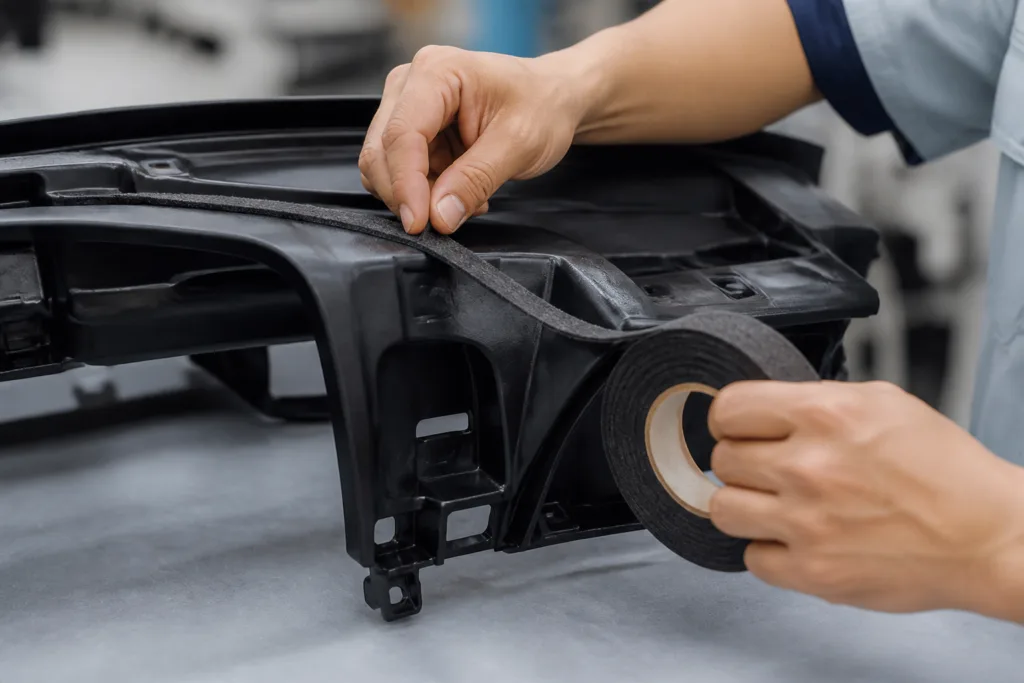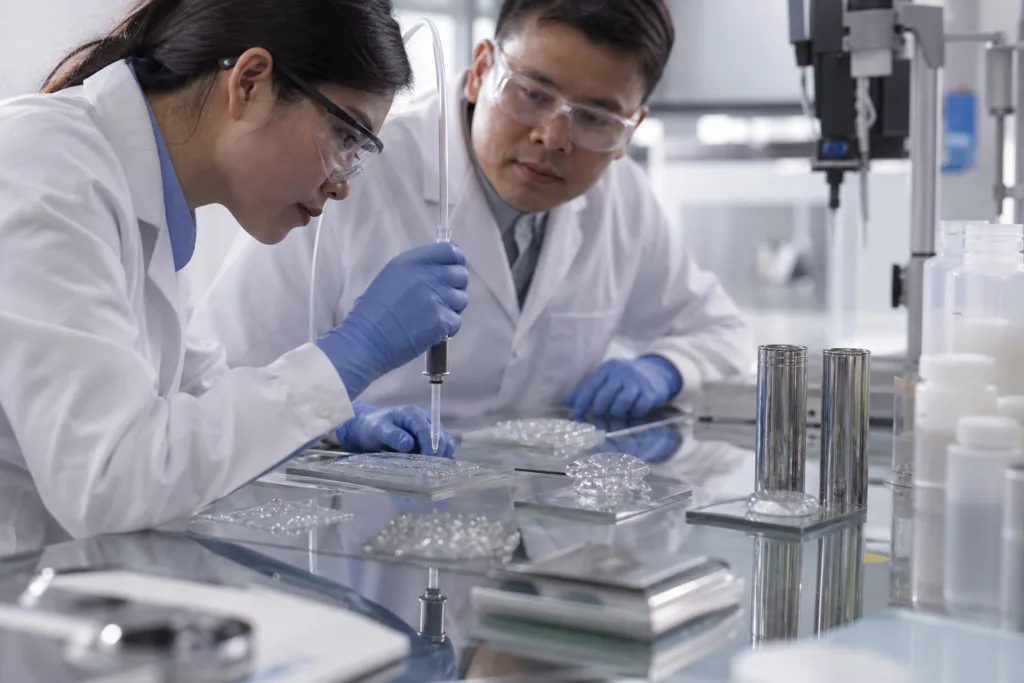
Choosing medical device adhesives is not the same as choosing a general-purpose industrial glue. For disposable devices and precision assemblies, the adhesive has to support small bond lines, fast cycle times, predictable cure behavior, clean processing, and performance that still makes sense after sterilization, packaging, shipping, and shelf life exposure. The right choice depends on the substrate pair, the device architecture, the manufacturing line, and the quality system around it—not just on initial bond strength.
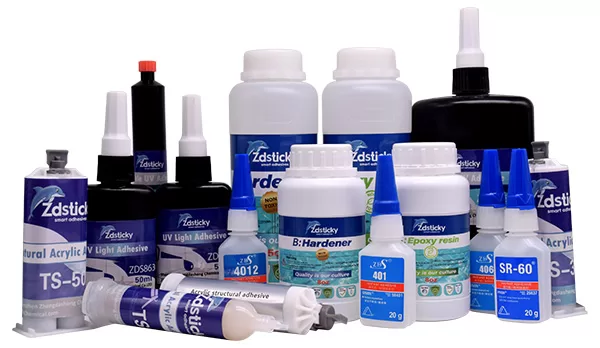
medical-grade cyanoacrylate selection guidance is a useful starting point when a program needs rapid fixture time, small bond areas, or simple assembly steps. From our adhesive manufacturing perspective, the real decision is broader: we look at substrate chemistry, viscosity, odor, blooming risk, process window, sterilization route, and how consistently the adhesive can be dispensed in production. At ZDS Adhesive, that is the same logic we use when supporting sample evaluation, formulation tuning, OEM/ODM supply, and bulk production planning for medical assemblies.
What Medical Device Adhesives Need to Do in Disposable and Precision Assemblies
Medical device assembly often combines tight tolerances with high throughput. A disposable product may look simple, but the adhesive still has to hold under vibration, handling, fluid exposure, temperature change, and sometimes short-term sterilization stress. In precision assemblies, the bond line may be tiny, the parts may be thin-walled, and the operator or automation equipment may have only seconds to place and cure the adhesive.
That means the adhesive must do more than “stick.” It must support the production method. In practice, we ask questions such as: Does the part need instant handling strength or a longer open time for alignment? Will the bond need flexibility to absorb movement, or stiffness to hold a sensor in place? Will the product contact skin, fluids, disinfectants, or packaged sterilization conditions? The answer determines chemistry, cure route, and the level of process control required.
Typical device functions that the adhesive must support
- Bonding wearable housings, clips, and small structural parts
- Securing tubing, cannulas, filters, and fluid connectors
- Fixing sensors, films, and electronic modules inside compact enclosures
- Sealing disposable housings and preventing leakage paths
- Potting or encapsulating delicate components that need moisture or vibration protection
Why Medical Device Selection Is Different From General Industrial Bonding
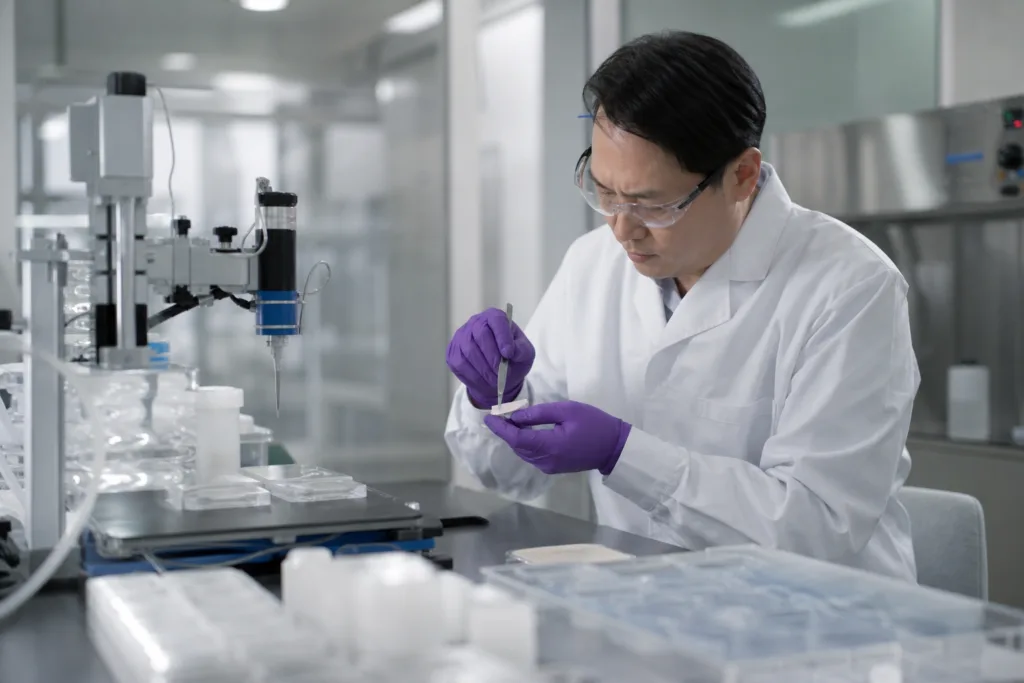
General industrial bonding often focuses on strength, cost, and production speed. Medical device selection adds another layer: the adhesive must fit the finished device as a regulated system. The raw adhesive is only one piece of the equation. We also have to consider residues, sterilization effects, extractables risk, documentation, and the final user environment.
This is why the adhesive choice is usually tied to process validation and change control. Once a device is qualified, even a small adjustment in viscosity, cure speed, or packaging can affect dispensing accuracy or bond quality. For that reason, buyers should evaluate whether the supplier understands repeatability, lot-to-lot control, and the practical realities of validation, not just the chemistry on paper. FDA guidance on biocompatibility emphasizes that the finished device and its processing history matter, not only the individual material used in isolation; that is especially important when adhesives, substrates, and sterilization methods interact in the final assembly. FDA biocompatibility expectations for finished medical devices are therefore relevant to adhesive selection discussions.
Common Medical Device Applications: Wearables, Tubing, Housings, Sensors, and Single-Use Components
Different device types create different bonding problems. A wearable patch may need a flexible, low-profile bond with skin-contact considerations. Tubing assemblies may require resistance to fluids and a secure seal without stress cracking the tube. Sensor modules may need a precise, low-outgassing adhesive that will not contaminate optics or electronics. Single-use housings often need a balance of speed, cost, and reliable sealing in high-volume production.
In many cases, the bond line is very small, so surface condition and application accuracy matter more than bulk adhesive volume. A thin, well-controlled bead can outperform a larger, messier application that traps air or interferes with fit-up. That is why we often discuss dispensing hardware and fixturing at the same time we discuss chemistry.
For lines that depend on tight bead size, shot consistency, and repeatable placement, precision dispensing for medical assembly is part of the adhesive decision, not an afterthought. The adhesive must be compatible with the pump, valve, needle, and cycle time used on the line.
Understanding Adhesive Chemistries for Medical Use
The most common chemistry families used in medical device adhesives each solve different problems. There is no universal winner. The better choice depends on the material set, cure window, and the mechanical demands of the final device.
| Chemistry | Typical Strengths | Key Trade-Offs | Common Use Cases |
|---|---|---|---|
| Cyanoacrylate | Very fast cure, small bead, high handling speed | Can be brittle, moisture-sensitive during storage, blooming risk | Small plastic parts, clips, tubing anchors, quick assembly |
| UV-curable | Fast on-demand cure, clean processing, precise timing | Needs light access and compatible substrates | Clear parts, electronics, film bonding, assembly stations |
| Epoxy | Strong structural performance, chemical resistance | Longer cure, more process control needed | Sensors, housings, structural bonds, potting |
| Silicone | Flexibility, stress relief, thermal and moisture tolerance | Lower structural rigidity, cure profile must be managed | Wearables, flexible assemblies, sealing, encapsulation |
| Polyurethane | Balanced toughness and flexibility | Moisture sensitivity in some systems, cure tuning needed | Plastic and elastomer bonding, sealing, protective assembly |
| Acrylic | Good balance of speed, toughness, and adhesion range | Odor, cure control, and substrate prep still matter | Mixed-material assemblies and high-throughput lines |
When cyanoacrylate makes sense
Cyanoacrylate is often chosen when the device needs a very fast tack or instant handling strength. It can be a practical solution for disposable products, small assemblies, and low-bond-volume designs. In our work, it is usually considered when the line requires fast cycle times, minimal fixture delay, and simple application. The main caution is that cyanoacrylate can be more brittle than other chemistries, and in some applications it may not tolerate peel or impact well.
That is also where application detail matters. The same adhesive can perform differently depending on bead size, humidity, substrate energy, and how tightly the parts fit. When a team needs to accelerate cure without losing control, faster instant-adhesive cure methods can be evaluated carefully, but only with a full understanding of the device geometry and the final performance requirement.
UV-curable, epoxy, silicone, polyurethane, and acrylic choices
UV-curable systems are attractive when the assembly design allows light access and the process needs exact cure timing. Epoxies are often selected for stronger structural demands or improved chemical resistance, but they may need longer cure or heat assistance. Silicones are valuable when the assembly must flex, absorb stress, or tolerate thermal cycling. Polyurethanes can offer a useful balance for assemblies that need toughness without becoming too rigid. Acrylics can work well in mixed-substrate designs where speed and adhesion range both matter.
For each chemistry, we look at the same practical variables: how the adhesive wets the substrate, whether the line can place the adhesive accurately, what the cure looks like in production, and whether the final assembly remains stable after aging. The chemistry is important, but the process window is just as important.
Substrate Compatibility: Plastics, Elastomers, Metals, Films, and Coated Surfaces
Medical devices often combine hard and soft materials in one assembly. A housing may be polycarbonate or ABS, the tubing may be silicone or TPU, the connector may be metal, and the label or barrier film may be coated with a low-energy surface. That combination makes substrate compatibility a central issue.
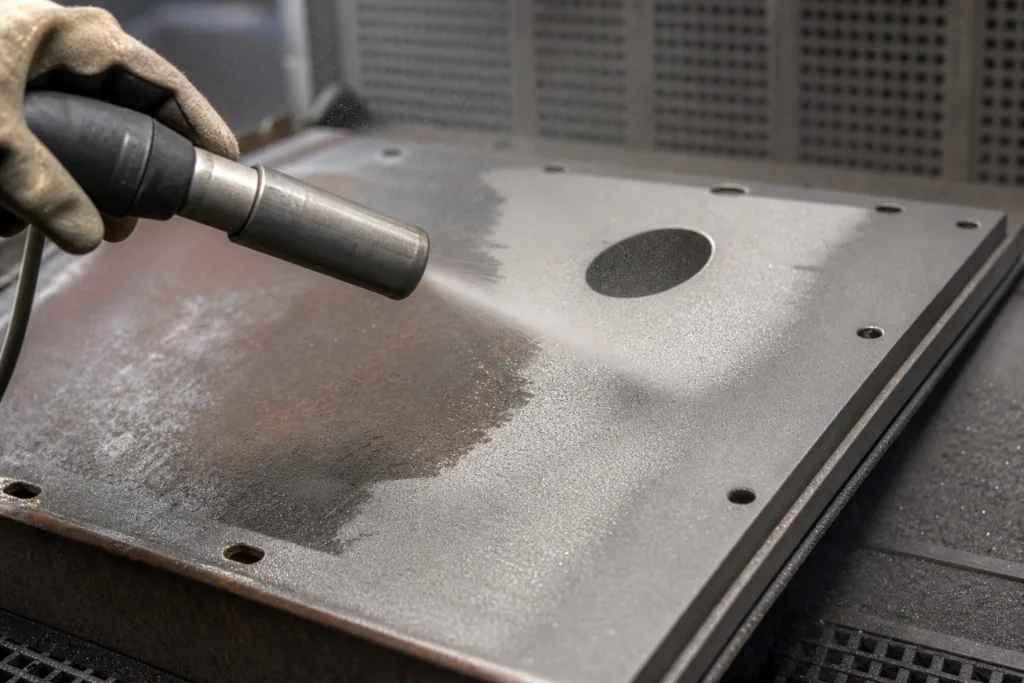
One common mistake is assuming that any adhesive that bonds one plastic well will bond all plastics well. Low-surface-energy materials such as polypropylene, polyethylene, POM, or fluoropolymer-based surfaces can be especially difficult. In those cases, surface treatment, primers, or formulation changes may be required. We also check whether the adhesive will stress-crack sensitive plastics or leave a residue that affects the downstream appearance or function of the product.
For hard-to-bond plastics, bonding low-surface-energy plastics often requires more than simply changing the glue. Surface activation, primer selection, and bead control can all matter. In our formulation and application support work, we often evaluate both the adhesive and the substrate prep method together.
When a project involves very difficult polymer surfaces, the right support path may include priming difficult medical plastics as part of the process qualification plan. This is especially relevant for disposable devices that need stable assembly across large batches.
Key Performance Requirements Beyond Initial Bond Strength
Bond strength is only one performance metric. For medical devices, the adhesive also needs the right balance of flexibility, peel resistance, cure cleanliness, odor, and environmental stability. A high-strength adhesive that creates stress in a delicate housing may be less useful than a moderate-strength adhesive that holds consistently without distortion.
Flexibility matters in wearable devices, tubing terminations, and compact assemblies that move during use. Peel resistance matters when thin films or layered materials may be lifted in service. Low odor and clean curing matter in enclosed housings and sensitive production areas. For electronics-related assemblies, the adhesive must also avoid interference with sensors, optics, or electrical pathways.
When buyers review a TDS, we recommend checking not only the headline cure speed but also the viscosity range, recommended surface prep, temperature limits, and the adhesive’s behavior under humidity or aging. Those details often explain why a material performs well in sample testing but struggles in production.
Sterilization Compatibility and Aging Effects
Sterilization is one of the biggest reasons medical adhesive selection differs from general industrial bonding. Gamma radiation, ethylene oxide, and steam can each affect polymer structure, bond integrity, color, flexibility, and residual profile. Even when the adhesive itself looks acceptable before sterilization, the final device must still be tested after the real processing route.
That is why we discourage teams from qualifying on raw adhesive data alone. The final assembled device may behave differently once it has gone through the full packaging and sterilization sequence. For sterilized device programs, post-process testing should reflect the actual manufacturing route and any relevant residues or aging effects. FDA guidance on sterilization compatibility and post-process testing requirements supports this final-device approach.
Aging is equally important. A disposable product may have a short use life, but it may still spend months in distribution and storage. The adhesive must remain stable through that period and should not become brittle, lose tack, or generate unwanted residues. We therefore look at shelf-life planning, storage temperature, packaging, and whether the adhesive system is sensitive to moisture, light, or air exposure.
Process Compatibility in Manufacturing
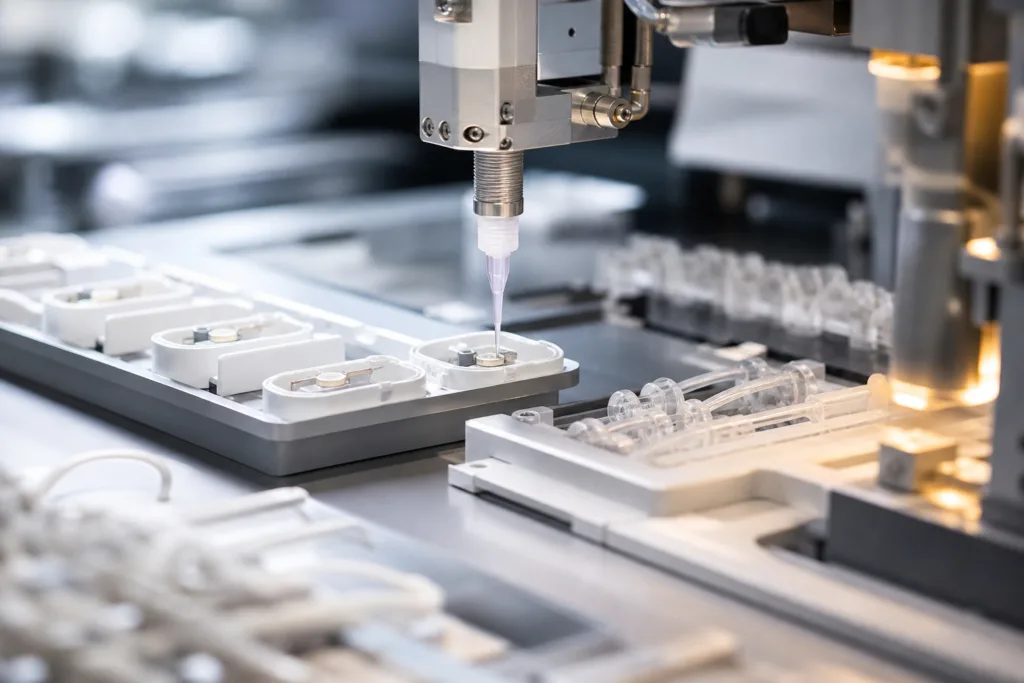
In medical assembly, a technically good adhesive can still fail if it does not fit the process. Open time, pot life, cure speed, and viscosity all affect line efficiency. If the adhesive gels too fast, operators may lose working time. If it cures too slowly, fixtures remain occupied and throughput drops. If viscosity drifts, automated dispensing may become unstable.
From a manufacturing perspective, the adhesive should match the line’s method of placement. Manual dispensing, semi-automated stations, and fully automated systems all place different demands on rheology and consistency. That is why we often review the application hardware together with the adhesive formula. For broader production alignment, repeatable adhesive application systems help reduce variability and make qualification easier.
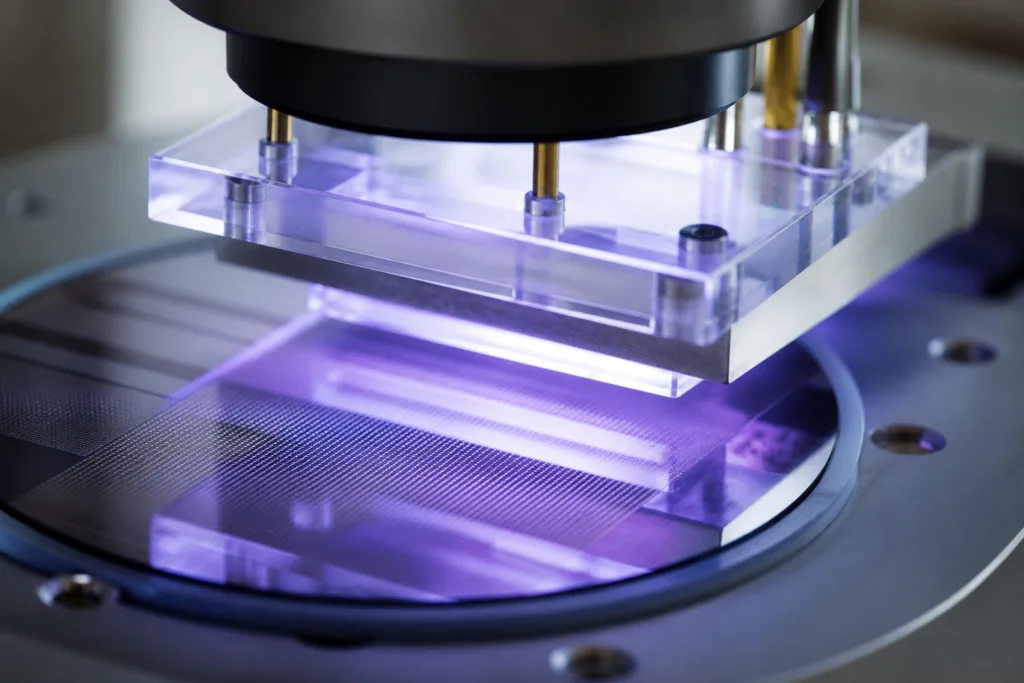
Precision dispensing is especially valuable when the device has small parts, shallow bond lines, or narrow sealing paths. Any variation in shot size can create flash, starvation, incomplete wetting, or cosmetic defects. The cure method must also fit the takt time. UV systems may help when immediate cure is needed, while moisture-cure or heat-cure systems may be better when the assembly design allows more dwell time.
How to think about automation and throughput
- Match viscosity to nozzle size, pump type, and dispense speed
- Confirm that open time is long enough for placement but short enough for throughput
- Check whether the cure mechanism fits the takt time and fixture strategy
- Verify that the adhesive remains stable in the storage and loading environment
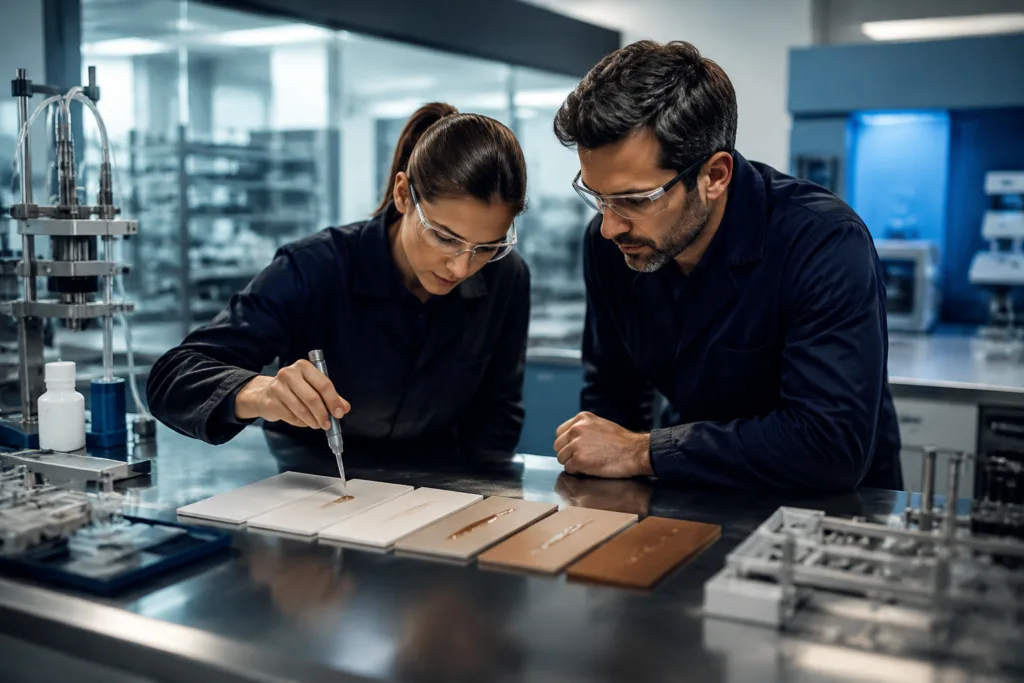
- Run sample trials with the actual substrate and real-line equipment whenever possible
Designing for Disposable Device Assembly
Disposable products are highly sensitive to cost, but low cost does not mean low engineering effort. In these programs, the adhesive must usually support high volume, simple process steps, and low waste. Packaging format can matter as much as chemistry because it affects how the material is handled on the line and how much is lost in setup or changeover.
Lot consistency is critical. If a disposable product is built in large batches, even modest variation in viscosity or cure speed can affect yield. The best way to protect production is to standardize as many factors as possible: substrate surface condition, dispense method, cure conditions, and inspection criteria. When an adhesive is intended for high-volume use, the supplier should be able to discuss not only formulation but also packaging options, lead time, and quality controls that support repeatable supply.
At ZDS Adhesive, we treat disposable-device programs as process integration projects. That means we pay attention to both the chemistry and the production workflow: sample quantity, application method, cure profile, packaging size, and bulk consistency all matter to the commercial outcome.
Traceability and Quality Control
Medical manufacturing requires documentation discipline. Buyers should expect COA review, TDS alignment, batch traceability, and change-control communication. If the adhesive is part of a validated line, the supplier’s documentation quality can be as important as the material itself.
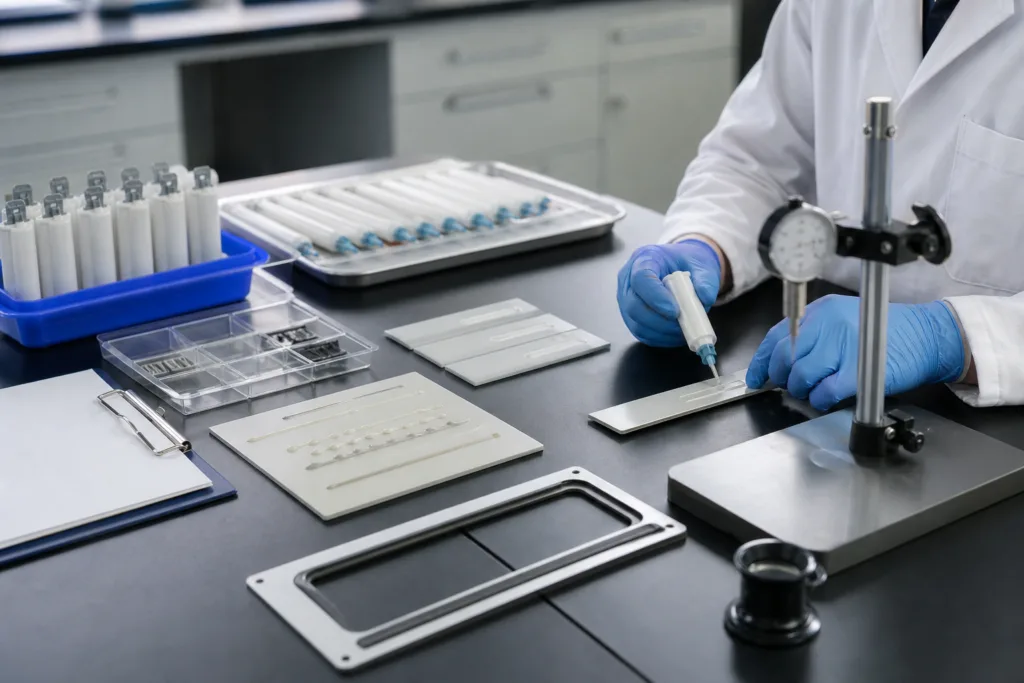
Good quality control starts with understanding what to inspect. Typical checkpoints include appearance, viscosity, dispense behavior, cure response, bond integrity, odor, packaging integrity, and storage stability. If the adhesive is used in a regulated device, records should show how the chosen material was tested, when it was approved, and how changes will be managed going forward. FDA process validation guidance reinforces the need to define and control parameters so the process consistently produces product within specification; in adhesive assembly, that means the dispense and cure steps cannot be treated casually. Process validation for adhesive dispensing and cure control is directly relevant to this workflow.
We also recommend checking whether the supplier can support change notification discipline. A small formulation update, packaging change, or raw-material substitution can have a major impact on a validated assembly line. For medical products, traceability is not just a paperwork issue—it is part of risk control.
Common Failure Modes in Medical Device Bonding
Most adhesive failures in medical device programs are not mysterious. They usually come from a mismatch between chemistry, surface, and process. The most common problems include poor wetting, weak adhesion to low-energy plastics, stress cracking, excessive blooming, incomplete cure, voids in the bond line, and performance drift after sterilization or aging.
Another frequent issue is over-specifying one property while ignoring another. A team may focus on strength, but the real problem is peel resistance or flexibility. Or the adhesive may be chemically suitable, but the dispense method leaves too much variation from part to part. In those cases, the fix is rarely just “choose a stronger adhesive.” It is more often a combination of better surface prep, different cure strategy, and tighter process definition.
How to prevent avoidable bonding failures
- Test the adhesive on the real substrate combination, not a simplified proxy
- Evaluate after sterilization, aging, and packaging exposure when relevant
- Confirm cure completion under production conditions, not only in lab conditions
- Review whether primers, activators, or surface treatments are needed
- Check whether the adhesive chemistry matches the device’s flexibility and stress profile
How to Evaluate a Medical Adhesive Supplier or Custom Formulation Partner
For medical device manufacturers, the supplier evaluation should go beyond catalog breadth. The right partner can help with formulation matching, dispensing support, sample design, packaging strategy, and quality-system communication. The wrong partner may offer a material that looks acceptable in the lab but is not prepared for the documentation and consistency demands of production.
Useful questions include: Can the supplier explain why a chemistry is suitable for the substrate combination? Can they suggest testing variables instead of only sending a sample? Can they support OEM or private label supply if the project grows? Do they understand lot consistency, lead time, and production continuity?
If the program requires a more controlled surface-prep or primer strategy, supplier resources such as faster instant-adhesive cure methods and related application guidance can help the engineering team shorten iteration time while keeping the process controlled.
Selection Checklist for Matching Adhesive Choice to Device Design
Before approving a material, we recommend walking through a simple checklist that links the adhesive to the device and the line.
- What substrates are being bonded, and are any of them low-surface-energy materials?
- Does the device need rigidity, flexibility, or a balance of both?
- What is the required fixture time, open time, and cure speed?
- Will the assembly undergo gamma, ETO, steam, or other sterilization?
- Is the adhesive used in a visible area where blooming, odor, or residue matters?
- Does the line use manual dispensing, semi-automation, or full automation?
- What documentation, traceability, and change-control expectations apply?
- What packaging size, shelf life, and supply frequency fit the production plan?
This checklist helps buyers compare products more consistently. It also makes technical discussions with suppliers more efficient because the conversation shifts from generic claims to the actual application conditions.
When a project needs a more structured application plan, the combination of adhesive selection and equipment choice can make or break the result. That is why we often advise teams to review both chemistry and hardware before freeze-point approval. In many cases, choosing the right adhesive is really choosing the right system.
Conclusion
The best medical device adhesives are the ones that fit the device, the process, and the quality system together. For disposable products and precision assembly, that means looking beyond basic bond strength and evaluating substrate compatibility, sterilization response, cure behavior, process window, and supply consistency. A well-matched adhesive can reduce rework, improve throughput, and make validation easier. A poor match can create hidden costs long after the first sample looks acceptable.
From our manufacturing perspective, the most successful programs are the ones that treat adhesive selection as part of device design. When chemistry, application method, and production control are aligned early, the final result is usually more stable and easier to scale.
FAQs
What should I prioritize first when selecting medical device adhesives?
Start with the substrate combination, the device’s mechanical needs, and the production method. If the assembly needs fast handling, a cyanoacrylate or UV-curable system may be practical. If the device needs flexibility, sealing, or stress relief, silicone, polyurethane, or a softer acrylic may be better. Always confirm that the adhesive also fits the sterilization route and documentation requirements.
Are medical device adhesives always different from industrial adhesives?
Not always in chemistry family, but often in qualification and control. A material used in a medical device may require tighter documentation, more rigorous testing, and a stronger understanding of biocompatibility, sterilization, and traceability. The final device context matters as much as the adhesive itself.
How do I know if a fast-curing adhesive will work on my line?
Check whether the adhesive’s open time, fixture time, and cure speed match your dispensing method and takt time. Then test it using the real substrates, the real bead size, and the actual assembly sequence. Fast cure is useful only if it remains repeatable in production.
What if my parts are made from difficult plastics?
Low-surface-energy plastics often need more than standard bonding. Surface treatment, primers, or an adhesion-promoted formulation may be required. We recommend testing the exact material grade and surface condition early, because surface energy differences can completely change the result.
How important is sterilization testing for adhesive selection?
Very important. Gamma, ETO, and steam can change bond performance, appearance, and residue behavior. The adhesive should be evaluated after the full sterilization and packaging sequence, not just in the raw-material state. Final-device testing is the safest way to avoid surprises later.
Can ZDS Adhesive support custom or OEM medical adhesive projects?
Yes, we can support custom formulation planning, sample evaluation, packaging discussion, and bulk production alignment for suitable medical assembly needs. The most efficient projects start with a clear description of the substrates, cure method, production line, and target performance so we can match the material to the actual workflow.