Packaging adhesives are often treated as a small line item, but in production they influence seal integrity, label appearance, machine uptime, food-contact risk, and final package quality. The right adhesive has to bond reliably at line speed, tolerate temperature and humidity changes, and stay consistent from sample to full-scale production.
For buyers comparing options, the challenge is rarely “which adhesive sticks?” It is usually which system fits the substrate, process window, storage conditions, and compliance requirements without creating residue, stringing, poor peel balance, or sealing failures. In our adhesive manufacturing work, that is where practical formulation support matters, especially when projects move across food packs, labels, and corrugated cartons.
When your project sits between heat, speed, and substrate variation, it helps to understand the processing side first. Our hot melt adhesive processing fundamentals article is a useful bridge because many packaging lines depend on melt behavior, open time, and application stability before the bond even starts to form. From there, we can help evaluate adhesive chemistry, coat weight, cure behavior, and packaging-line fit, whether the need is a faster-setting carton adhesive, a cleaner label bond, or a formulation tuned for a specific food-pack structure.
What packaging adhesives do in industrial packaging lines
In packaging operations, adhesives are part of the production system, not just a bonding material. They help close cartons, attach labels, laminate layers, seal pouches, and support graphics or functional components. A suitable adhesive must work with machine timing, substrate chemistry, and the final use environment. If the line is high speed, the adhesive has to transfer cleanly and build strength quickly. If the package is exposed to refrigeration, transport vibration, or moisture, the bond has to survive those conditions without failure.
From a manufacturer’s perspective, the most successful packaging adhesive projects start with process mapping. We ask how the package is made, what surfaces are being bonded, how fast the line runs, and what happens after packing. That answer usually determines whether a hot melt, water-based adhesive, pressure-sensitive adhesive, or reactive system is the right starting point.
Main packaging segments: food packs, labels, and carton sealing
Although the packaging industry uses many adhesive types, three application areas dominate day-to-day selection work.
- Food packs: Used for indirect food contact structures, secondary sealing, carton conversion, pouches, and laminated packs where safety, odor, and migration control matter.
- Labels: Used for pressure-sensitive labeling, wrap-around labels, removable labels, and decorative or informational graphics that must stay readable and properly aligned.
- Carton sealing: Used for corrugated cartons, folding boxes, tray assemblies, and shipping packs where bond strength and production speed are critical.
Each category creates a different balance of tack, set speed, flexibility, clean application, and substrate compatibility. A label adhesive that peels too easily may be unsuitable for shipping labels, while a carton adhesive that sets too slowly can cause line delays and open-seam issues.
Key performance requirements for packaging adhesives

Before choosing packaging adhesives, buyers should define the functional requirements in practical terms. Bond strength matters, but so do tack, open time, heat resistance, aging stability, and application cleanliness. On a production line, a technically acceptable adhesive can still be a poor choice if it strings, clogs, bleeds through paper, or leaves visible residue on the final pack.
| Requirement | Why it matters | Typical trade-off |
|---|---|---|
| Initial tack | Keeps parts in position during fast handling | Very high tack may reduce repositioning window |
| Open time | Allows enough time to close or align components | Longer open time can slow handling strength build-up |
| Set speed | Supports high-speed lines and short cycle times | Faster set can reduce working time |
| Heat resistance | Prevents softening during storage, transport, or display | Higher heat resistance may require tighter process control |
| Clean application | Reduces stringing, clogging, overspray, and waste | Cleaner flow may need narrower viscosity control |
These are not isolated properties. They interact with each other, with the substrate, and with the dispensing system. That is why packaging adhesive selection should always include sample testing on the real machine or a close production equivalent.
Food packaging adhesives: compliance, odor, and migration control
Food packaging is where performance and compliance overlap most clearly. Packaging adhesives used on food packs may not touch food directly, but they still need to be evaluated for intended use, exposure conditions, and possible migration concerns. Regulatory expectations differ by market, so the adhesive must be chosen with the actual supply chain and destination region in mind. A useful starting point for understanding U.S. food-contact expectations is the FDA’s food-contact safety framework for packaging adhesives, while European buyers often need to work within the EU’s food-contact material rules and migration principles.
For food packaging, buyers typically ask for low odor, low taste transfer risk, and stable performance under warehouse and transport conditions. These projects may also need tighter control over extractables, migration risk, and cure completeness. In our formulation work, we treat the packaging construction as a system: paper, board, film, barrier layer, coating, and adhesive must all work together without creating contamination concerns or weak seals.
What to check in food-pack adhesive selection
- Intended food-contact status: Confirm whether the adhesive is used in direct contact, indirect contact, or non-contact structural bonding.
- Odor and sensory impact: Low odor is important for many food packs, especially in sealed or retail-visible formats.
- Migration risk: Review the formulation strategy, layer thickness, and the complete package design, not just the adhesive alone.
- Temperature exposure: Consider hot-fill, cold chain, or ambient storage conditions that may affect bond stability.
- Processing cleanliness: Verify whether the adhesive leaves residue, stringing, or die-cut contamination on the line.
For buyers, the practical message is simple: food-pack adhesive selection is not only about stickiness. It is about controlled interaction with the package structure and the regulatory system around it.
Label adhesives: tack, peel balance, and surface compatibility
Label projects usually fail when the adhesive’s tack profile does not match the substrate. A pressure-sensitive label must grab fast enough to stay in place, but not so aggressively that it causes wrinkling, bubbles, or rework during application. The bond also needs to match the label’s purpose. A promotional label, a product identity label, and a removable shipping label all require different balances of peel strength and removability.
We recommend treating label qualification as both a product and process exercise. Surface energy, coating type, curvature, moisture, and application pressure can all change the result. For peel performance, a recognized method such as ASTM peel adhesion testing for pressure-sensitive labels helps buyers compare options in a more disciplined way than visual inspection alone.
Label adhesive trade-offs buyers should expect
- Permanent labels: Higher peel strength, better long-term hold, less forgiving during repositioning.
- Removable labels: Lower residue risk, easier removal, but may have narrower surface compatibility.
- Freezer or chilled labels: Need adhesion that builds under low temperature and humidity conditions.
- High-gloss or coated surfaces: May need specific tack design to avoid edge lift and early failure.
If your label line includes multiple substrates, it is often wiser to qualify one adhesive family across several surfaces rather than assuming a single generic formulation will work everywhere. That is where lab trials, peel checks, and line-side observations become part of the procurement decision.
Carton sealing adhesives and corrugated board performance
Carton sealing is one of the most demanding packaging adhesive tasks because the bond must form quickly and survive handling, stacking, vibration, and sometimes temperature swings during storage or delivery. Corrugated board is also variable by nature. Flute structure, liner quality, recycled content, moisture level, and coating can all affect adhesive wetting and final strength.
For carton sealing, the most important questions are whether the adhesive develops enough bond quickly, whether it remains stable under heat or cold, and whether the seam stays closed after transport. Industry testing for corrugated containers often focuses on environmental exposure, and methods such as TAPPI’s testing carton-sealing adhesives for heat, water, and cold resistance are useful because they reflect real handling and distribution stress rather than only initial bonding.
Selection criteria for carton sealing
- Open time: Must match the machine cycle and carton close-up timing.
- Set speed: Needs to be fast enough to prevent seam spring-back or pallet instability.
- Bond strength: Must hold during stacking, vibration, and shipping.
- Board variability: Adhesive should perform across expected corrugated board grades and moisture conditions.
- Clean seam behavior: Excess squeeze-out, stringing, or burn-through can create waste and quality complaints.
In practice, carton sealing projects are often won or lost on application control. A good adhesive with poor setup can still underperform if temperature, bead size, or nozzle maintenance drifts out of range.
How line speed changes adhesive choice
Line speed is one of the most important selection variables in packaging adhesives, but it is often underexplained in early purchasing discussions. The same adhesive can perform well in a slower, manual line and fail on a high-speed automated system because the machine leaves less time for wetting, positioning, and set. This is why equipment and adhesive should be reviewed together. Our experience is that selection improves when the buyer considers adhesive chemistry and machine design at the same time, not separately.
For fast packaging lines, the dispenser, nozzle design, pump response, and temperature control all influence whether the adhesive behaves consistently. The relationship between process and chemistry is also why guides on industrial hot melt application equipment and matching hot melt systems to production needs are useful when you are setting up or upgrading a line.
What happens when speed and adhesive are mismatched
- Too slow to set: Cartons open, labels shift, or layers slide before the bond builds.
- Too fast to wet: Adhesive sets before full surface contact, reducing bond area.
- Incorrect viscosity: Can cause stringing, poor deposition, or inconsistent bead size.
- Poor temperature control: Creates variable flow and unstable machine performance.
A technically sound adhesive selection should always include a line-speed target and an application method review. Without that, lab results can look promising while production results remain unstable.
Viscosity, coat weight, and dispensing behavior
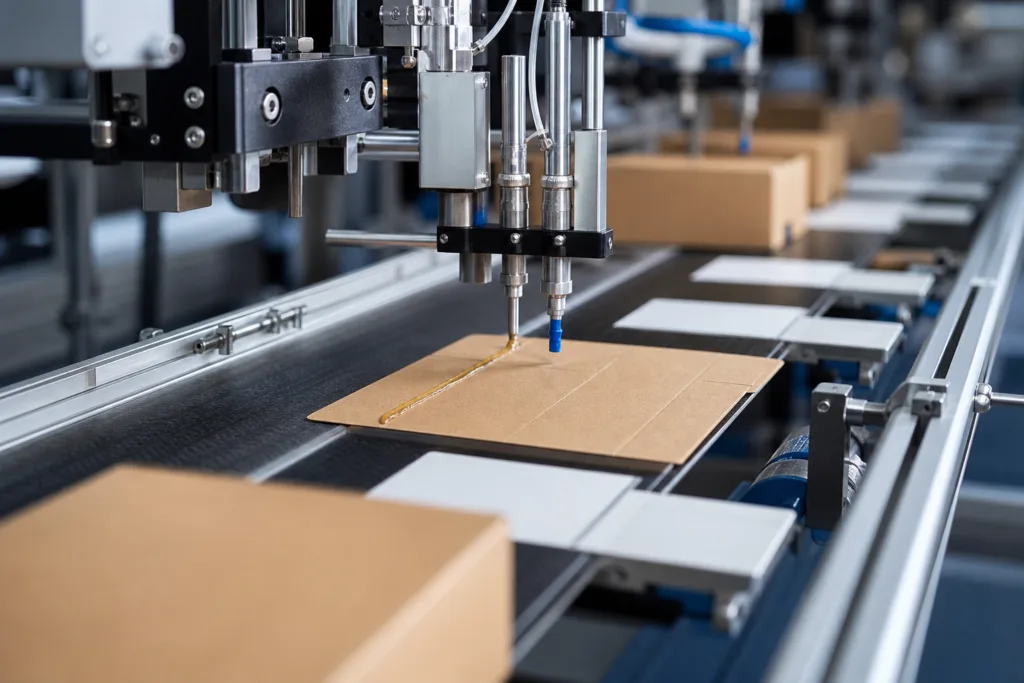
Packaging adhesives need to be applied consistently, and the way they flow matters as much as their chemistry. Viscosity influences pumpability, atomization, bead formation, and the risk of clogging. Coat weight affects wetting, bond build, material cost, and visual appearance. In high-speed operations, a narrow process window is usually better than a broad one that is unstable from run to run.
For plants using automated applicators, precision adhesive dispensing equipment can improve control over bead placement, but the adhesive still has to match the hardware. If viscosity is too high, the machine may struggle to deliver a consistent pattern. If it is too low, the adhesive may bleed into porous board, migrate on coated surfaces, or create a messy seam.
Practical checks for coat weight and flow
- Confirm the adhesive deposits the intended amount at production temperature, not just in the lab.
- Watch for stringing at the nozzle and see whether it increases during long runs.
- Check whether porous board absorbs too much adhesive and reduces effective bond line thickness.
- Inspect for bleed-through on print-sensitive surfaces or visible panels.
- Measure whether the same setting gives repeatable results across shifts.
When the right adhesive chemistry is paired with stable dispensing equipment, packaging lines usually see fewer interruptions and more predictable bond quality.
Temperature, humidity, and storage stability
Packaging adhesive performance is not only determined during application. Storage and environmental exposure can change how a product behaves before it ever reaches the line. Hot-melt materials must remain stable in storage and must be protected from contamination or overheating. Water-based systems are more sensitive to freeze-thaw conditions and evaporation. Pressure-sensitive adhesives may change tack characteristics if exposed to heat or humidity outside the expected range.
Procurement teams often focus on shipment price and overlook storage reality. Yet if a formulation is sensitive to warehouse temperature or has a short usable window after opening, the hidden cost appears later in scrap, downtime, or inconsistent final seals. At ZDS Adhesive, we pay close attention to how packaging, drum size, and shelf-life planning affect factory use, especially for buyers managing multiple shifts or multiple plants.
Storage and handling points to verify
- Recommended storage temperature: Keep materials within the supplier’s process window.
- Shelf life: Confirm how long the adhesive remains usable in unopened and opened packaging.
- Moisture sensitivity: Check whether water uptake or ambient humidity changes performance.
- Freeze-thaw resistance: Important for water-based or temperature-sensitive systems.
- Container sealing and packaging: Helps avoid contamination and viscosity drift.
Choosing between hot melt, water-based, pressure-sensitive, and reactive systems
There is no universal packaging adhesive. The right choice depends on substrate type, line speed, end-use conditions, and the balance between cost and performance. Hot melt systems are often chosen for fast set and efficient processing. Water-based systems are commonly used where clean-up, flexibility, or paper-based bonding is important. Pressure-sensitive systems are central to labels and some closure formats. Reactive systems can be useful when higher long-term performance or special environmental resistance is needed.
For buyers comparing the practical limits of water-based systems against faster-setting alternatives, our water-based adhesive selection limits article helps explain where these products fit well and where process constraints become more important. The real decision is not whether one chemistry is universally better, but which one best fits the package design and production environment.
| Adhesive type | Strengths | Typical packaging fit |
|---|---|---|
| Hot melt | Fast setting, good for high-speed lines | Carton sealing, some labeling, secondary packaging |
| Water-based | Clean handling, flexible bonding options | Paper-based packaging, certain laminations, folding cartons |
| Pressure-sensitive | Immediate tack, easy labeling workflow | Labels, removable or permanent stickers, information labels |
| Reactive | Higher durability or special performance needs | Specialty structures, demanding environments, selected custom projects |
Common application problems and how to prevent them
Many packaging failures are process failures that show up as adhesive problems. A carton seam that opens may be due to poor surface contact, wrong bead placement, or board moisture rather than weak chemistry alone. A label that lifts may be caused by a coating mismatch or insufficient tack under the actual storage temperature. Diagnosing these problems correctly saves time and avoids unnecessary reformulation.
The most useful troubleshooting approach is to compare the failure against the process conditions used when the adhesive was qualified. If the line speed changed, if the substrate supplier changed, or if the climate shifted, the adhesive may be performing exactly as formulated while the application environment moved outside its expected range.
Frequent mistakes buyers should avoid
- Choosing adhesive only by price without testing on the actual substrate.
- Ignoring machine temperature, nozzle setup, and coat weight consistency.
- Assuming one formulation will work across coated, uncoated, and laminated surfaces.
- Skipping environmental testing for heat, humidity, cold storage, or transport.
- Failing to define whether the bond should be permanent, removable, or repositionable.
How ZDS Adhesive approaches packaging adhesive development
From our production and formulation perspective, packaging adhesives work best when the project is defined like an engineering problem. We want to understand the package structure, the substrate surface condition, the dispensing method, the target line speed, and the environmental exposure after application. That allows us to recommend the most suitable chemistry, adjust viscosity or set behavior when needed, and support sample evaluation before bulk production.
For many buyers, the value of a manufacturer lies in consistency and communication. A formulation that performs in one trial but drifts in full production is not enough. That is why we focus on QC checkpoints, stable raw material control, and clear technical discussion around application limits, packaging format, and storage conditions. When projects require custom packaging, private label support, or production scaling, we also use line-ready thinking so the adhesive fits the actual manufacturing workflow rather than only the specification sheet.
When buyers need process-ready product planning, we often review dispensing format, packaging size, and support materials at the same time. The goal is to reduce surprises during launch and to make sure the adhesive can move from sample to stable operation with fewer adjustments.
For teams evaluating supply capability, it can also help to review how equipment, throughput, and automation influence the adhesive format. Our automated dispensing for higher throughput article is relevant for plants trying to keep application stable as output rises, especially when packaging lines must maintain uniform bead placement across long shifts.
Selection checklist for packaging buyers
Before final approval, we recommend checking the following points with both the supplier and the production team.
- What package type is being bonded: food pack, label, carton, or a combination?
- What substrate pair is involved, including coatings, films, and board grades?
- What is the expected line speed and application method?
- Does the bond need to be permanent, removable, or repositionable?
- What are the heat, moisture, cold storage, and transport conditions?
- Does the project require food-contact awareness, low odor, or migration review?
- What viscosity, open time, or set speed window does the line require?
- How will sample results be validated before bulk production?
- What packaging size, shelf life, and storage conditions suit the plant?
- Can the supplier support customization, QC, and consistent reorders?
Conclusion
Packaging adhesives may look simple on paper, but they sit at the center of line performance, package durability, and regulatory confidence. The right choice depends on more than bond strength. It must fit the substrate, the machine, the storage environment, and the end-use demands of food packs, labels, or carton sealing. Buyers who treat packaging adhesives as a system decision, rather than a commodity purchase, usually get better production stability and fewer packaging failures. At ZDS Adhesive, we focus on helping teams match adhesive behavior to real manufacturing conditions so the final package performs reliably from sample to scale.
FAQs
How do I choose the right packaging adhesives for my line?
Start with the package type, substrate, line speed, and end-use environment. Then decide whether you need fast setting, removable bonding, high tack, food-pack compliance awareness, or moisture resistance. The best choice is the adhesive that fits the full production window, not just the lab sample.
Are packaging adhesives for food packs different from general-purpose adhesives?
Yes. Food-pack applications usually require more attention to odor, migration risk, and regulatory suitability. Even when the adhesive does not touch food directly, the full package design and intended market still matter, so food-contact review should be part of the selection process.
What should I test before approving a label adhesive?
Test peel behavior, initial tack, repositioning window, residue risk, and performance on the actual label substrate and container surface. Temperature and humidity also matter because a label that looks fine in the lab may behave differently in chilled or coated-surface applications.
Why do carton seals fail even when the adhesive seems strong?
Failures often come from process mismatch rather than weak chemistry. Common causes include wrong bead placement, poor board contact, excess moisture, unstable line temperature, or a set speed that is too slow for the machine cycle. The adhesive and equipment need to be evaluated together.
Can packaging adhesives be customized for a specific substrate or machine?
Yes. Customization may involve viscosity adjustment, open time tuning, tack modification, odor control, or packaging format changes. Custom work is most successful when the supplier receives detailed information about substrate type, machine setup, and production speed.
What information should I give a supplier before requesting samples?
Share the package structure, substrate details, line speed, application method, storage conditions, and target performance requirements. If possible, include photos, a sample of the substrate, and any known issues such as stringing, clogging, edge lift, or seal failure so the sample can be matched more accurately.